
Last-click attribution is a lie that B2B marketers tell themselves to feel in control of a chaotic buying process. If your product costs $50,000 a year, no one is clicking a LinkedIn ad and buying it on a credit card ten minutes later. By clinging to standard conversion metrics, you aren't just mismeasuring your impact—you are actively defunding the campaigns that build your pipeline.
TL;DR
- The Trust Gap: 51% of B2B marketers don't trust their own budget data because it ignores the 6-month sales cycle.
- Intent-Signal Clustering: A new framework that groups high-value actions (HVAs) rather than chasing a single 'conversion' event.
- Dark Social Reality: LinkedIn's true value lies in the unmeasurable conversations happening in DMs and Slack communities.
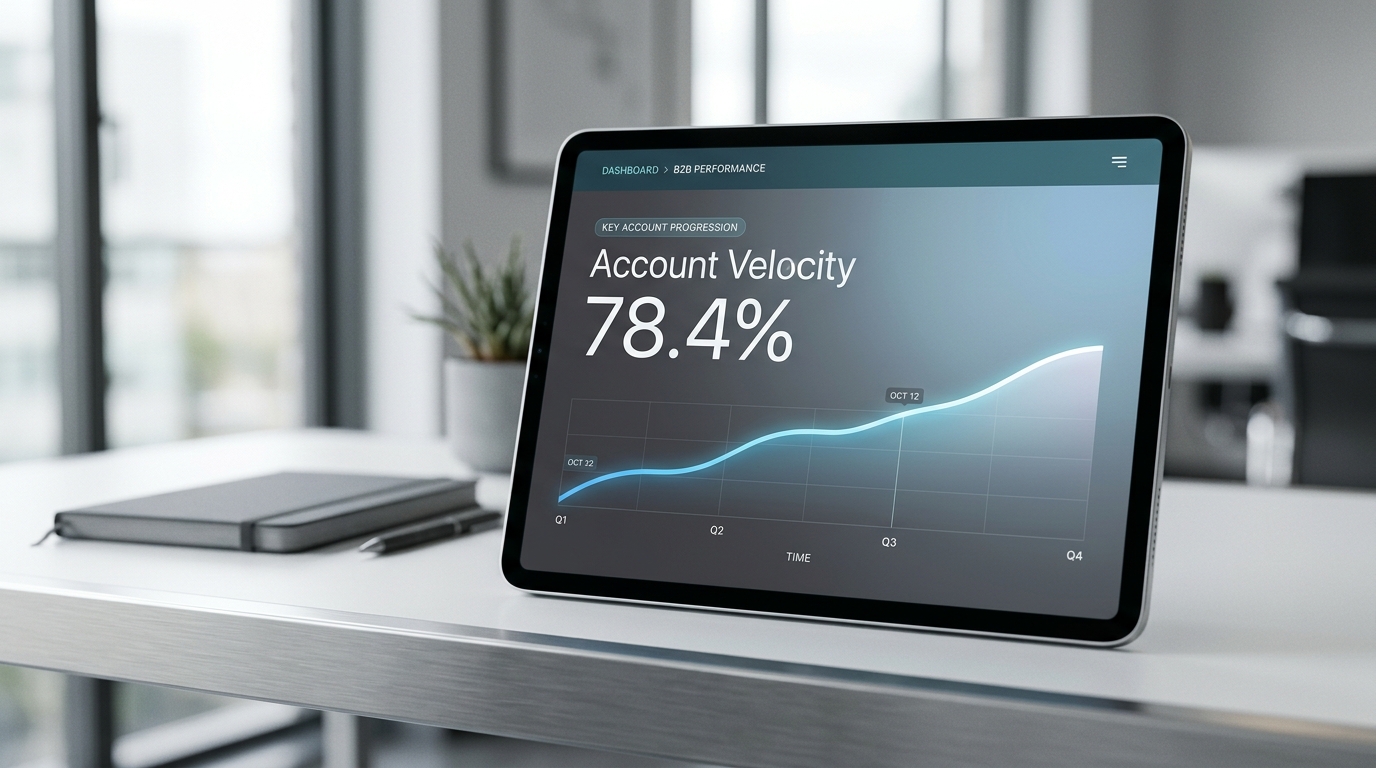
- The Prediction: By 2027, 'cost-per-lead' will be a dead metric for enterprise social, replaced by 'account-level engagement velocity.'
Why 51% of B2B marketers are flying blind
We have a data trust problem. According to recent industry sentiment surveys, over half of B2B marketing leads don't believe their attribution software accurately reflects how customers actually buy. This isn't just cynicism; it's a rational response to a broken methodology. Most platforms are still optimized for the B2C impulse buy—the $80 pair of boots or the $15 subscription.
In the enterprise world, the journey from seeing a LinkedIn Thought Leader Ad to signing a Master Service Agreement (MSA) is a marathon, not a sprint. When you look at your HubSpot or Salesforce dashboard and see 'Direct Traffic' as the source for a million-dollar deal, you're seeing a ghost. That buyer didn't wake up and decide to type your URL into a browser by accident. They spent four months consuming your white papers, seeing your VP of Product's videos on their feed, and hearing your brand mentioned in a 'Dark Social' peer group on Slack.
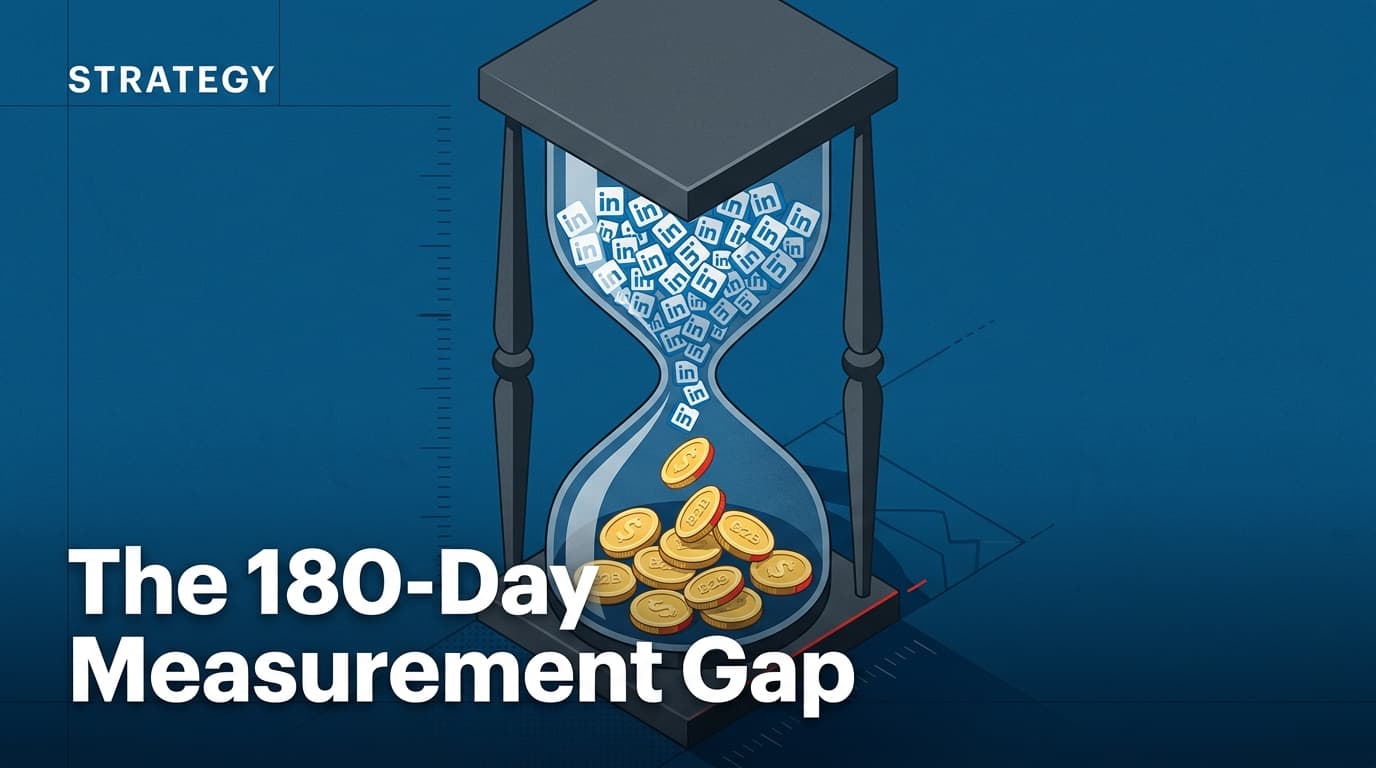
LinkedIn's own internal data consistently shows that B2B buyers require between 10 and 20 touchpoints before they even enter a formal sales funnel. If your measurement window is set to the standard 30-day post-click or 7-day post-view, you are effectively invisible to your own reporting. You're cutting the budget for the very top-of-funnel awareness that makes the 'Direct' lead possible six months later.
The Intent-Signal Clustering Framework
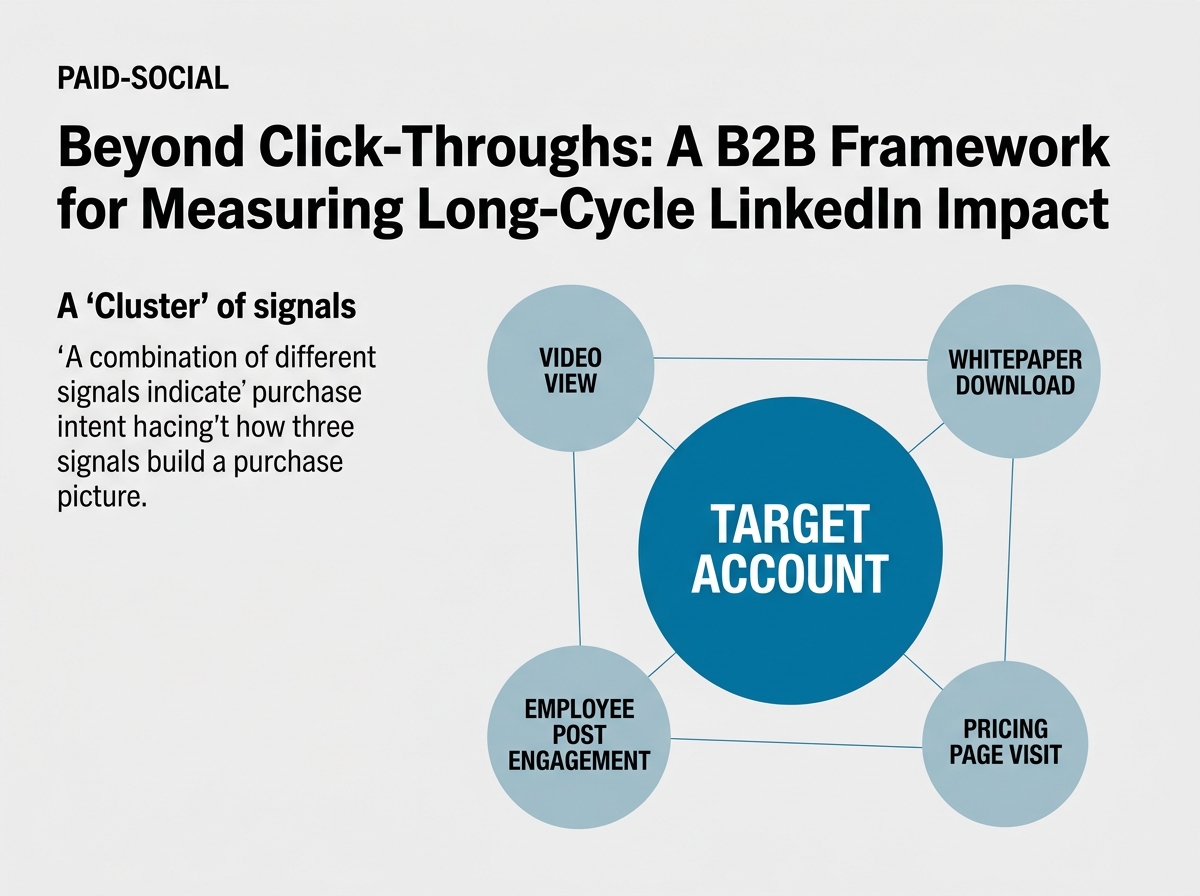
Instead of looking for a linear path, we need to measure 'clusters.' Intent-signal clustering treats the target account—not the individual cookie—as the unit of measure.
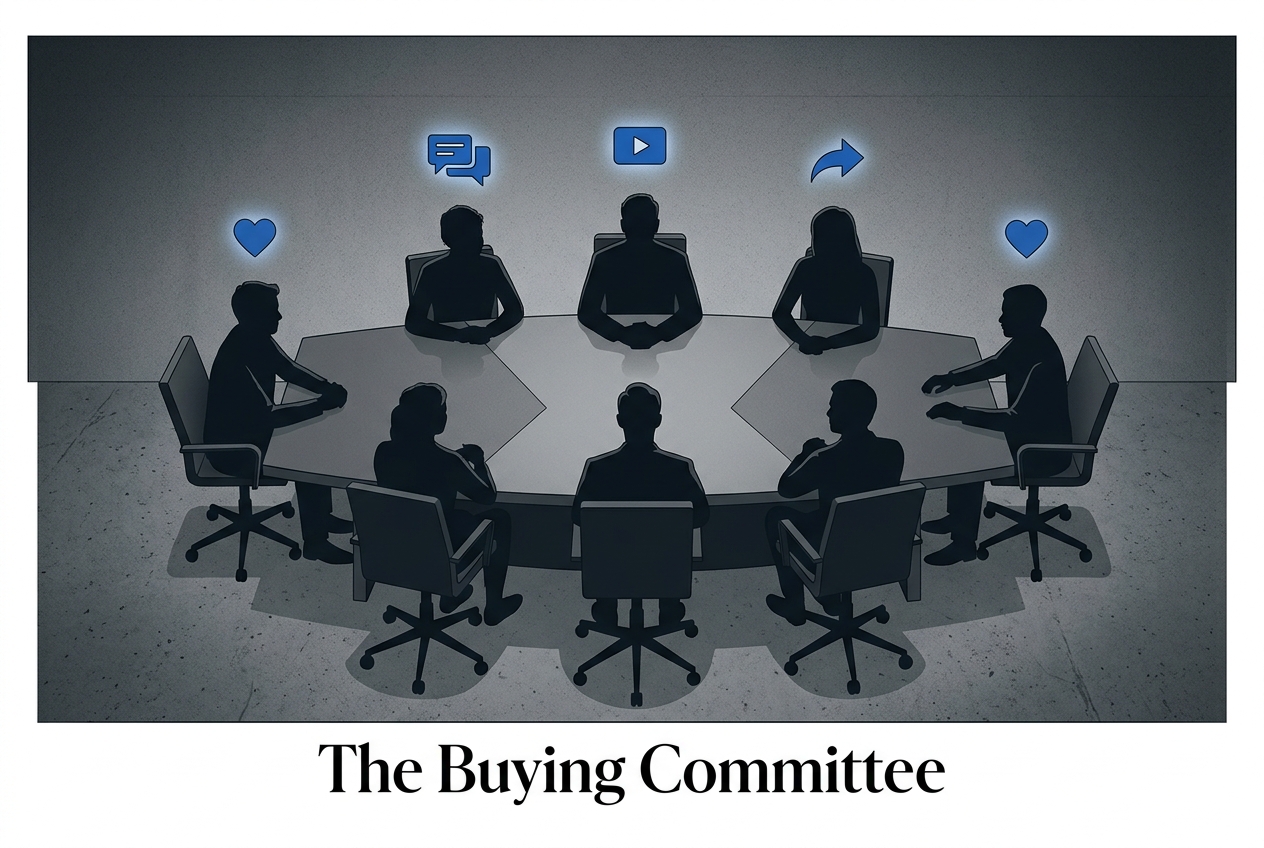
In this framework, we assign weighted values to specific actions that signal a 'buying committee' is forming. For example, a single click on an ad is low value. However, if three different people from the same Fortune 500 company visit your pricing page within the same 48-hour window after seeing a LinkedIn campaign, that is a high-intent cluster.
How to set up LinkedIn Conversion API for better data
This moves the goalpost from 'Did this ad generate a lead?' to 'Did this campaign increase the velocity of this account through the funnel?' We are looking for three specific signal types:
- Consumption Depth: Did the user watch more than 50% of the video? Did they scroll through the entire carousel?
- Cross-Platform Echo: Are we seeing an uptick in branded search volume in regions where our LinkedIn spend is highest?
- Inbound Quality: Not just the volume of leads, but the seniority of the job titles engaging with the content.
Counterargument: The 'CFO Problem' and the need for hard numbers
The most common pushback to this framework is what I call the 'CFO Problem.' Your finance lead doesn't care about 'clusters' or 'intent signals.' They want to know the Customer Acquisition Cost (CAC) and the Return on Ad Spend (ROAS). They want a spreadsheet where Column A is the dollar spent and Column B is the dollar earned.
It is a fair critique. Marketing cannot be a black box of 'vibes' and 'brand awareness.' However, providing the CFO with false data (last-click) is worse than providing them with complex data (clustering). If you tell the CFO that LinkedIn is failing because the 'conversions' are low, and then you turn off LinkedIn, you will see your 'Direct' and 'Organic' leads crater four months later.
To refute the last-click obsession, you must run a 'hold-out test.' Take a specific geographic region or a vertical and stop all LinkedIn activity for 90 days. Compare the 'Direct' lead flow in that region against your active regions. The delta between those two is the true, unmeasured value of your social presence. When you show a CFO that turning off social killed 30% of your 'free' leads, the conversation about attribution changes instantly.
The 2026 Platform Reality: Lessons from the TikTok/Meta shift
While LinkedIn remains the king of B2B, we have to look at how other platforms are forcing a measurement evolution. Recent shifts in the Instagram Algorithm for 2026 show a move away from follower counts toward 'interest-based' distribution. This means your B2B content is being shown to people based on their professional behavior, not just their job title.
Similarly, even though TikTok faced a $400 million settlement regarding privacy (S5), its advertising engine remains a powerhouse for 'discovery.' B2B brands like Shopify and Sage are already using TikTok to reach the 'prosumer' (S2). They aren't measuring these ads based on clicks; they are measuring them based on 'brand lift' and 'search incrementality.'
If B2B marketers on LinkedIn continue to use 2015-era measurement tactics while the rest of the social world moves toward algorithmic, behavior-based modeling, they will find themselves priced out of the auction. The cost of a LinkedIn click is only going up. If you only value the click, you'll eventually find the math doesn't work. If you value the influence the ad has on the entire buying committee, the math looks very different.
How to implement this tomorrow
You don't need a $100,000 attribution suite to start this. You can begin by changing your internal reporting cadence.
First, stop reporting on 'Leads' from LinkedIn as your primary KPI. Instead, report on 'Qualified Account Reach.' How many of your Tier 1 target accounts saw an ad at least three times this month?
Second, implement a 'How did you hear about us?' free-text field on your demo request form. This is the 'Dark Social' decoder ring. You will find that people who are marked as 'Organic Search' in your CRM will write 'I've been following your CEO on LinkedIn for months' in that text box.
Third, use LinkedIn’s 'Website Demographics' tool to see which companies are visiting your site. If you see a spike in traffic from a target account that hasn't clicked an ad, but you are running ads to that company's zip code or industry, you have a correlation signal.
Prediction: The death of the 'Lead'
Here is my falsifiable prediction: By December 2027, the term 'Lead' will be deprecated in sophisticated B2B marketing organizations. We will instead talk about 'Account Readiness Scores.'
We are moving toward a world where the 'hand-raiser' is the final 5% of the journey. The other 95% happens in the shadows of LinkedIn feeds, podcast mentions, and private communities. If you continue to measure only the final 5%, you are ignoring the engine that drives the entire machine.
Stop asking your LinkedIn ads to do the job of a sales rep. Let them do the job of a billboard on the digital highway where your buyers spend eight hours a day. Measure the traffic flow, the brand recognition, and the account-level heat—not just the one car that pulled over to ask for directions.
Final thoughts for the practitioner
If you are a social media manager or a paid buyer, your job is to educate your leadership. They are looking at the wrong dashboard because that's the one the software vendors sold them. Show them the 'Dark Social' evidence. Show them the 'How did you hear about us' data.
Building a B2B brand on LinkedIn is the most expensive and most rewarding long-term play in digital marketing. Don't let a 30-day attribution window kill a ten-year growth strategy. Trust the signals, cluster the intent, and play the long game. The companies that do this will own their categories; the ones that don't will be stuck fighting for the scraps of the last-click auction until their margins disappear.
Why B2B creators are the new ad format
FAQ