
If you have spent the last decade listening to Google’s webmaster advocates tell you that 'Googlebot can render JavaScript,' you have likely built a false sense of security. You assume that if a human can see a link, a crawler can follow it. But as we move into the era of Generative Engine Optimization (GEO), that assumption is becoming a liability.
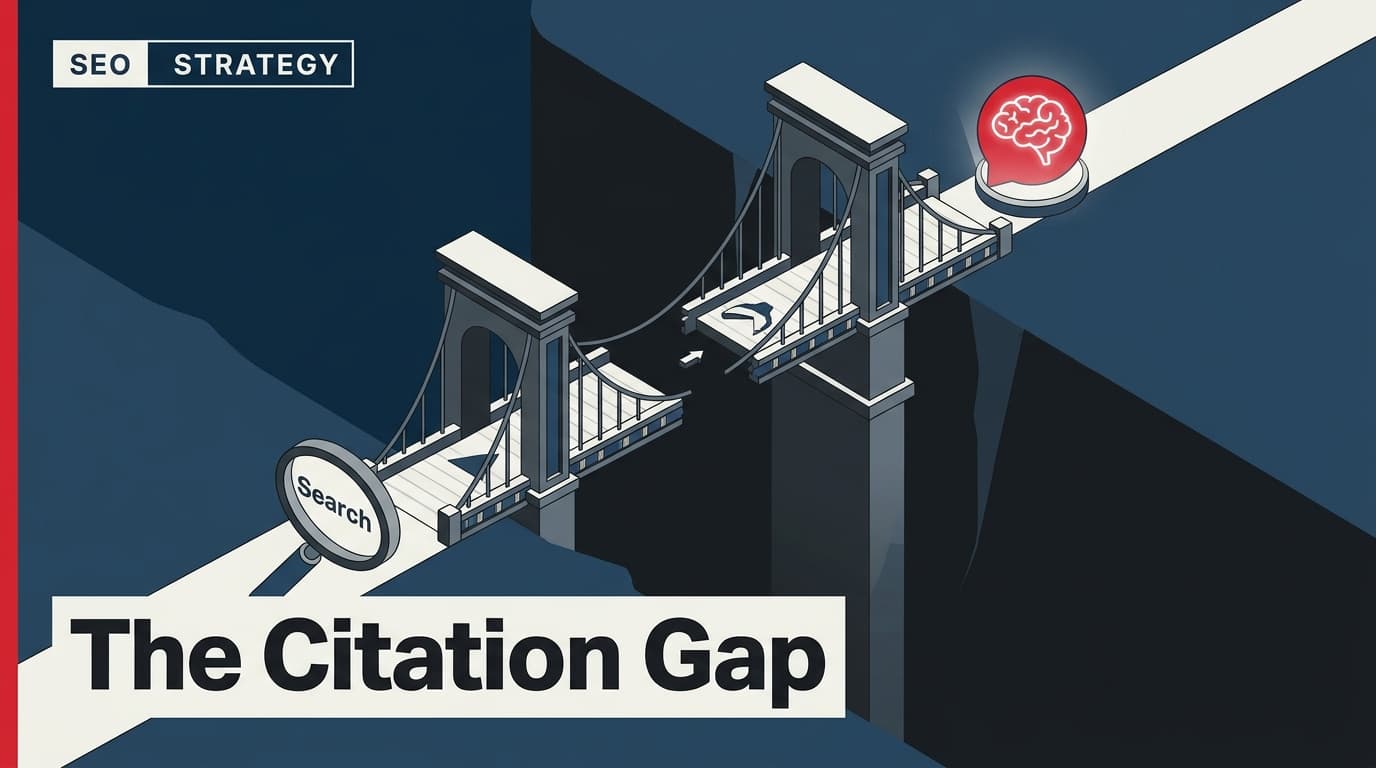
Recent testing indicates a widening gap between what traditional search engines can parse and what AI-native crawlers like Perplexity, OpenAI’s SearchGPT, and Google’s own Gemini actually ingest. While Googlebot has become proficient at executing client-side code to discover links, the LLM-based agents powering AI search results are often operating on a 'lite' version of the web. They are looking for raw text, clear HTML structures, and immediate accessibility. If your social landing pages, creator portfolios, or brand hubs rely on complex JavaScript frameworks to load content or navigation, you aren't just invisible to some users—you’re invisible to the AI engines that are increasingly becoming the primary source of brand discovery.
Why does this matter now? Because the stakes of citation have changed. A study of 14,472 AI citations published in August 2026 found that business websites dominate Gemini’s local AI search results, but the specific sources cited are highly volatile (Source: Search Engine Land). If an AI crawler fails to 'see' your link structure during a single pass, you don't just drop a few spots in the SERP; you disappear from the generative response entirely.
The Rendering Trap: Why AI Crawlers Are Not Googlebot
To understand why your links are invisible, you have to understand the difference between a search engine that indexes and an AI agent that reads.
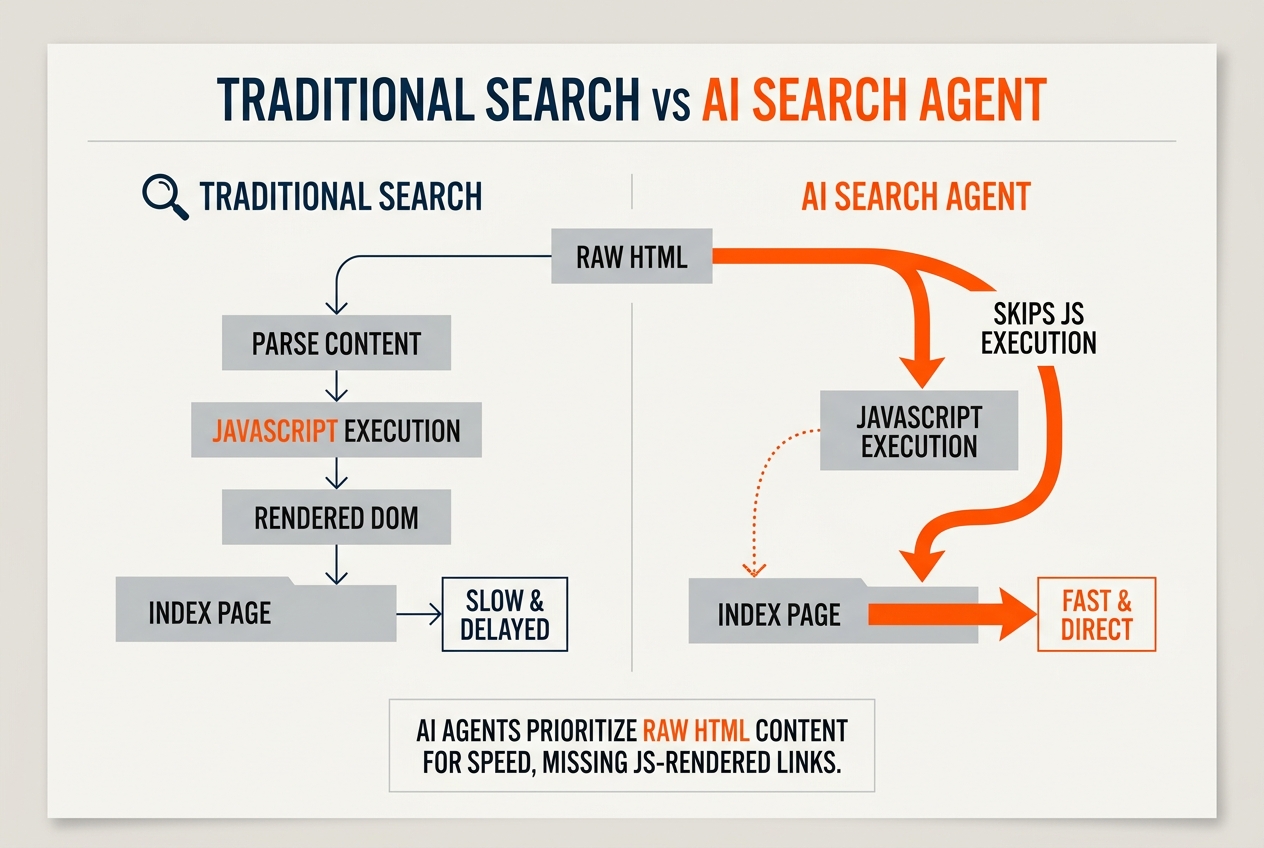
Think of a traditional search engine like a meticulous librarian. They take the time to open every book, look at the pictures, and even translate the text if necessary. Googlebot, for example, uses a two-wave indexing process. First, it scrapes the raw HTML. Then, as resources become available, it renders the page using a headless Chrome browser to see what the JavaScript produces. This second wave is where your React or Vue.js links finally get discovered.
AI crawlers, however, behave more like a frantic researcher on a deadline. When Perplexity or the GPT-4o browsing tool hits a URL, they are optimized for speed and token efficiency. Executing heavy JavaScript is computationally expensive. If your navigation menu doesn't exist until a script fires, the AI agent often sees a blank page or a 'loading' state. It moves on to the next source, leaving your content unread and uncited.
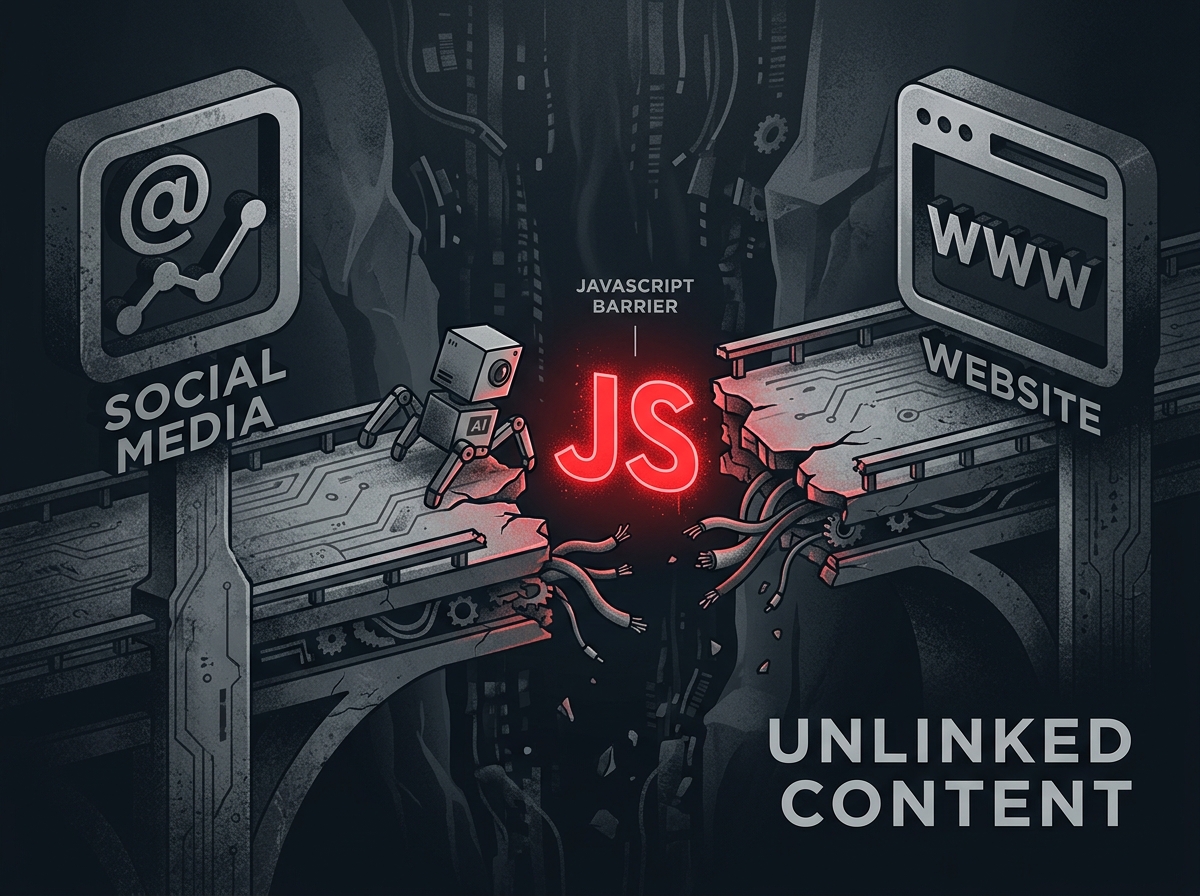
We are seeing this play out particularly on social landing pages—those 'Link in Bio' sites or custom-built mobile hubs. Because these pages are often built with high-interactivity JavaScript to mimic app-like behavior, they are the first to break in an AI-first search environment. If you are using a tool like Linktree, you’re usually safe because they’ve optimized for crawlability. But if you’ve built a custom solution using a modern JS framework without Server-Side Rendering (SSR), you are likely blocking the very bots you want to attract.
The Anatomy of an Invisible Link
What does an 'invisible' link actually look like? In the eyes of a technical SEO, it is any link that requires a user action (like a click) or a script execution to enter the DOM (Document Object Model).
Consider the 'Load More' button. In a traditional setup, this might be a standard <a href="/page-2"> link. But in many modern web apps, it’s a <div> or a <button> with an onClick event that fetches data via an API. Googlebot might eventually figure out that this button triggers new content, but an AI crawler looking for a structured path through your site will see a dead end.
Another common offender is the 'client-side redirect.' If your social links point to a tracker that uses JavaScript to forward the user to the final destination, an AI agent might get stuck at the gate. They prefer clean, HTTP 301 redirects that happen at the server level.
This isn't just a technical nuance; it’s a visibility crisis. As Microsoft rolls out AI Max globally for Search campaigns (Source: Search Engine Land, August 2026), the platform is increasingly using AI to optimize landing pages and creative. If the AI can't parse your landing page's link structure, it can't optimize the journey for the user. You are effectively feeding the machine a broken map.
Performing a GEO Technical Audit
If you want to ensure your content is eligible for Gemini citations or Perplexity summaries, you need to conduct a GEO (Generative Engine Optimization) technical audit. This goes beyond standard SEO tools like Ahrefs or Semrush. You need to see the web through the eyes of an LLM.
Step 1: The 'Text-Only' Test. The simplest way to audit your site is to disable JavaScript in your browser and reload your page. Does the navigation still work? Can you see the links to your most important articles or products? If the page is a white screen, you have a critical failure. AI agents are getting better at rendering, but they always prefer the HTML version.
Step 2: Inspect the Fetch. Use tools like the 'Inspect' element in Chrome, but specifically look at the 'Network' tab. Are your links being delivered in the initial document response, or are they coming in later via an XHR/Fetch request? If it’s the latter, you are relying on the crawler to wait for those requests to finish. Most AI agents won't.
Step 3: Check the User-Agent.
AI crawlers often identify themselves differently. OpenAI uses OAI-SearchBot, and Perplexity uses PerplexityBot. You can use browser extensions to spoof these user-agents and see if your server is serving them a different, perhaps broken, version of your site. Some CDNs (Content Delivery Networks) mistakenly flag these bots as malicious scrapers and serve them a CAPTCHA or a 403 error. If a bot hits a 403, your brand doesn't exist to the AI.
Step 4: Schema Markup Verification. AI engines rely heavily on structured data (JSON-LD) to understand the relationship between entities. If your JavaScript is responsible for injecting Schema markup, there is a high probability the AI crawler will miss it. Ensure your Schema is hard-coded into the HTML or generated on the server side.
Social Landing Pages: The Weakest Link
Social media managers often overlook the technical health of their 'Link in Bio' pages. We focus on the aesthetic, the tracking UTMs, and the conversion rate. But these pages are the primary entry point for AI crawlers trying to understand a brand’s current activities.
Recent studies show that brands, particularly in sensitive niches like the cannabinoid industry, are already misusing social media marketing by failing to provide clear, compliant, and accessible pathways for consumers (Source: MediaPost, August 2026). When you add a technical layer of 'invisible' links to an already complex regulatory environment, you create a black hole for information.
If a user asks Gemini, "What are the best new products from [Your Brand]?" and your social landing page hides those products behind a JavaScript-heavy carousel that doesn't render for the bot, Gemini will likely cite a third-party review site or a competitor instead. You are voluntarily ceding your authority to whoever has the most crawlable site.
Strategic Fixes for the AI Era
Fixing these issues doesn't mean you have to revert to 1990s-era HTML. It means adopting a 'Progressive Enhancement' or 'Server-Side Rendering' (SSR) approach.
If you are using frameworks like Next.js or Nuxt, ensure you are utilizing SSR or Static Site Generation (SSG). This ensures that when a bot—AI or otherwise—requests a page, they receive a fully formed HTML document with all links and content present. The JavaScript then 'hydrates' the page for the human user, providing the interactive experience you want without sacrificing visibility.
For those using third-party social tools, audit your provider. Ask them: "How does your platform handle bot rendering?" If they don't have a clear answer, it might be time to move your social hub to a subdomain you control (e.g., links.yourbrand.com) where you can manage the technical SEO personally.
Furthermore, pay attention to how you link out from social platforms. While we can't control how Instagram or TikTok renders their internal browsers, we can control the destination. Avoid 'middleman' redirect scripts whenever possible. Direct, clean URLs are the gold standard for AI discovery.
What This Means for Your Strategy
The transition from traditional search to AI-driven discovery is not just a change in how users behave; it’s a change in how the internet is indexed. We are moving away from a world where 'Google will eventually find it' to a world where 'if it isn't immediate, it doesn't exist.'
Your strategy for the next 18 months should prioritize Technical Accessibility over Visual Flare.
- Audit your most high-traffic social entry points. Use the text-only test mentioned above. If your 'Link in Bio' is a JS-ghost town, fix it immediately.
- Move to Server-Side Rendering. If your brand site is a Single Page Application (SPA), the 'AI search crawling' era is your signal to migrate to an SSR framework.
- Monitor AI Citations. Use tools like BrightEdge or specialized GEO platforms to see which of your pages are being cited by Gemini and Perplexity. If a page has high traffic but zero AI citations, it likely has a rendering issue.
- Simplify Navigation. AI agents struggle with 'mega-menus' that only appear on hover or click. Use a standard, visible footer with direct links to your most important pillars.
We are already seeing the impact of these technical choices. As users wonder why they are losing Instagram followers (Source: Caribbean National Weekly, August 2026), the answer often lies in the friction of the user journey. If the journey from a social post to a product is broken for a bot, it’s likely frustrating for a human, too. AI search visibility is simply the new 'canary in the coal mine' for general web health. Don't let your JavaScript be the reason your brand falls silent in the age of AI.
FAQ