
The standard SEO playbook—optimizing for blue links and meta descriptions—is officially a secondary priority. As Google rolls out AI Overviews (AIOs) globally and Perplexity captures a growing share of high-intent search traffic, the goal has shifted. You aren't just fighting for a click; you're fighting to be the source material for the answer itself.
By the end of this guide, you will have a repeatable framework to audit your brand's presence across generative engines and restructure your highest-value assets to earn citations. Before you start, you'll need access to your Google Search Console data, a Perplexity Pro or ChatGPT Plus account for manual testing, and a list of your top 20 high-intent 'money' keywords.
Why it matters: According to recent data from Search Engine Journal and HubSpot (July 2026), nearly 40% of informational queries are now answered directly within the search interface or chat window. If your brand isn't cited in that summary, you're effectively invisible to the user.
TL;DR
- Audit First: Identify where AI is hallucinating or omitting your brand using specific intent-based prompts.
- Format for Extraction: Use structured tables, bulleted lists, and clear Q&A headers to make your content 'parsable' for LLMs.
- Verify Accuracy: Monitor local data and service claims, as AI frequently misreports business hours and locations.
- Optimize for Sentiment: Generative engines don't just look for keywords; they synthesize brand sentiment from third-party reviews and social proof.
Step 1: Conduct a Generative Gap Analysis
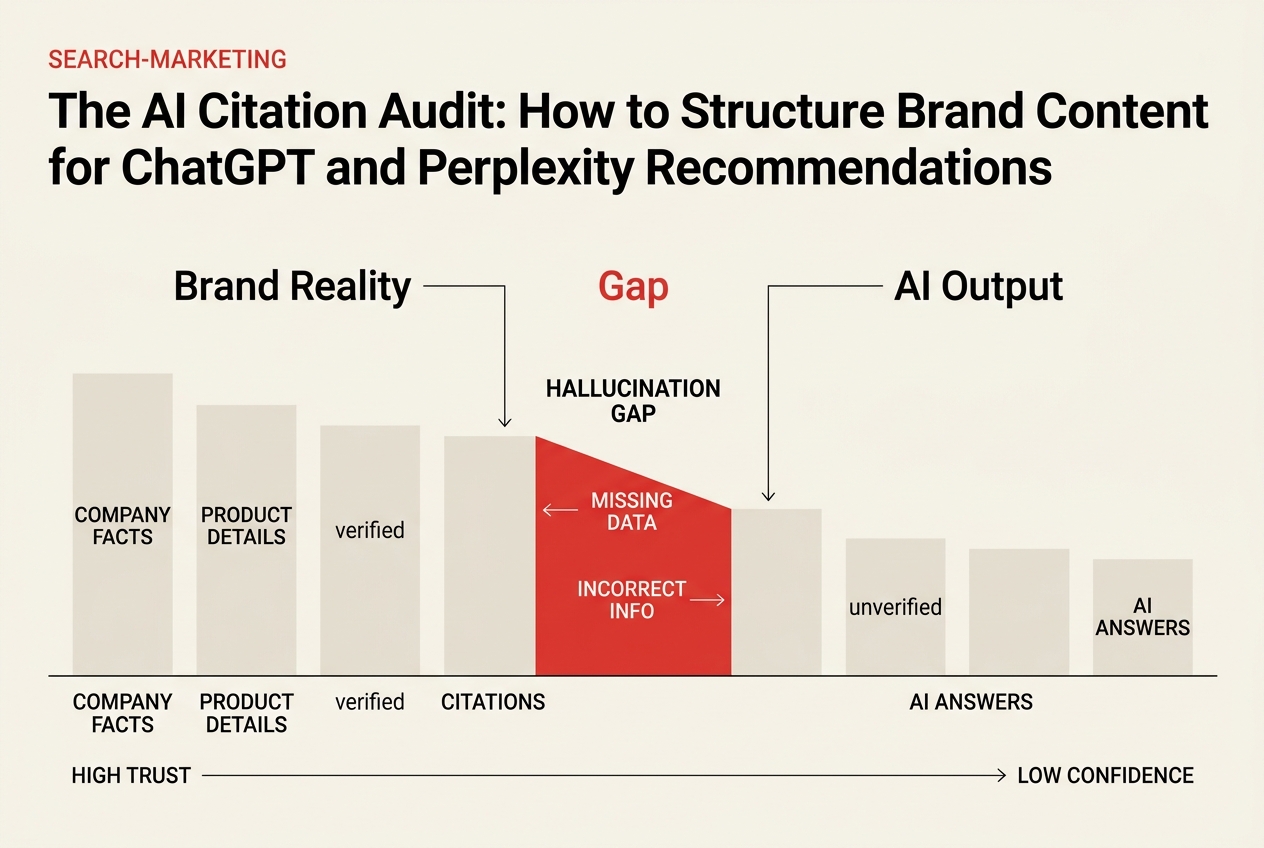
You cannot fix what you haven't mapped. The first step in an AI Citation Audit is identifying the 'hallucination gap'—the distance between what your brand actually offers and what an LLM says you offer. Recent reports from Search Engine Journal in July 2026 highlight a disturbing trend: AI frequently invents services or misreports location data, such as claiming a business is closed when it's thriving.
Start by feeding a series of 'Who is' and 'What are the best [category] products' prompts into ChatGPT, Perplexity, and Claude. Don't just look for your name; look for the context. Are you being categorized correctly? Is the AI citing a blog post from 2019 while ignoring your 2026 product launch?
This matters because LLMs rely on a weighted consensus of training data and real-time web indexing. If your most recent technical specs are buried in a 50-page PDF, the model will likely default to an easier-to-read (but outdated) third-party review. You are looking for instances where the AI mentions a competitor for a feature you also provide.
Common Pitfall: Many marketers only test their brand name. You must test category-level queries (e.g., 'best behavior change apps for GLP-1 users') to see if you appear in the consideration set at all. As Noom recently demonstrated in their shift toward GLP-1 companion services, staying relevant in search requires being cited alongside the newest industry trends.
Step 2: Structure Content into 'Extractable' Blocks
Generative engines are lazy. They prefer content that requires the least amount of computational effort to summarize. This is where Generative Engine Optimization (GEO) differs from traditional SEO. While Google's classic algorithm might reward a 2,000-word deep dive, an LLM wants a table it can scrape.
To earn citations, you must transform your key value propositions into structured blocks. This means using H3 headers that are phrased as direct questions and following them immediately with a concise, one-sentence answer. Use HTML tables for pricing and feature comparisons rather than stylized CSS boxes that search crawlers might struggle to parse.
[INTERNAL: How to optimize for zero-click searches -> zero-click-seo-strategy]
Data from HubSpot's mid-2026 analysis suggests that content formatted as 'Summary Tables' has a 3x higher likelihood of being cited in a Perplexity 'Source' bubble compared to standard paragraph text. If you're a B2B SaaS company, don't just describe your integrations; list them in a clear, bulleted list with the most popular ones at the top.
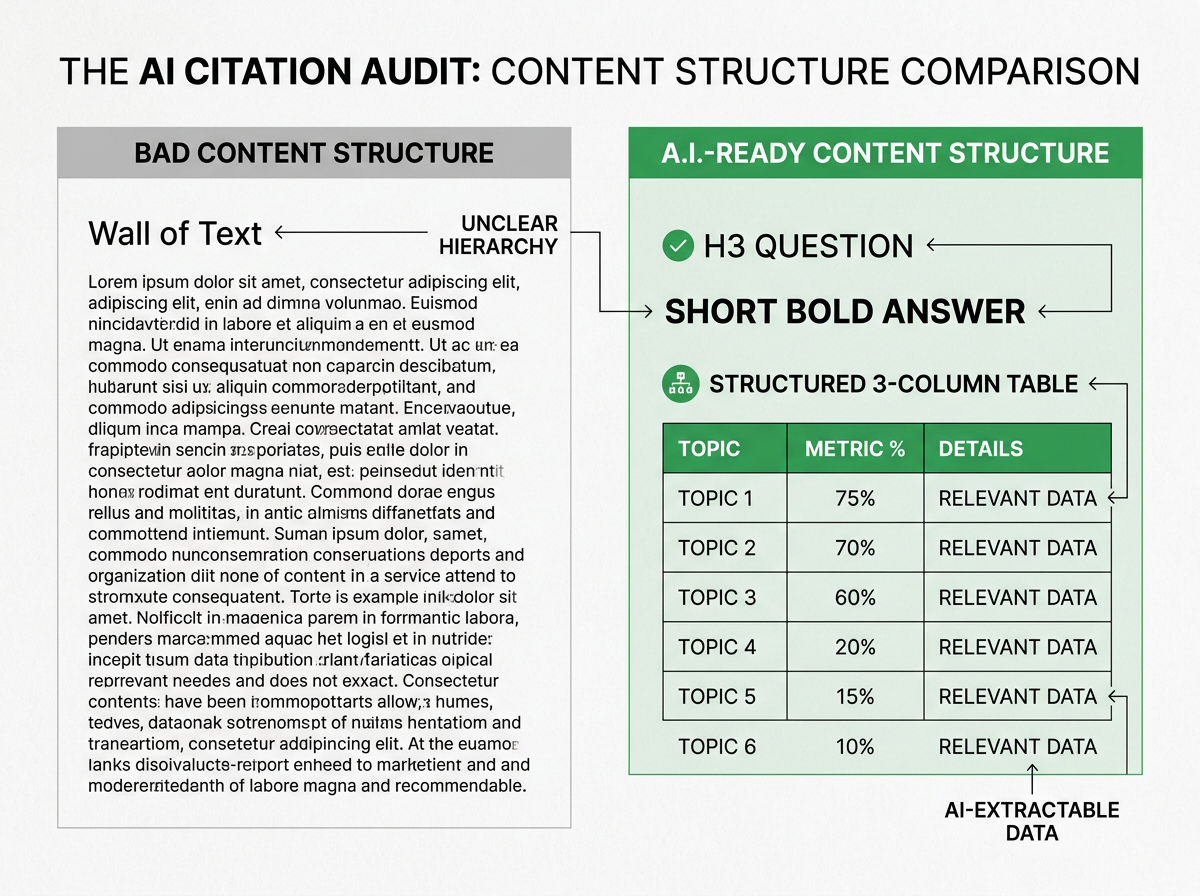
Common Pitfall: Using 'clever' or 'branded' headers. 'The Magic Behind Our Engine' is invisible to an AI. 'How the [Brand Name] AI Engine Works' is a citation magnet. Stick to literal, descriptive language.
Step 3: Implement the 'Fact-First' Local Audit
As noted by Search Engine Journal on July 20, 2026, AI answers about business locations are frequently wrong. They invent postcodes, claim stores are closed, and hallucinate services. For brands with a physical footprint, this is a conversion killer. If ChatGPT tells a customer your Las Vegas office is closed on Saturdays, they won't bother checking your website.
Your audit must include a verification of 'Local Entity Data.' LLMs pull this from a mix of your website, Google Business Profile (GBP), and third-party directories like Yelp or TripAdvisor. If there is a conflict—say, your website says you close at 6 PM but an old Yelp review says 5 PM—the AI may hedge or report the wrong one.
Local SEO updates for 2026
You must ensure your NAP (Name, Address, Phone) data is identical across all platforms. Furthermore, include a 'Locations' page on your site that uses Schema.org markup specifically for 'LocalBusiness'. This provides a structured data signal that LLMs use to override conflicting, unstructured information from the web.
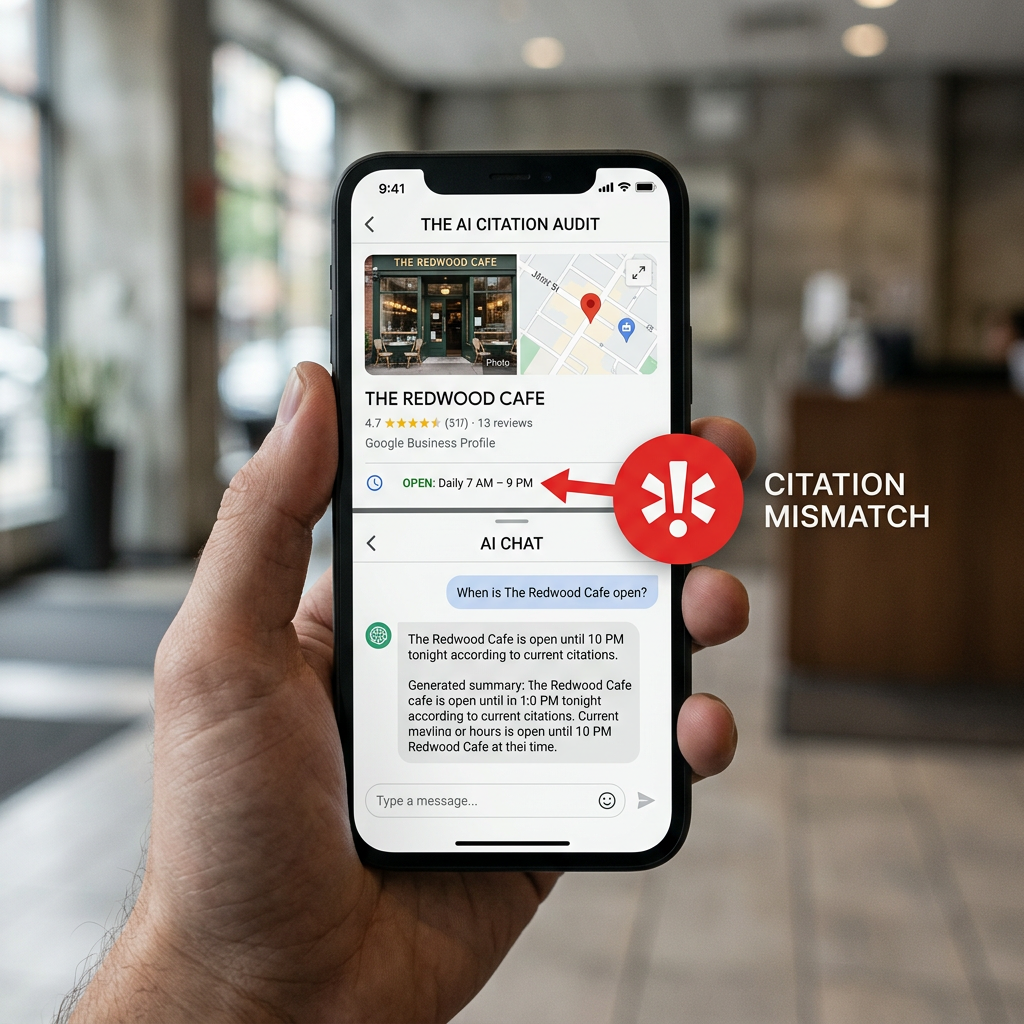
Common Pitfall: Neglecting third-party aggregators. AI often trusts a high-authority directory over a brand's own site if the directory's data structure is cleaner. Clean up your citations on Apple Maps, Bing Places, and industry-specific lists.
Step 4: Leverage Social Signals as 'Citation Proof'
LLMs are increasingly incorporating real-time social data into their recommendations. Perplexity, for instance, often cites Reddit threads and TikTok trends to gauge public sentiment. If your brand is being discussed positively on TikTok, you are more likely to be recommended in a 'What are people saying about...' query.
Jamie Love of Monumental recently noted that TikTok Shop is a discovery channel first and a sales channel second. This discovery isn't just happening within the TikTok app; the transcripts and captions of these videos are being indexed. To win the citation battle, you need a presence where the 'conversational' web lives.
Encourage creators and customers to use specific, keyword-rich language in their reviews. When an AI scans the web for 'Is [Brand] worth it?', it looks for a consensus across social platforms. If your recent 'Farmers Market' activation in Las Vegas generated 500 mentions of your 'organic honey blend,' that specific phrase becomes a 'fact' the AI can cite.
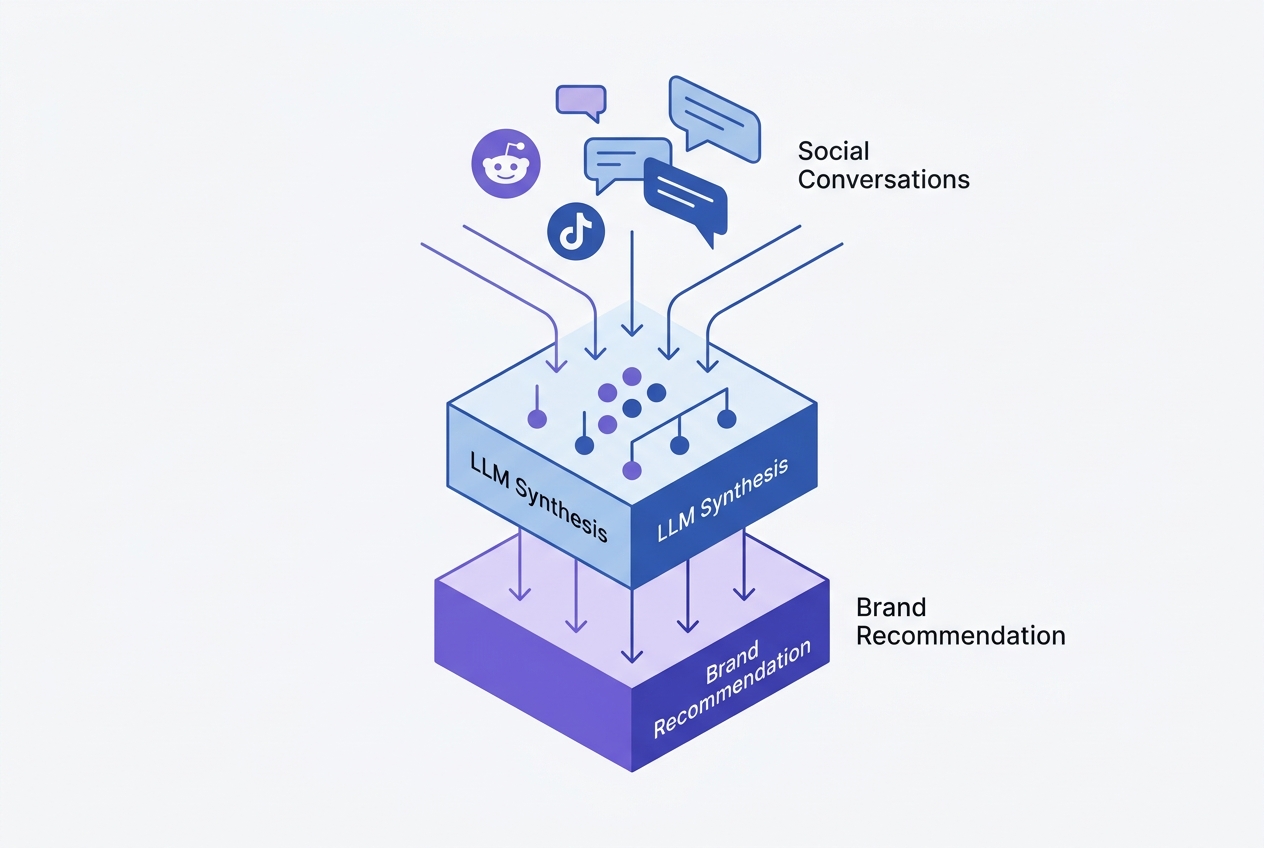
Common Pitfall: Ignoring the 'Sentiment Gap.' If your technical SEO is perfect but your Reddit sentiment is 'overpriced,' the AI will cite you but add a caveat like 'though some users find it expensive.' You must audit for sentiment, not just visibility.
Step 5: Verification and Monitoring
How do you know if your AEO (Answer Engine Optimization) strategy is working? Unlike traditional SEO, there isn't a single 'rank' to track. Instead, you must monitor 'Share of Model.'
Use a tool like Brandwatch or a custom script to query the top 5 LLMs weekly for your primary keywords. Track three metrics:
- Presence: Does the brand appear in the answer?
- Citation Accuracy: Is the link provided actually the best page for that query?
- Sentiment Tone: Is the AI recommending you or merely mentioning you?
If you see a drop in citations after a content refresh, run the 'Traffic Drop Test' as suggested by MarTech (July 2026). Determine if the loss is due to a ranking drop (classic SEO) or 'AI click theft,' where the AI is now answering the question so well that the user no longer needs to visit your site. If it's the latter, you must move your 'value-add' content further up the page to ensure the AI cites your most profitable insights.

Common Pitfall: Setting and forgetting. LLMs update their weights and indices constantly. A citation you held in June might be lost in August if a competitor publishes a more 'parsable' comparison guide.
Three Related Tactics to Try Next
- The 'Reddit-First' FAQ Strategy: Identify the top 10 questions asked about your niche on Reddit and create a dedicated FAQ page on your site using the exact phrasing of those questions. This aligns your content with the 'conversational' training data LLMs prefer.
- Video Transcript Optimization: Since AI now 'listens' to video content, ensure your YouTube and TikTok captions are descriptive and keyword-rich. Don't rely on auto-captions; upload a clean .SRT file that uses your primary brand terms.
- The Comparison Page Pivot: Create 'Brand A vs. Brand B' pages. AI Overviews love comparison data. By hosting the comparison on your own site, you control the narrative and provide the structured 'nodes' the AI needs to build its summary.
By treating AI as a sophisticated research assistant rather than just another search engine, you can position your brand as the definitive source of truth in the generative era.
FAQ