
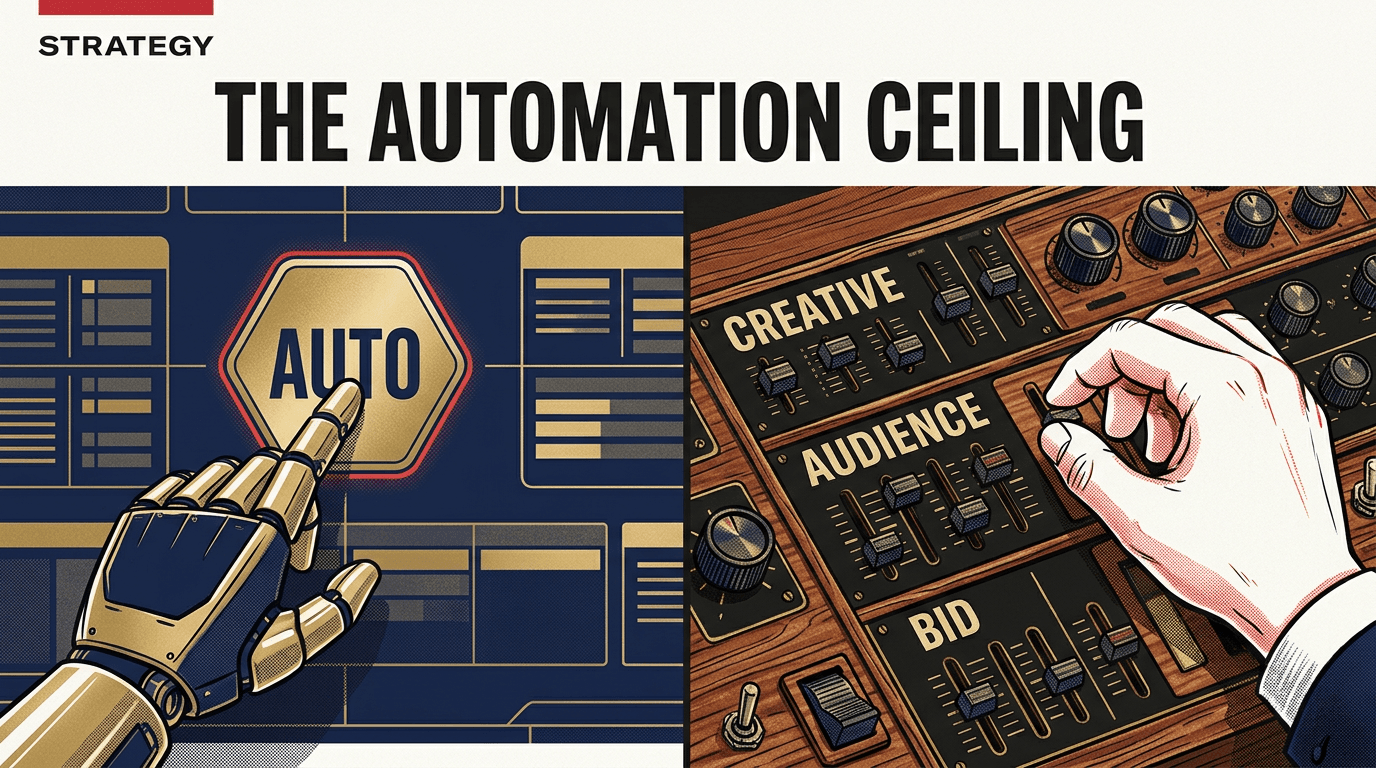
Meta’s Advantage+ Shopping Campaigns (ASC) promised a world where the algorithm did the heavy lifting, leaving marketers to focus on big-picture creative. For eighteen months, that promise largely held true. But as we move through Q2 2026, the 'set it and forget it' era of Meta ad optimization has officially hit a ceiling. While ASC remains a powerful tool for scaling proven winners, internal agency data and performance benchmarks from high-growth D2C brands suggest that fully automated ad sets are increasingly being outperformed by strategic manual overrides.
The thesis is simple: Meta’s automation is excellent at finding the path of least resistance to a conversion, but it is increasingly poor at diversifying a brand’s audience or testing radical creative departures. By abdicating control to the black box of Advantage+, you aren't just saving time—you're likely capping your growth and inflating your customer acquisition costs (CAC). To win in the current landscape, you must move toward a hybrid model that uses manual ad sets for rigorous creative isolation and audience expansion, reserving ASC only for the final stage of the funnel.
TL;DR
- Efficiency vs. Growth: Advantage+ often defaults to retargeting-heavy delivery, even when set to focus on new customers, leading to skewed ROAS reporting.
- The Creative Trap: Fully automated campaigns struggle to give new, unproven creative concepts enough impressions to truly 'break out' against established winners.
- The Hybrid Solution: Top-performing agencies are now using manual CBO (Campaign Budget Optimization) for 60% of their testing, only moving 'graduated' winners into ASC environments.
- Platform Saturation: As more brands use identical automated tools, the competitive advantage shifts back to those who can engineer specific audience breakthroughs manually.
The Illusion of Efficiency in Advantage+ Shopping Campaigns
If you look at your Meta Ads Manager dashboard today, your Advantage+ campaigns likely show the highest ROAS. On the surface, the machine is winning. However, when we look under the hood using third-party attribution tools like Northbeam or Triple Whale, a different story emerges. Advantage+ has a documented tendency to 'cherry-pick' easy conversions—users who have already interacted with the brand or are deep in the consideration phase—even when the 'New Customer' cap is applied.
In Q1 2026, internal data from several mid-market agencies showed that while ASC reported a 4.2x ROAS, the incremental lift was often 30% lower than manual campaigns with a 3.5x reported ROAS. Why? Because the manual campaigns were forced to find cold audiences that the ASC algorithm ignored in favor of 'safe' bets. If you are a growth lead, you don't just want the cheapest conversion; you want the conversion that wouldn't have happened without the ad. ASC is increasingly failing to provide that distinction.
[INTERNAL: How to measure incremental lift in the post-cookie era -> incremental-lift-measurement-guide]
Furthermore, the lack of granular control over placements in ASC means your ads are often served in the 'cheap seats' of the Meta ecosystem—Audience Network or low-intent Messenger placements—to hit your CPA targets. While the cost per click is lower, the long-term brand equity and customer lifetime value (LTV) from these placements rarely match the high-intent feed environments that manual overrides allow you to prioritize.
Why Creative Testing Dies in a Black Box
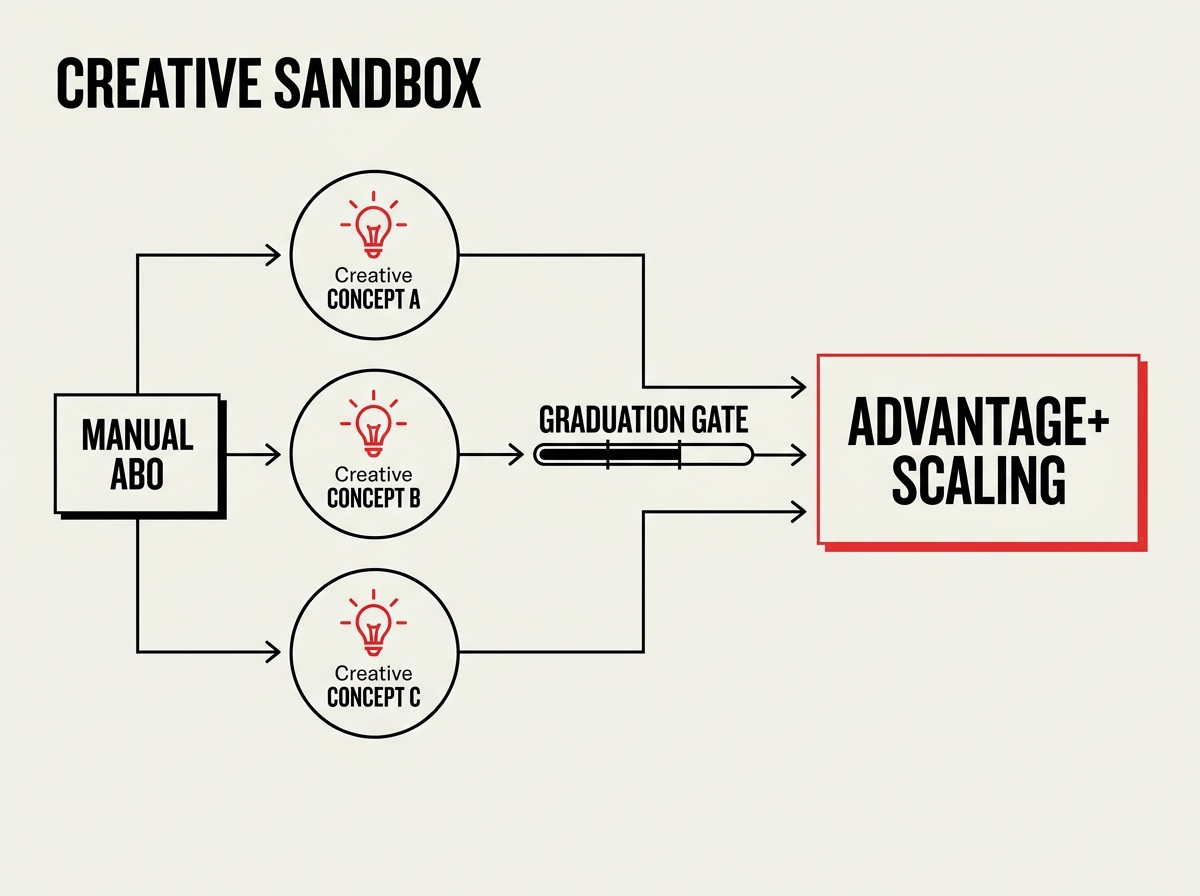
The biggest casualty of the automation-first mindset is the creative testing framework. In a standard Advantage+ setup, you might throw 20 pieces of creative into one campaign. Meta’s algorithm will quickly identify one or two 'winners' based on early engagement signals and funnel 95% of the budget toward them.
This sounds efficient, but it creates a 'winner-take-all' environment that stifles innovation. A radical new creative concept—perhaps a lo-fi TikTok-style testimonial or a high-production cinematic brand piece—needs a minimum threshold of impressions to find its audience. In an ASC environment, if that new ad doesn't perform in the first 500 impressions, it is effectively dead.
We are seeing a resurgence of the 'Scientific Method' in ad buying. This involves using manual ad sets with fixed budgets (ABO) to ensure every new creative concept gets a fair shake. For example, beauty brands, which [S4] Influencer Marketing Hub notes are now prioritizing TikTok-style content, find that Meta's automation often rejects these 'raw' formats early on in favor of polished, older assets. By manually overriding the spend, marketers can force the algorithm to learn how to sell the new format, often discovering a new 'control' ad that would have been suppressed by the automated system.
The Return of Manual Audience Segmentation
For years, the industry mantra was 'Broad is Best.' We were told that pixel data was so smart that we didn't need to target interests or lookalikes anymore. And for a while, that was true. But in 2026, broad targeting has become a commodity. If every brand in your category is targeting 'Broad,' you are all bidding for the same 10% of the population that Meta identifies as 'likely buyers.'
Manual overrides allow you to explore the other 90%. By using specific interest stacks or high-intent Lookalike Audiences (LLAs) in manual ad sets, you can carve out a niche that the Advantage+ algorithm is ignoring because it hasn't seen immediate conversion data there.
Consider the travel sector. As [S2] NextTrip’s acquisition of YADA suggests, the industry is moving toward creator-commerce travel platforms. A travel brand using only ASC will likely hit the same 'frequent travelers' audience as every airline and hotel chain. A manual override allowed a recent client to target 'emerging backpacker' interests combined with specific creator-led creative, resulting in a 25% lower CAC than their 'Broad' automated campaigns. The machine is a follower; manual strategy is a leader.
The Counterargument: Is the Machine Just Smarter Than We Are?
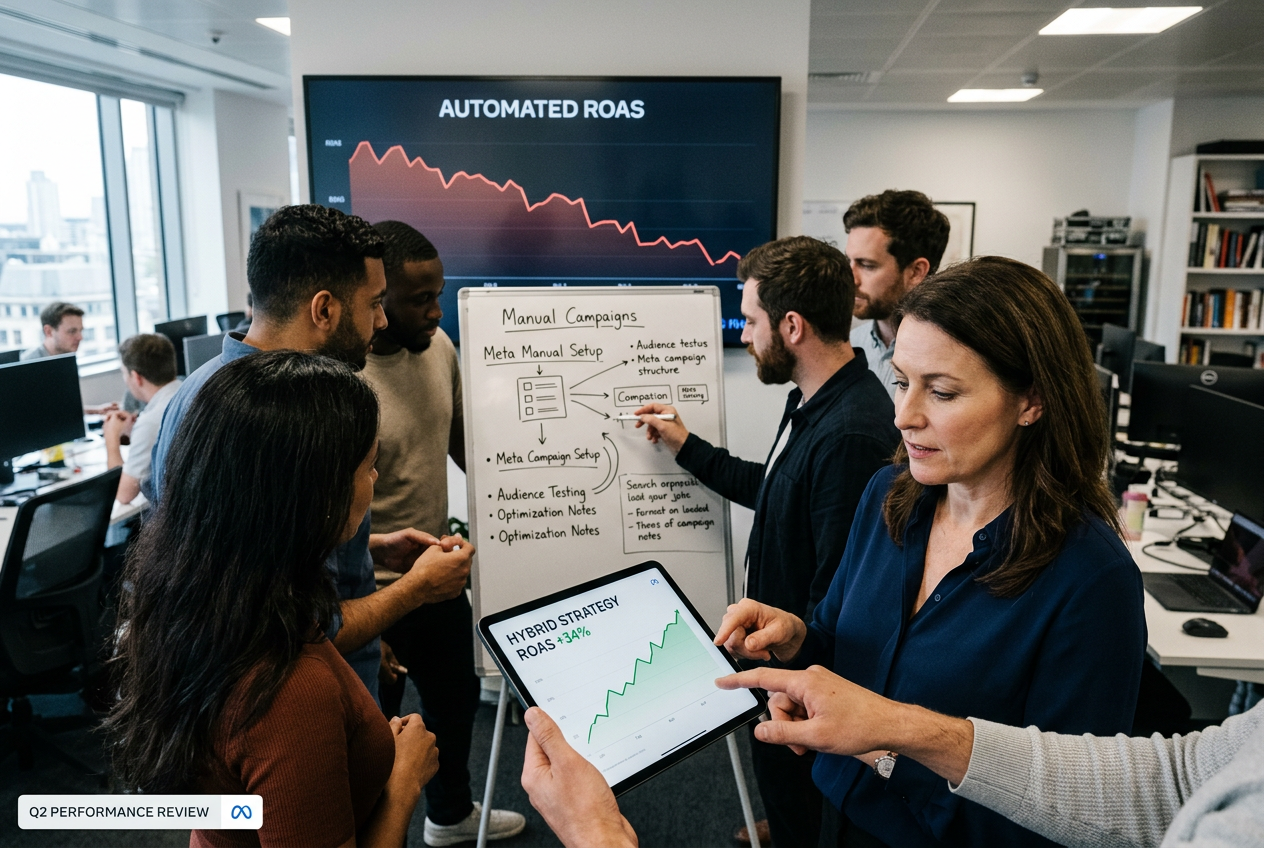
The most common pushback from Meta's internal teams and some large-scale agencies is that manual overrides introduce 'human bias.' They argue that by forcing spend into specific audiences or creatives, we are preventing the AI from finding even better opportunities that we hadn't considered. They point to the 'Power 5' and 'Performance 5' frameworks as proof that simplified accounts perform better over time.
This argument is valid if your goal is purely maintenance. If you have a stable product-market fit and a massive budget, ASC is a fantastic maintenance tool. But for brands that need to scale 2x or 3x year-over-year, the machine's inherent conservatism becomes a liability. The AI is trained on historical data. It cannot predict a shift in culture or a sudden change in consumer sentiment.
Why the 'Performance 5' isn't enough for 2026
If you rely solely on the machine, you are essentially betting that the future will look exactly like the past. Manual overrides are the 'R&D' department of your ad account. You don't do them because they are easier; you do them because they are the only way to find the 'Alpha'—the outsized returns that come from being first to a new creative trend or audience segment.
How to Implement a 60/40 Hybrid Strategy Tomorrow
If you're currently 100% in on Advantage+, don't switch everything off overnight. That's a recipe for a performance cliff. Instead, we recommend a transition to a 60/40 hybrid model.
- The 60% (The Scale Engine): Keep your best-performing, 'graduated' creatives in an Advantage+ Shopping Campaign. This is your baseline. Set a minimum ROAS target and let it run.
- The 40% (The Innovation Lab): Create a manual Campaign Budget Optimization (CBO) or Ad Set Budget Optimization (ABO) campaign specifically for testing.
- Test 1: Isolate a new creative hook with a manual broad ad set. Give it a fixed budget for 72 hours.
- Test 2: Use a 'Cost Cap' override on a manual ad set to see if you can pick up volume at a specific price point that ASC is overshooting.
- Test 3: Target a competitor’s interest stack with creative specifically designed to highlight your USP against them.
Once a creative or audience in the 'Innovation Lab' hits your performance benchmarks consistently for 7 days, move it into the 'Scale Engine.' This creates a virtuous cycle where your manual efforts feed the machine, rather than the machine starving your creativity.
Future Outlook: The Rise of 'Human-in-the-Loop' Advertising
By the end of 2026, we predict that the pendulum will swing back from 'Full Automation' to 'Human-in-the-Loop.' Meta will likely introduce more 'semi-automated' features that allow for the granular control we're currently achieving through manual overrides.
We are already seeing this on other platforms. TikTok, for instance, is emphasizing [S5] specific video ad specs and best practices that require deep human understanding of 'hooks' and 'trends' rather than just algorithmic placement. Brands that have spent the last two years getting 'lazy' on Meta’s automation are finding it incredibly difficult to pivot back to the creative-first, strategic thinking required on platforms like TikTok or even the 'new' manual Meta environment.
My falsifiable prediction is this: By Q4 2026, brands that spend at least 30% of their budget on manual, non-automated ad sets will see a 15% higher year-over-year growth rate compared to those who remain 100% automated. The data is already trending this way. The question is whether you’ll wait for your ROAS to tank before you make the switch, or if you’ll start overriding the machine today.
FAQ