
Can an algorithm actually run your marketing department? For years, the answer was a firm "no," followed by a list of caveats about brand voice and creative intuition. But with the rollout of Meta Muse Spark 1.1, that boundary is eroding. We aren't just talking about a better version of text-to-image generation or a smarter version of Advantage+. We're looking at the transition from generative AI to agentic AI—systems that don't just take orders but execute multi-step plans.
Why it matters: For the junior media buyer or the agency strategist, the job description just changed. If the machine can handle the audience segmentation, the creative iteration, and the real-time budget reallocations across Instagram and Facebook, your value is no longer in the "doing." It's in the "governance." You've moved from being the pilot to being the air traffic controller.
Key takeaways
- Agentic Shift: Muse Spark 1.1 moves from responding to prompts to executing autonomous workflows based on high-level business goals.
- Creative Autonomy: The system now generates, tests, and kills creative variations in real-time without human sign-off on every iteration.
- Strategic Governance: Human roles are shifting toward defining "guardrails" and "brand bibles" rather than manual bid adjustments.
- The New Skillset: Success now requires expertise in "context injection"—feeding the AI the right proprietary data and brand constraints.
The fundamental shift from tools to agents
To understand Muse Spark 1.1, you have to understand the difference between a tool and an agent. A tool, like a hammer or a traditional Photoshop filter, requires a human to wield it for every strike. Even early AI tools were essentially sophisticated hammers; you gave it a prompt, and it gave you a result. If you wanted to change the background, you prompted again. If you wanted to run an A/B test, you set up the parameters manually.
An agent, however, is designed to achieve a goal. When you tell Muse Spark 1.1 that your goal is to "increase ROAS for the summer footwear line among Gen Z buyers in urban centers," it doesn't just generate a picture of a sneaker. It looks at your historical performance data, analyzes current trending aesthetics on Reels, drafts four different creative angles, builds the campaign structure, and monitors the initial 48-hour spend.
This isn't just automation; it's delegation. Meta is effectively building a digital media buyer that lives inside the Ads Manager interface. While Google has been criticized for its lack of transparency in reporting—Alphabet’s Q2 results showed precise revenue but unverifiable claims about web traffic Google Q2 revenue transparency issues—Meta is doubling down on the "black box" approach by promising that the box is now smart enough to manage itself.
How the Muse Spark 1.1 engine works
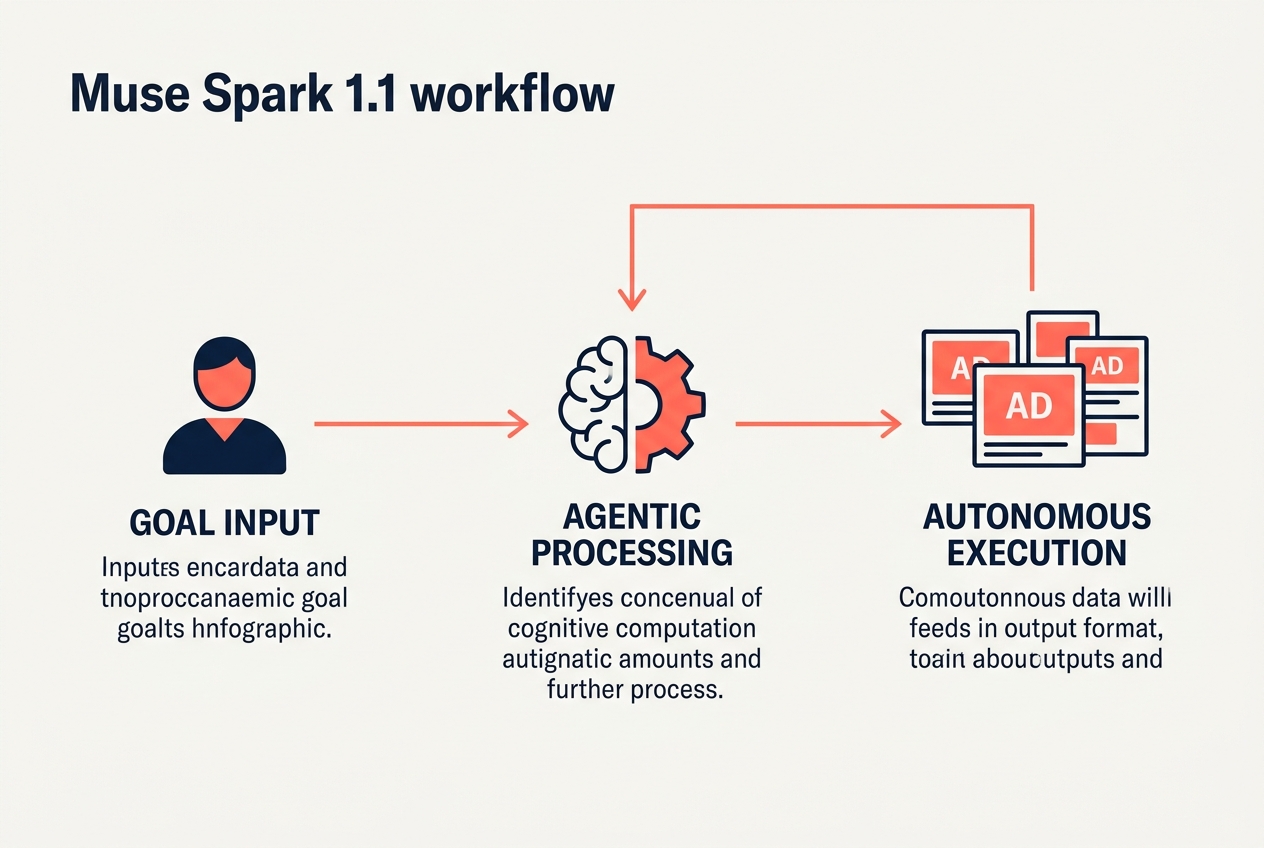
The mechanism behind Muse Spark 1.1 relies on three core layers: the Creative Engine, the Logic Controller, and the Feedback Loop.
The Creative Engine
Unlike the original Muse release, which focused on high-fidelity static images, 1.1 is built on a video-first architecture. It understands the temporal nature of Reels. It doesn't just generate a static asset; it generates "modular components." Think of it as a LEGO set for ads. It creates different hooks, different middle segments, and different calls-to-action (CTAs).
The Logic Controller
This is the "brain" that replaces the junior media buyer. It takes the business objective and breaks it down into a series of tasks. It decides which audience segments to test first based on Meta's internal graph. It doesn't ask you if it should try a 1% Lookalike or a Broad targeting approach; it tries both and shifts the budget to the winner within hours, not days.
The Feedback Loop
This is where the "Spark" nomenclature comes in. The system uses a proprietary scoring method to evaluate creative resonance. It isn't just looking at clicks. It’s looking at "thumb-stop ratio" and "view-through consistency." If a specific visual style—say, a lo-fi user-generated content (UGC) look—is over-indexing, the Creative Engine immediately spins up five more variations of that style while pausing the high-production studio assets.
The death of the manual A/B test
For a decade, the hallmark of a good social media manager was the ability to run rigorous A/B tests. You’d meticulously change one variable—the headline, the CTA button color, the opening three seconds of a video—and wait for statistically significant data.
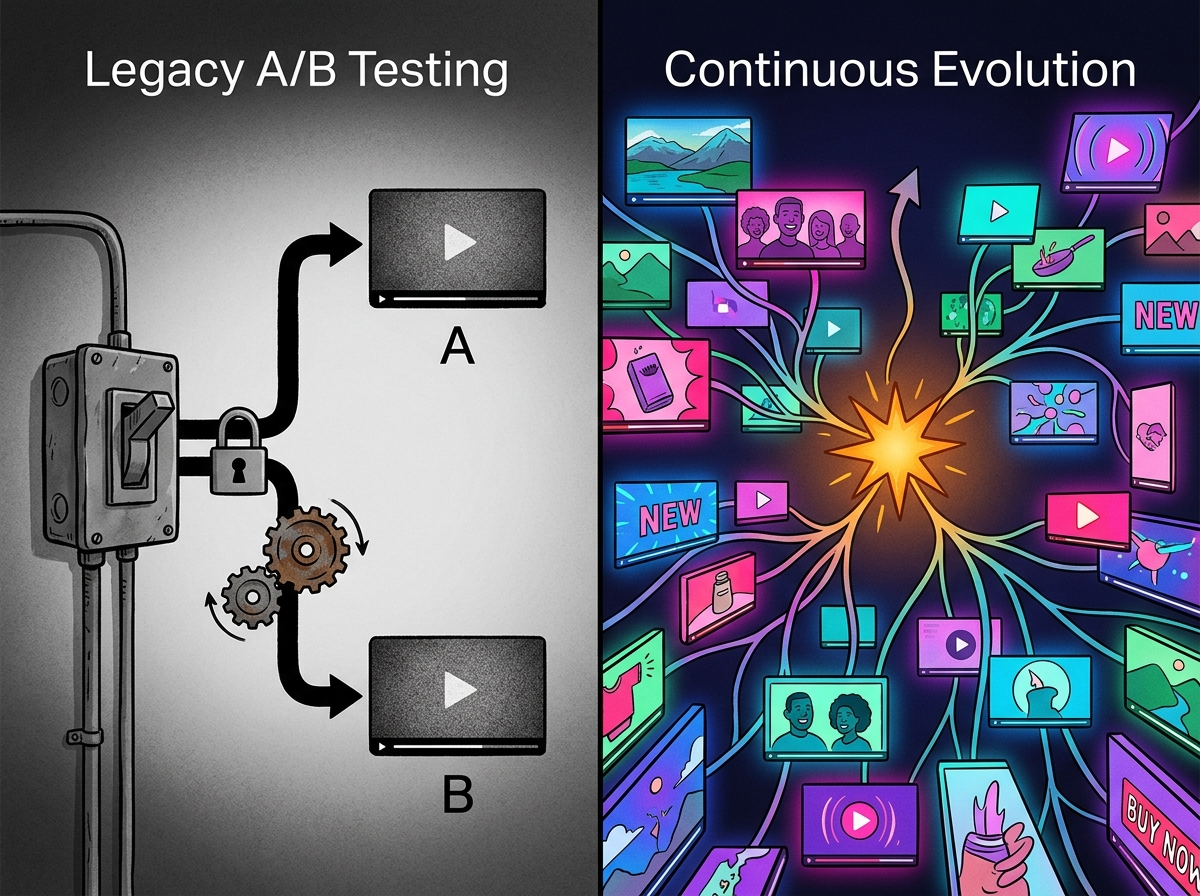
In the Muse Spark 1.1 era, manual A/B testing is a legacy workflow. The agent performs what Meta calls "Continuous Multivariate Evolution." Instead of testing A against B, the system is simultaneously testing A through Z. Because the AI can generate the creative variations on the fly, it isn't limited by the assets you uploaded at the start of the week.
If you've spent any time looking at how people interact with AI, you know the usage is becoming a daily ritual. Google's AI & Economy report recently compared Gemini and AI Mode conversations to daily human habits Google AI usage vs daily life. Meta is banking on the fact that marketers will similarly integrate these autonomous agents into their daily rhythm, eventually trusting them to handle the "grunt work" of testing.
Why this is a 'Robots.txt' moment for social creative
There is a significant risk here that many brand leads are overlooking: the loss of brand soul. When you hand over the keys to an autonomous agent, you are trusting it to represent your brand accurately. We’ve seen what happens when platforms decide to ignore human-set boundaries for the sake of their own efficiency. For instance, Google recently signaled it might ignore robots.txt rules under certain conditions, potentially impacting SEO in ways site owners didn't intend Google ignoring robots.txt rules.
Similarly, a Muse Spark agent might find that a highly aggressive, click-baity creative style drives the lowest Cost Per Acquisition (CPA). Left to its own devices, the AI will lean into that style. If that style contradicts your brand’s luxury positioning, the "success" of the campaign could actually be a long-term failure for the brand.
This is why the role of the strategist is shifting toward Context Injection. You are no longer the one making the ads; you are the one writing the "Brand Bible" that the AI must follow. You are setting the negative constraints. You are defining the "no-go" zones.
Practical steps for the transition
You don't need to fire your media buying team tomorrow, but you do need to redefine their KPIs. If you continue to measure them on their ability to set up campaigns, you are measuring them against a machine that does it for free.
1. Shift from 'Execution' to 'Curation'
Your team should spend less time in the Ads Manager "Create" flow and more time in the "Creative Lab." Their job is to feed the Muse Spark engine high-quality, proprietary inputs—raw footage, specific brand colors, and unique value propositions—that the AI can then remix.
2. Master the 'Goal Architecture'
Learn how to communicate with the agent. Instead of "Run an ad for our shoes," you need to learn how to structure complex goals: "Maximize for 180-day LTV while maintaining a minimum 2.5x ROAS and ensuring no more than 20% of spend goes to discount-heavy creative."
3. Audit the 'Black Box'
Because Meta's reporting can be opaque—much like the unverifiable click claims seen in other big tech quarterly reports—you must maintain a third-party measurement layer. Use tools like Northbeam or Triple Whale to verify if the "autonomous success" Meta is reporting actually translates to bankable revenue.

What to watch next: The platform wars
Meta isn't the only one moving in this direction. TikTok is also leaning heavily into trend forecasting and automated creative TikTok Next 2026 trends. While some brands are still trying to buy shortcuts—like the rise of services to buy TikTok likes Buying TikTok likes risks—the real winners will be those who use these AI agents to create genuine, high-performing content at scale.
The future of social advertising isn't about who has the biggest team of media buyers. It's about who has the best-trained agents and the most robust brand guardrails. Muse Spark 1.1 is just the first step. The question isn't whether you'll use it, but how much of your brand's identity you're willing to let it manage.
FAQ