
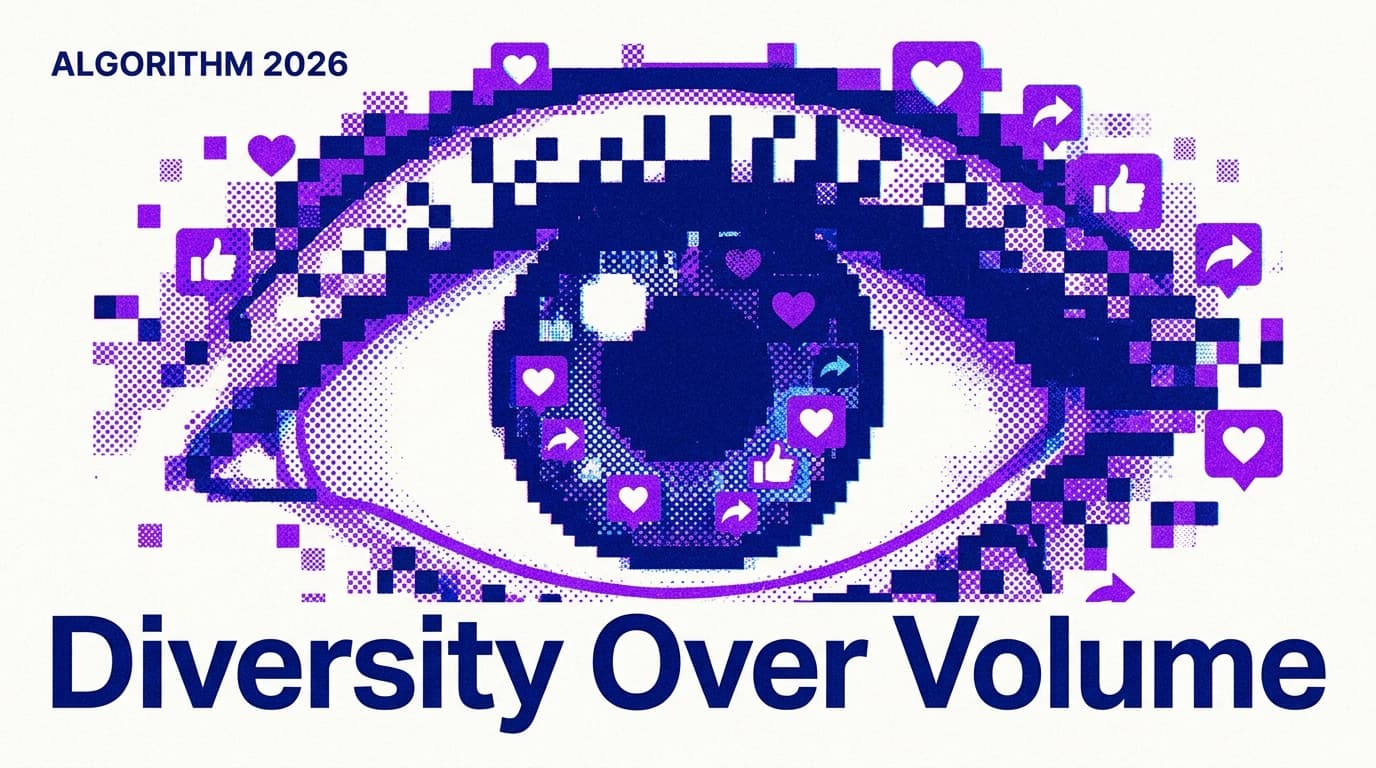
If you are still asking your creative team for 'five more variations' of the same winning ad, you are effectively paying Meta a tax for redundancy. The question every performance marketer is googling right now isn't how to scale spend, but why their winning creatives suddenly 'fatigue' faster than they did eighteen months ago. The answer lies in a fundamental shift in how Meta’s delivery system—specifically the Advantage+ engine—interprets value. In 2026, the algorithm no longer treats volume as a proxy for relevance. It treats diversity as the primary signal for reach.
The Shift from Volume to Distinct Creative Signals
For years, the standard operating procedure was 'volume testing.' You would take a single value proposition—say, 'This serum reduces wrinkles'—and produce ten versions of it. You’d swap a headline, change a button color, or use a slightly different background. In the old regime, this gave the algorithm more 'bites at the apple' to find a winner.
Today, that strategy is a recipe for high CPAs and internal competition. Meta's current ranking factors now include a 'Creative Redundancy' penalty. If your assets are too semantically similar, the system consolidates their delivery, effectively picking one and burying the rest before they ever get a fair shake.
Think of it like a party. If you send five people to the same party and they all tell the same joke, the guests get bored. If you send five people and one tells a joke, one performs a magic trick, and one offers a thoughtful compliment, you’ve engaged three different types of guests. This is Meta ads creative diversity in action. You aren't just making more ads; you are making different arguments for why someone should buy.
How Meta's new Reels ranking changes paid budget pacing
Why Diversity Matters: The Sub-Segment Matching Mechanism
To understand why diversity wins, we have to look at how the algorithm 'reads' your creative. Meta uses computer vision and natural language processing to categorize every frame of your video and every word of your copy. It then matches these 'creative signals' to the behavioral patterns of users.
If you only produce 'Founder Story' ads, you will only ever reach the sub-segment of your audience that responds to founder stories. There might be a massive cohort of potential buyers who only care about 'Scientific Proof' or 'Unboxing Aesthetics,' but if your creative doesn't contain those signals, the algorithm cannot find them for you.
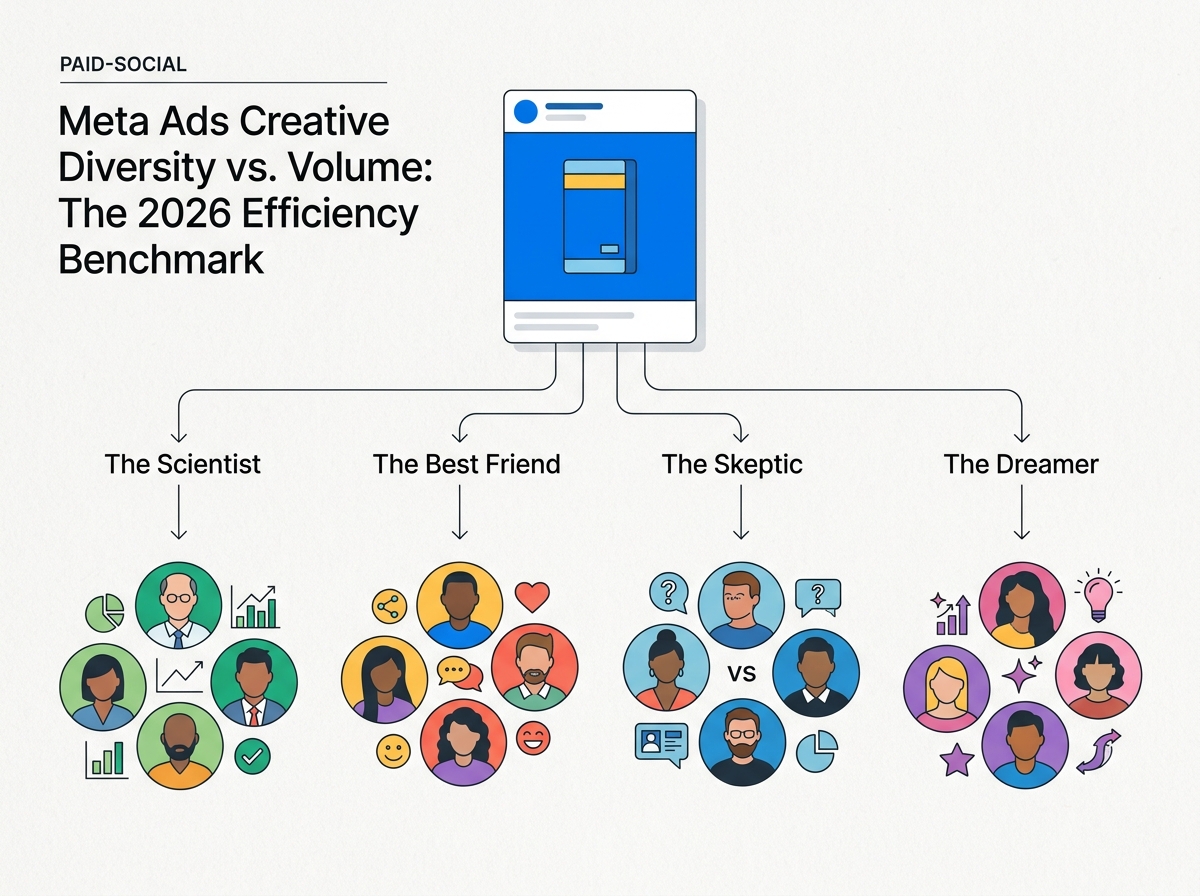
As noted in recent industry shifts, such as Estée Lauder’s move to enter 'group chat' culture with Bowen Yang [S4], brands are realizing that high-gloss, singular messaging is losing its grip. By diversifying the vibe and the hook, they reach different psychological profiles within the same broad interest group.
The Four Pillars of a Diversity-First Brief
When building your next campaign, stop thinking about 'assets' and start thinking about 'angles.' Per MarTech's August 2026 analysis on building briefs around people rather than keywords [S1], the goal is to map creative to human situations. A diverse creative set should include:
- The Rational Hook: Focus on specs, price, and logic. (e.g., 'Save $50 on your first order').
- The Emotional/Aspirational Hook: Focus on the 'after' state. (e.g., 'Wake up feeling refreshed').
- The Social Proof Hook: Focus on reviews, press, and user-generated content. (e.g., 'Why 50,000 people switched').
- The Negative Constraint Hook: Focus on the pain of not having the product. (e.g., 'Stop wasting time on manual entry').
If your testing sandbox contains one of each, you are giving the algorithm the tools it needs to lower your blended CPA. If you have four 'Rational Hooks,' you are just fighting yourself for the same 10% of the audience.
Facebook Ad Creative Testing: The 3x3 Framework
How do you actually execute this without losing your mind in Ads Manager? We recommend the 3x3 Framework. Instead of testing 20 random variables, you test three distinct 'Angles' against three distinct 'Formats.'
- Angle A (Benefit-Led): Static Image, Lo-fi Reel, Carousel.
- Angle B (Problem-Led): Static Image, Lo-fi Reel, Carousel.
- Angle C (Testimonial-Led): Static Image, Lo-fi Reel, Carousel.
This creates a matrix of nine assets. Within 48 to 72 hours, Meta’s 'Breakdown by Creative' report will show you which angle is resonating, not just which ad. This is the critical distinction. If the 'Problem-Led' angle is winning, you don't just keep that ad running—you double down on new creative variations of that specific problem.
[INTERNAL: The three creators who broke 1M followers this week using audio-first -> creator-growth-trends]
Navigating the 'Creative Fatigue' Trap
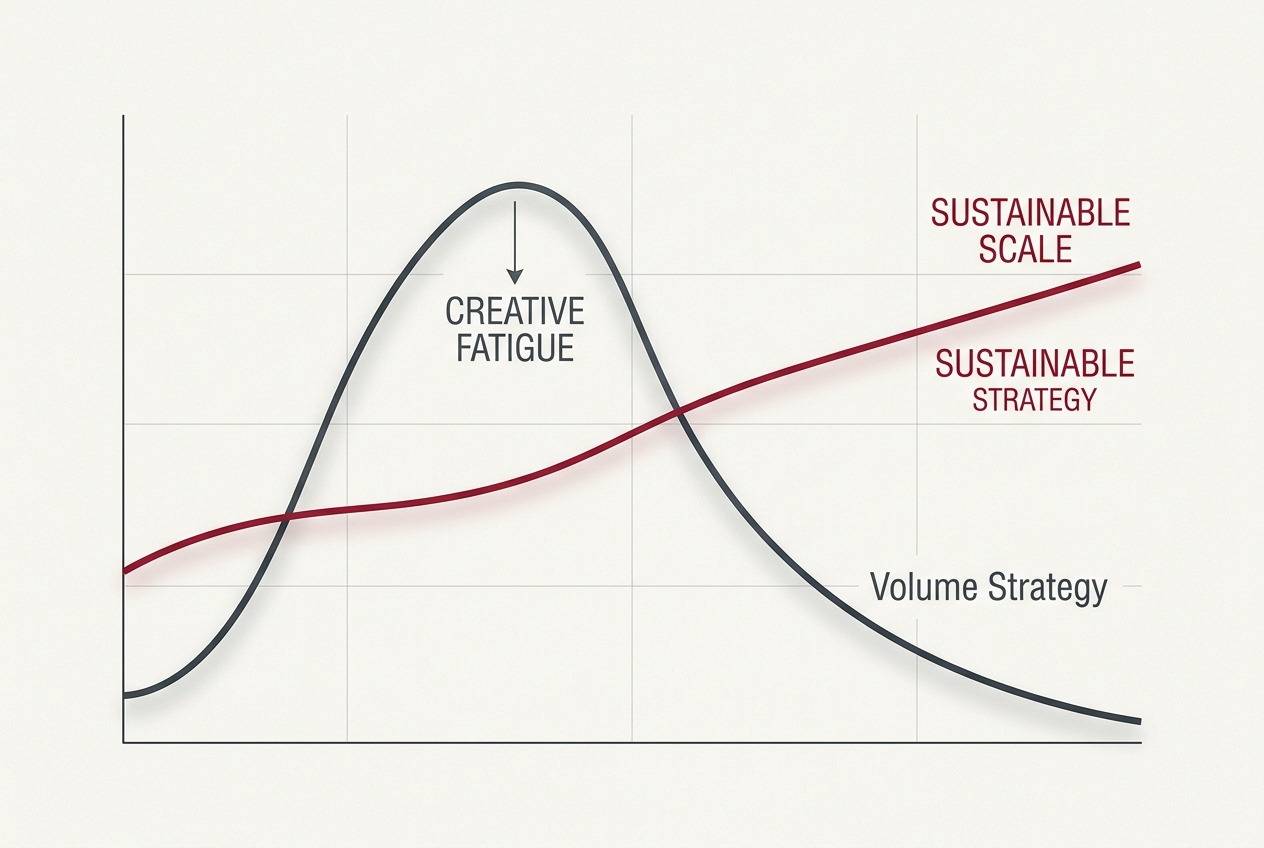
One of the most common complaints in Q3 2026 is that ads are 'burning out' faster. According to internal benchmarks from top-tier agencies like Emberos, what we call 'fatigue' is often just 'saturation of a sub-segment.'
If you have spent $50,000 on a single 'Unboxing' video, you have likely reached every person in your target audience who is prone to clicking on unboxing videos. Your frequency among that specific group is high, and your CTR is dropping. The novice marketer tries to 'fix' the unboxing video. The veteran marketer realizes they need a 'Comparison' video to reach the other 70% of the market that hasn't been moved by the unboxing format yet.
The Role of AI and Generation-Specific Nuance
We cannot talk about creative diversity in 2026 without addressing the generational divide in AI consumption. Recent data from Search Engine Journal [S5] highlights that Gen Z’s preference for specific AI tools like Claude over others is shifting how they perceive 'AI-generated' versus 'Human-authentic' content.
For Meta advertisers, this means your 'diversity' must also include a diversity of production styles.
- For Gen Z: High-cringe, lo-fi, and extremely fast-paced edits often outperform high-production value.
- For Boomers: Clearer, slower, and more instructional creative still holds the highest conversion weight.
If your creative suite is entirely 'TikTok-style' content, you are voluntarily excluding older demographics with higher disposable income. Diversity isn't just about what you say; it's about the visual language you use to say it.
Benchmarking Success: Beyond the ROAS Metric
In a diversity-first world, ROAS (Return on Ad Spend) can be a lagging and sometimes misleading indicator. If a new, diverse hook has a lower ROAS but brings in a high volume of new-to-brand customers, it is objectively more valuable than a 'winning' ad that is just retargeting your existing fans.
Look at your Hook Rate (3-second views / Impressions) and your Hold Rate (ThruPlays / 3-second views).
- A high Hook Rate with a low Hold Rate means your 'diversity' is just clickbait.
- A low Hook Rate with a high Hold Rate means your content is great, but your 'distinct signal' isn't strong enough to stop the scroll.
Aim for a Hook Rate of at least 25-30% in your testing phases. If you aren't hitting that, your creative isn't 'diverse' enough from the noise of the feed.
What This Means for Your 2026 Strategy
To compete in the current Meta landscape, you must move away from the 'Creative Director as Dictator' model and toward the 'Creative Strategist as Scientist' model.
Actionable Guidance:
- Audit your current winners: Are they all the same style? If so, your next three briefs should be intentionally 'uncomfortable'—trying styles you’ve previously ignored.
- Consolidate your ad sets: Give the algorithm more budget per ad set so it has the liquidity to test your diverse assets properly. Stop splitting audiences by interest; let the creative do the targeting.
- Invest in 'Hook' variations: Spend 80% of your production time on the first 3 seconds. A different hook on the same body video counts as a 'distinct signal' in Meta's eyes.
- Ignore 'Best Practices' that preach uniformity: Your brand guidelines should be a guardrail, not a straitjacket. If every ad looks like a carbon copy of your website's hero banner, you are failing the diversity test.
Meta’s algorithm is smarter than your media buyer. It knows who wants to buy your product better than you do. Your only job is to provide it with enough different 'keys' (creative hooks) until it finds the right 'locks' (audience segments). Volume is dead. Long live diversity.
FAQ