
TikTok’s commerce evolution reached a critical inflection point this month as new data suggests the primary driver of first-time purchases has migrated from the For You Page (FYP) to the comments section. Since May 2026, brands utilizing TikTok Shop have seen a surge in conversion rates stemming directly from community interactions rather than high-production video creative.
Why it matters: For social media managers and paid-social buyers, this shift demands an immediate reallocation of resources. The era of 'post and forget' is over; the comments section is no longer just a place for sentiment tracking—it is your most effective sales floor. If you aren't staffing for real-time community management, you are leaving the majority of your potential first-time customers at the top of the funnel.
Key takeaways
- Conversion Shift: Data from Glossy indicates the comments section is now responsible for the majority of initial TikTok Shop transactions.
- Video vs. Interaction: High-production value in main-feed videos is losing ground to the authenticity of 'reply-video' ads and text-based community management.
- Budget Realignment: Brands are moving spend from expensive video shoots toward full-time community management and agency ad accounts optimized for high-frequency engagement.
The death of the polished ad and the rise of the 'Reply-Video'
For years, the industry consensus was that the TikTok algorithm favored high-energy, perfectly lit, and tightly edited short-form video. However, the May 2026 reporting from Glossy highlights a stark reversal. Consumers are increasingly skeptical of the primary feed, viewing it as a broadcast medium, while they treat the comments section as a peer-review sanctuary.
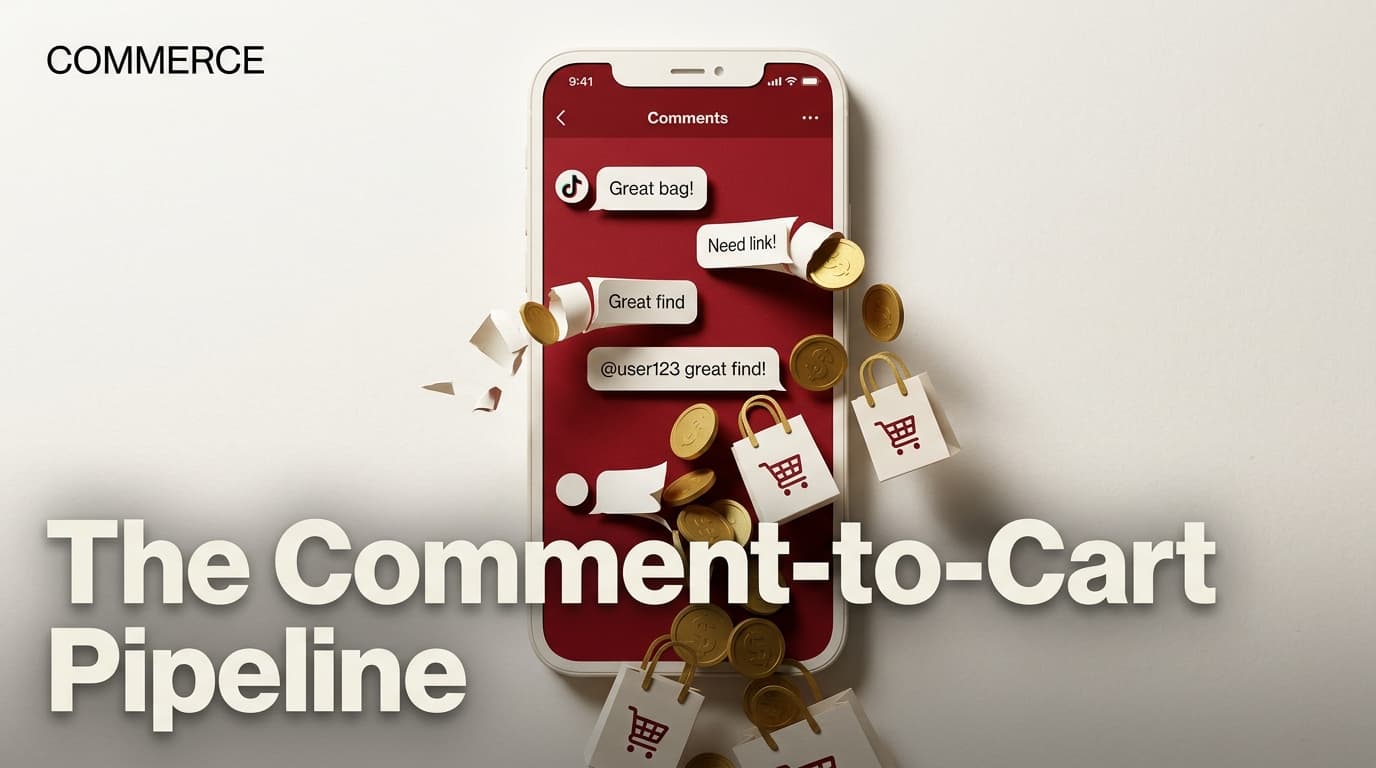
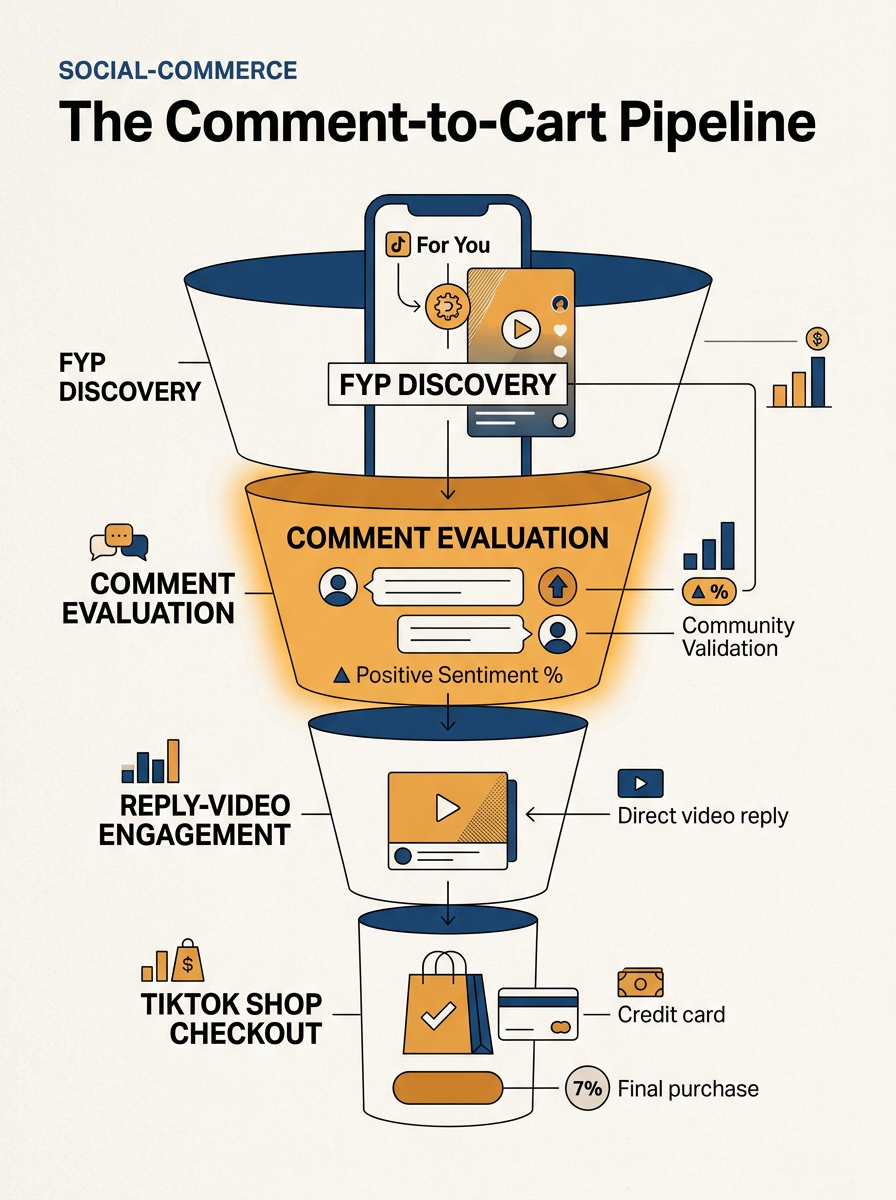
When a user scrolls through their FYP, they are in discovery mode. When they click the comment bubble, they are in evaluation mode. This is where the 'Comment-to-Cart' pipeline begins. Brands that have successfully navigated this shift aren't just answering questions; they are using 'Reply with Video' features to create a secondary loop of content that feels more personal and less intrusive than a standard ad.
According to recent performance benchmarks, these reply videos—often shot on a mobile phone with zero post-production—see a 40% higher click-through rate (CTR) to TikTok Shop than the original video that prompted the question. This is because the reply video addresses a specific friction point: a question about sizing, a doubt about durability, or a request for a real-world demonstration. In the context of social commerce conversion strategies, this direct utility is the new gold standard.
Quantifying the impact: Why the comments section is the new storefront
The data published by Glossy on May 7, 2026, confirms what many agency strategists suspected: the comments section is driving the majority of first purchases. This isn't just about 'engagement' in the vanity-metric sense. It’s about the psychological shift from passive viewer to active shopper.
In the traditional marketing funnel, the comments were considered 'mid-funnel' at best. In 2026, they have become the 'bottom-funnel' closer. When a brand representative or a creator responds to a comment with a tagged product link, the social proof of the interaction serves as a powerful nudge.
Consider the workflow of a modern social media manager. Previously, 80% of their time was spent on content ideation and 20% on moderation. We are now seeing a total inversion. Large-scale retailers are now hiring dedicated 'Commerce Moderators' whose sole KPI is the conversion rate of their replies. This shift is supported by innovations in the tech stack; for instance, Shoplazza recently won the TikTok Partner Innovation Award for commerce marketing technology, specifically for tools that bridge the gap between social engagement and backend inventory management (per PR Newswire, May 21, 2026).
Scaling community management through agency ad accounts
As the importance of the comments section grows, so does the technical complexity of managing it at scale. Brands are finding that standard organic accounts often hit 'shadow' limits when they attempt to reply to thousands of comments with product links. This has led to a boom in the specialized agency ad account market.
According to The European Business Review's May 2026 rankings, the best TikTok agency ad accounts now offer features specifically designed for high-frequency commerce. These accounts allow for higher spending limits and, crucially, better access to TikTok’s 'Spark Ads' and 'Video Shopping Ads' (VSA) infrastructure.
By 'Sparking' a comment—essentially turning a user's comment or a brand's reply into a boosted ad—marketers can amplify the social proof that already exists. This isn't just theory; it’s a logistical necessity. If a brand has a viral hit, the comments section can easily swell to 10,000+ entries. Without an agency-grade account and a robust community management tool like Sprout Social or Sprinklr, that brand loses the ability to convert those 10,000 hand-raisers into customers.
The Instagram comparison: Why TikTok is winning the trust war
While TikTok is leaning into the raw, unpolished nature of comment-based commerce, its competitors are struggling to keep up. Reports from 매일경제 (May 21, 2026) indicate that while the Instagram algorithm is constantly changing to help users 'make money through social,' it remains heavily weighted toward aesthetic perfection.
Instagram’s shopping features still feel like a digital catalog. TikTok’s shopping features feel like a conversation. This is the fundamental difference that the Glossy data highlights. On TikTok, the purchase feels like a byproduct of a community interaction. On Instagram, it still feels like an interruption of a visual experience.
For small businesses, this distinction is vital. As Sprout Social noted in their May 2026 guide for small business marketing, the barrier to entry on platforms like LinkedIn or Instagram is often the cost of 'looking the part.' TikTok has lowered that barrier by making the 'part' a helpful, responsive human in the comments.

Future-proofing your TikTok commerce strategy
If the comments section is the new conversion engine, how should you adjust your Q3 and Q4 2026 budgets? First, stop over-investing in the 'hero' video. The hero video is now merely the bait; the comments are the hook.
- Shift Production to Response: Allocate 30% of your production budget to 'on-call' creators who can film high-quality, authentic reply videos within 4 hours of a trending comment appearing on your posts.
- Integrate Commerce Tech: Use platforms like Shoplazza or specialized TikTok Shop connectors to ensure that when a moderator drops a link in the comments, it reflects real-time inventory and localized pricing.
- Monitor Sentiment as a Sales Signal: Use Brandwatch or similar tools to identify not just who is talking about you, but who is asking 'buying intent' questions. These should be prioritized by your community team as high-value leads.
We are moving toward a world where the 'social' in social commerce is no longer a prefix—it is the product itself. The brands that win in the latter half of 2026 will be those that stop acting like broadcasters and start acting like concierge services in the palm of the consumer's hand.
As you refine your creator economy economics and pricing, remember that the value of a creator isn't just their reach anymore. It's their willingness to get into the weeds of the comments and sell on your behalf.
What to watch: The automation of community commerce
The next frontier is the AI-assisted moderator. While authenticity is the current driver, the sheer volume of comments will eventually necessitate AI intervention. The challenge for developers—and the opportunity for marketers—is creating AI that doesn't feel like a chatbot.
The winner of the next TikTok Partner Innovation Award will likely be the company that masters 'Human-in-the-Loop' AI for the comments section—tools that can draft the perfect, snarky, or helpful response in the brand's voice, leaving only the final 'send' click to a human moderator.
Until then, the strategy remains clear: get in the comments, stay in the comments, and treat every question as a potential checkout. The pipeline is open; you just have to manage it.
FAQ