

Cloudflare’s introduction of AI agent wallets marks the definitive end of the 'open web' as a charity for Silicon Valley’s model builders. By allowing AI agents to pay for the resources they access, we are moving toward a future where every crawl, scrape, and prompt response is a metered financial transaction. Marketers who continue to optimize for 'free' visibility are missing the pivot: your high-intent data is no longer just a lead magnet; it is a billable asset.
Key takeaways
- The end of free scraping: Cloudflare’s AI wallets allow site owners to set a price for AI agents (like GPT-Bot or Claude-Bot) to access specific content, effectively turning your robots.txt into a billing department.
- Data as a SKU: High-intent product guides and proprietary research should move from 'gated for emails' to 'gated for micro-payments' from LLM providers.
- The visibility trap: Relying on 'citations' is a losing game when AI agents synthesize answers without driving click-through traffic. If they use your data to answer a user, they should pay for the privilege.
The death of the 'exposure' economy in AI search
For two decades, the trade-off was simple: you give Google your content for free, and in exchange, they give you a link that might result in a visitor. That social contract is dead. As OpenAI begins testing health and finance ads within ChatGPT (per Search Engine Journal’s August 2026 reporting), it’s clear the platforms are monetizing the output while expecting the input to remain free.
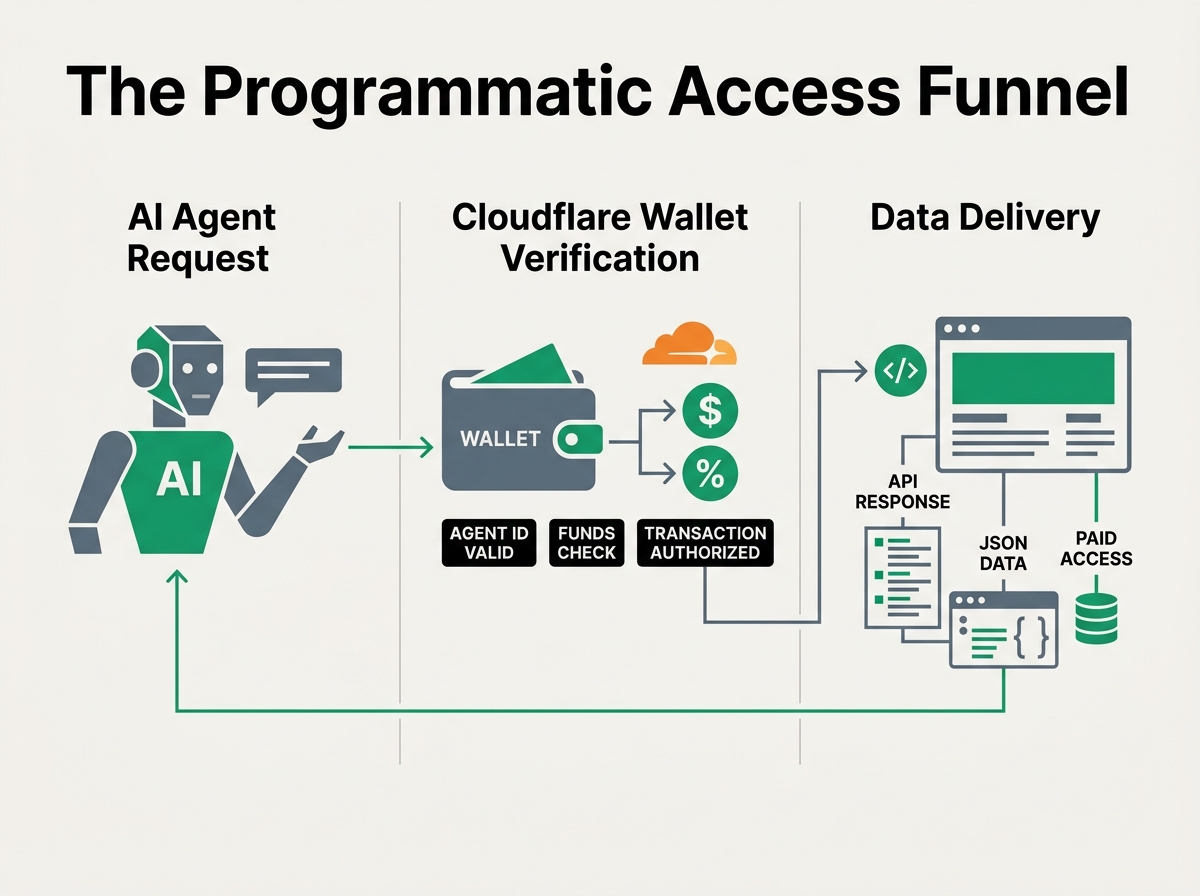
Cloudflare’s move to give AI agents identity handles and wallets flips the script. It allows you, the brand marketing lead, to treat an incoming crawler not as a guest, but as a customer. According to Cloudflare's August 4 announcement, these wallets extend paid access beyond simple crawlers to any programmatic caller. This means if Perplexity wants to summarize your 5,000-word deep dive on enterprise SaaS architecture to satisfy a user's query, your server can demand a micro-payment before serving the first byte.
We’ve seen the value of proprietary data skyrocket. A Search Engine Land report from August 12, 2026, highlighted that community signals—user-generated content from platforms like Reddit and specialized forums—are now the largest third-party source for AI training. Why? Because it’s high-intent, human-verified data. If you are producing that level of quality in-house, giving it away for a 'citation' that has a 0.5% click-through rate is professional malpractice.
Why marketers must shift to a pay-per-prompt budget model
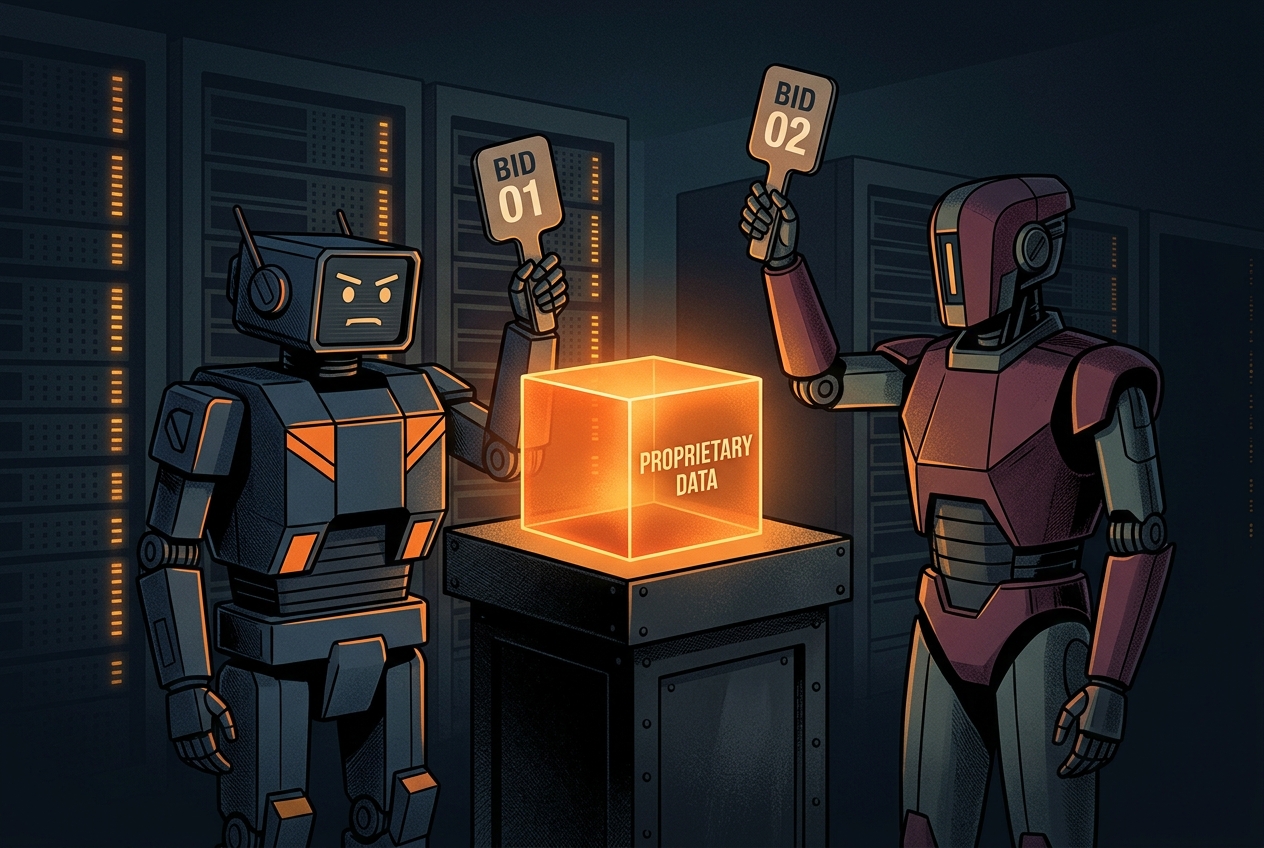
If agents are paying to access your site, the inverse will soon be true: you will pay to ensure your brand is the one the agent 'buys' to answer a query. This isn't just about charging OpenAI; it’s about the emergence of a programmatic bidding layer for AI responses. Imagine a scenario where a user asks an AI agent, "What is the best CRM for a 50-person manufacturing firm?"
The agent has three high-quality sources it could synthesize. If Salesforce, HubSpot, and Pipedrive all have 'AI-ready' data behind a Cloudflare wallet, the agent might choose the one that offers the most seamless (or cheapest) transaction, or the one that has bid for 'preferred source' status. This is the new SEO. It’s not about keywords; it’s about the economic viability of your data for the agent’s budget.
[INTERNAL: How to optimize for AI-first search engines -> ai-search-optimization-guide]
We are looking at a shift from CPM (Cost Per Mille) to CPP (Cost Per Prompt). In this environment, your marketing budget isn't just spent on creative; it’s spent on 'liquidity' for your data. You are essentially subsidizing the AI agent's cost of research to ensure your brand is the one it recommends.
Gating for dollars instead of leads
The traditional lead magnet—give me an email, I give you a PDF—is failing because AI agents can’t easily jump through those hoops, and users don't want to. However, if your content is behind a Cloudflare-managed AI wallet, the agent can pay a fraction of a cent, ingest the data, and provide a verified answer.
You might ask: "If I charge the agent, won't it just go to my competitor who provides it for free?"
Perhaps. But as Meta’s recent partnership with NABTU to build AI infrastructure suggests, the sheer cost of running these models is forcing a search for efficiency. High-quality, structured data that is easy for an agent to parse is worth paying for because it lowers the compute cost of the LLM. A 'free' site with messy HTML and hallucination-prone text is actually more expensive for an AI to process than a paid site with clean, structured JSON-LD.
The counterargument: Will this break the open web?
Critics argue that turning every interaction into a transaction will kill the serendipity of the internet. They claim that if everyone starts charging for access, the only entities that will be able to afford to 'know' things are the trillion-dollar tech giants, further entrenching their monopolies.
This is a valid concern, but it ignores the current reality: the tech giants are already the only ones profiting from your data. The 'open web' is currently a one-way street where value flows up to the model owners and rarely trickles back down to the creators. Cloudflare isn't breaking the web; it’s providing the plumbing for a long-overdue rebalancing of power. By putting a price on access, you aren't just making money; you are signaling the quality of your information. In a world of AI-generated sludge, that which costs money to access will eventually be perceived as more reliable than that which is free.
How to prepare your content gating strategy today
Don't wait for your traffic to hit zero before you act. You need to audit your content based on 'Agent Value.'
- Identify your 'High-Signal' assets: These are your original research pieces, your deep-dive case studies, and your proprietary calculators. These are the items you should consider placing behind an AI wallet.
- Clean your technical debt: AI agents prefer structured data. If you want to be the preferred source for an agent, your Schema.org markup needs to be flawless. Use tools like Sprout or Brandwatch to see which of your topics are being most frequently cited by LLMs currently.
- Experiment with micro-pricing: Start by charging a nominal fee for bot access to your most 'stolen' assets. Monitor whether LLMs like Perplexity or SearchGPT continue to cite you.
The role of structured data in 2026 SEO
As MarTech recently noted, not every change in a marketing metric deserves a response. But the shift from 'crawling' to 'transactional access' is not a temporary fluctuation. It is a fundamental change in the architecture of the internet.
The 2027 Prediction
By the end of 2027, I predict that at least 30% of the Fortune 500 will have 'AI Access Fees' as a line item in their digital revenue reports. We will see the emergence of 'Data Exchanges' where brands bundle their high-intent content and sell access to LLM providers in bulk, managed through platforms like Cloudflare. The era of the 'free' crawler is over. The era of the 'AI Customer' has begun. If your marketing strategy doesn't include a plan to invoice an LLM, you aren't just leaving money on the table—you're giving away the table itself.
FAQ