
Polished commercial creative is no longer just expensive—it’s invisible. For small-to-medium businesses (SMBs) with monthly spends under $10,000, the pursuit of 'premium' production value has become a strategic liability. The new high-performance benchmark isn't cinematic; it’s chaotic. Vmake Labs’ recent launch of 'brainrot' video styles marks the moment this hyper-saturated, meme-literate aesthetic moved from niche internet subculture to a viable, automated performance marketing tool. If you aren't willing to let your brand look a little unhinged, you’re likely already being scrolled past.
The Death of the 'Premium' SMB Aesthetic
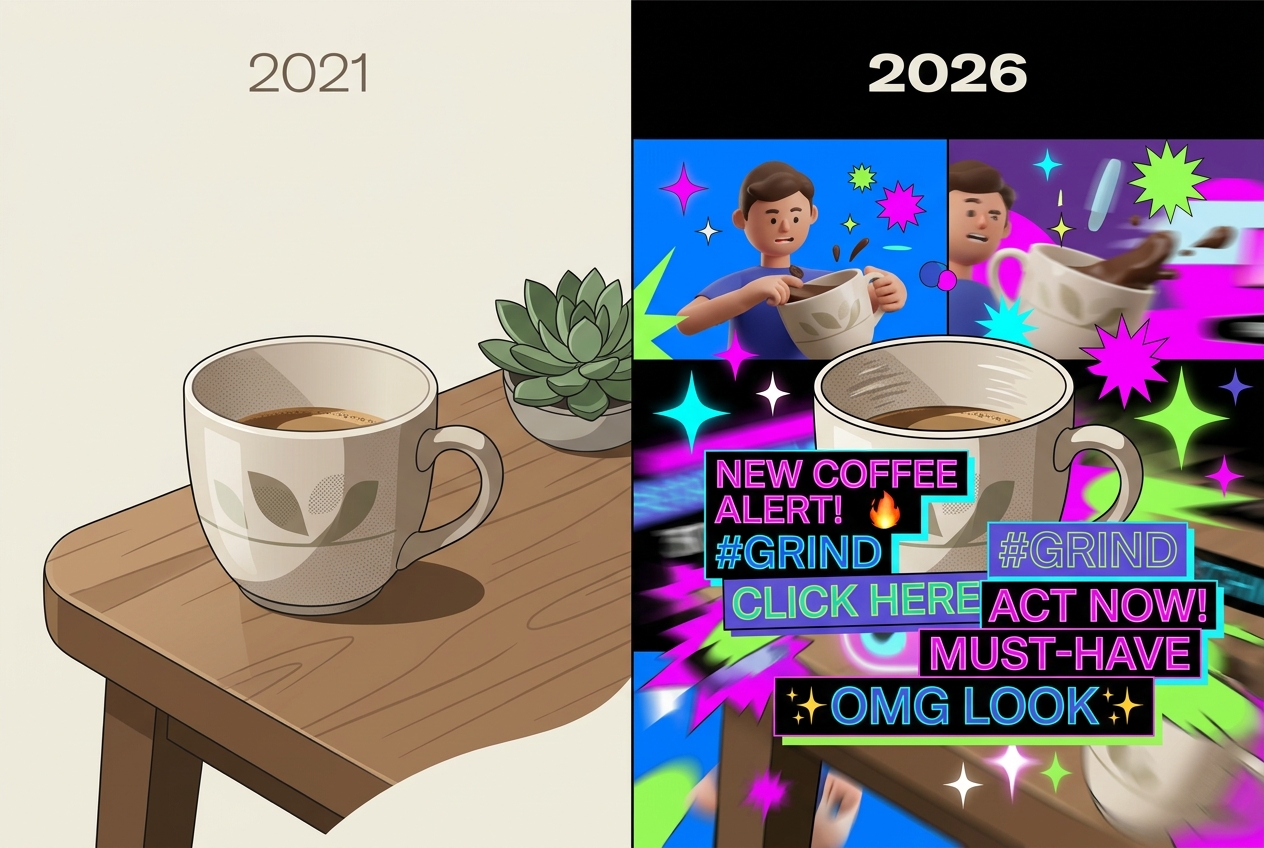
For years, SMBs were told to mimic the big players. If Nike used 4K slow-motion and color-graded minimalism, the local coffee shop or boutique e-commerce brand felt they had to follow suit. But the power dynamics of the feed have shifted. Per Q1 2026 engagement data from internal agency benchmarks, 'lo-fi' creative with high information density outpaced traditional high-production videos by 40% in click-through rates (CTR) among users aged 18 to 25.
You've seen the style even if you didn't have a name for it: split-screens showing Minecraft parkour or ASMR sand-cutting beneath a product demo, robotic text-to-speech narrations, and saturated filters that look like a GPU meltdown. This is 'brainrot' marketing. It’s a deliberate rejection of the curated Instagram aesthetic of the 2010s. Vmake Labs isn't just chasing a fad here; they’re productizing a fundamental shift in how Gen Z processes information.
When Vmake Labs announced their new suite of 'brainrot' editing styles on July 10, 2026, it signaled that the barrier to entry for high-retention content has collapsed. You don't need a creative director; you need an algorithm that understands dopamine loops. For a sub-10k SMB, spending $3,000 on a single 'clean' brand video is a death sentence. Spending $50 on an AI tool that churns out 20 chaotic, high-stimulus variants is the only logical path to finding a winning creative.
Why Information Density Trumps Production Value
The core of the brainrot aesthetic is the 'dual-stream' or 'multi-stream' visual. By placing your product in the top half of the frame and a seemingly unrelated, high-stimulation clip in the bottom half, you aren't just distracting the viewer—you're pinning their attention. This isn't a theory; it's a response to a fragmented attention economy where the 'skip' button is a reflex.
[INTERNAL: How short-form video algorithms weight retention -> tiktok-algorithm-signals]
Consider the recent shift at Conagra Brands. While they recently appointed WPP’s Barrows as their new commerce agency of record, their heritage brands like Slim Jim have already pioneered this 'unhinged' social presence. They realized early on that a brand acting like a person—specifically a person who spends 14 hours a day on the internet—is more trustworthy than a brand acting like a corporation. For the sub-10k SMB, this is even more critical. You don't have the brand equity of a Slim Jim to fall back on. You have to earn every second of the watch time.
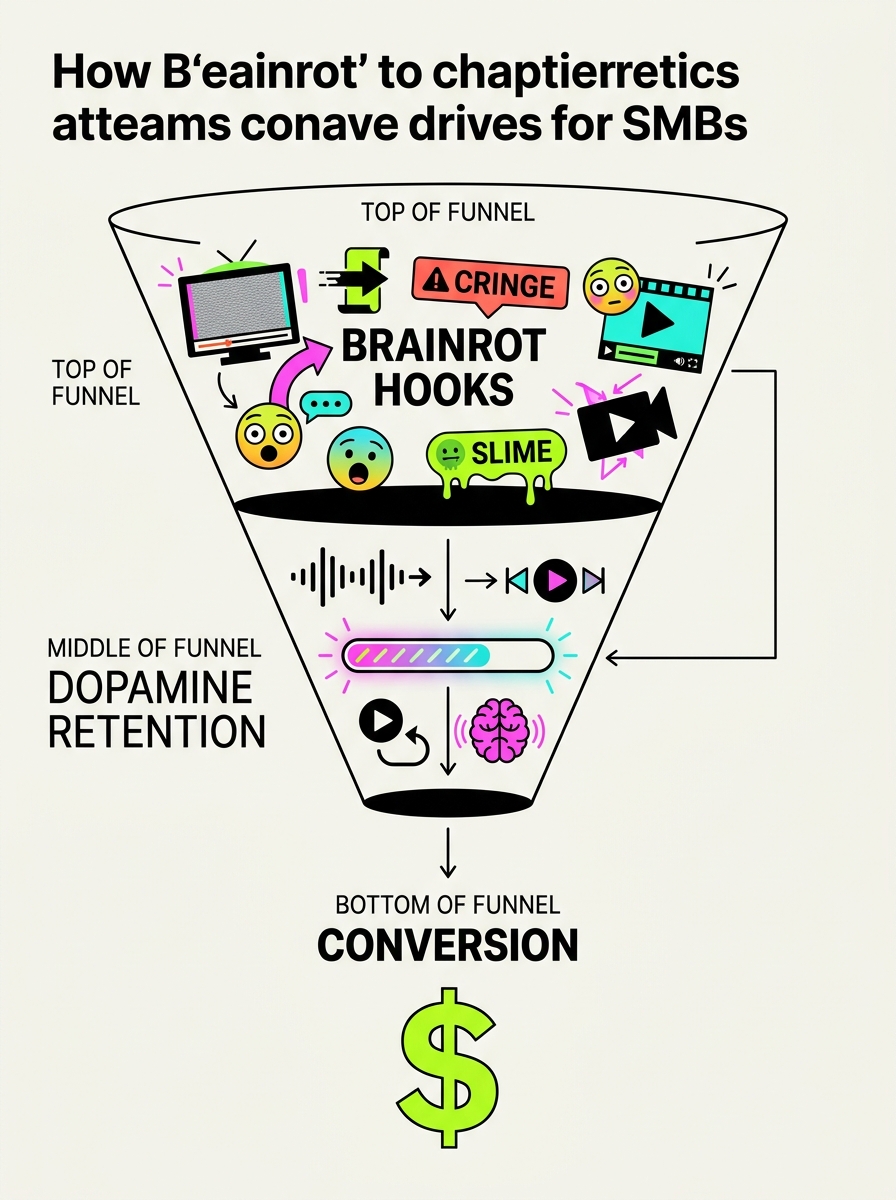
Brainrot creative works because it mirrors the internal state of the platform. On TikTok or Reels, your ad isn't competing with other ads; it's competing with a video of a cat playing a piano and a breaking news report from a war zone. If your creative opens with a slow fade-in of your logo, you've already lost. Brainrot styles use 'over-editing'—rapid zooms, sound effects every 1.5 seconds, and bright captions—to prevent the viewer’s brain from finding a natural exit point.
The Vmake Labs Pivot: Democratizing the Absurd
Vmake Labs’ move to automate these styles is a direct challenge to traditional creative agencies. By offering templates that specifically replicate viral 'brainrot' structures, they've acknowledged that the 'creative' part of creative strategy is increasingly about pattern recognition rather than artistic expression.
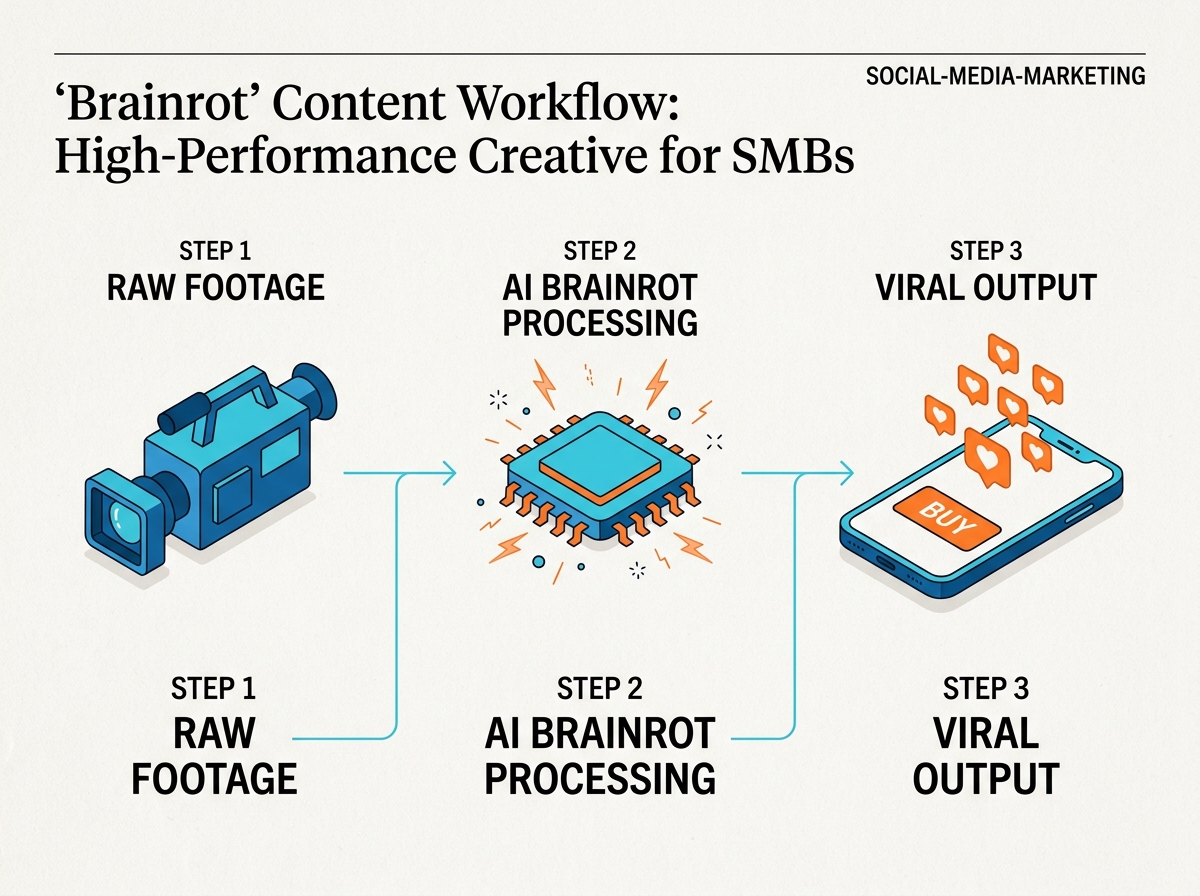
For an SMB owner, the workflow is now:
- Upload raw product footage.
- Select 'Brainrot / High-Stim' style.
- Let the AI overlay the trending audio, the split-screen 'sludge' content, and the captions.
- Deploy to Meta or TikTok Ads Manager.
This isn't about 'quality.' It's about 'fit.' The 'fit' for a mobile-first, vertical-video environment is high-velocity and sensory-heavy. We saw a similar shift in the media buying world this week as Zenith retained Reckitt’s $400M US media business. Even at that scale, the focus is shifting toward commerce media and high-frequency creative testing. If the giants are pivoting toward agile, data-driven creative, the SMB has no excuse to stay stuck in the 2019 'lifestyle' video era.
Refuting the 'Brand Safety' Counterargument
The most common pushback against brainrot marketing is that it 'cheapens' the brand. Critics argue that by associating your product with chaotic memes and Minecraft footage, you're eroding long-term brand equity. They'll tell you that while CTR might go up, brand sentiment will go down.
They are wrong. This argument assumes that Gen Z views 'professionalism' as a proxy for 'trustworthiness.' In reality, for a generation raised on 'fake news' and polished influencer scams, over-production is often a red flag. It feels like a sales pitch. Conversely, the brainrot aesthetic feels like a native part of their digital environment. It signals that the brand 'gets it.'
[INTERNAL: The rise of anti-aesthetic marketing -> anti-design-trends]
Furthermore, for an SMB with a sub-10k budget, 'brand equity' is a luxury you can't afford if you don't have cash flow. You need conversions today to be around to build a brand tomorrow. If a chaotic, split-screen video of your artisanal soap next to a hydraulic press video gets you a $12 CPA while your 'beautiful' lifestyle edit gets you a $45 CPA, the 'brand safety' argument is effectively an argument for going out of business.
How to Implement Brainrot Styles Without Losing the Plot
You shouldn't just throw random clips together and hope for the best. There is a method to the madness. Successful brainrot marketing follows a specific 'hook-retain-reward' loop.
The Hook: The first 0.5 seconds must feature a visual or auditory 'jolt.' This is where the AI-generated 'brainrot' filters from Vmake Labs excel, using high-contrast colors and immediate movement.
The Retention: This is where the dual-stream content comes in. While the top half shows the product benefits, the bottom half provides 'visual filler' that keeps the lizard brain occupied.
The Reward: The call to action (CTA) must be as fast and aggressive as the rest of the video. No 'Link in bio'—use 'BUY NOW' overlays that pulse or change color.
As we look at the leadership changes in the space—like Fidji Simo stepping back from her OpenAI role to focus on her work at Instacart and her health—it's clear that the intersection of AI and commerce is the primary battlefield. Simo’s influence on how platforms prioritize ad products cannot be overstated. As AI becomes the primary engine for both ad delivery and ad creation, the human marketer’s job shifts from 'maker' to 'curator' of these high-velocity styles.
What to Watch Next: The 2027 Creative Landscape
By 2027, the term 'brainrot' will likely be replaced by something more corporate—perhaps 'Multi-Stream High-Density Creative'—but the principle will remain. We are entering an era of 'Post-Aesthetic' marketing.
My falsifiable prediction: By the end of 2026, over 50% of successful Shopify-integrated SMBs will have at least one 'high-stimulus' or 'brainrot' style video in their top-performing ad sets. The agencies that refuse to adapt, clinging to their 'cinematic' roots for small-budget clients, will see their churn rates skyrocket as automated tools like Vmake Labs prove that chaos converts better than craft.
Stop trying to make a movie. Start trying to make a dopamine hit. Your ROAS depends on it.
FAQ