
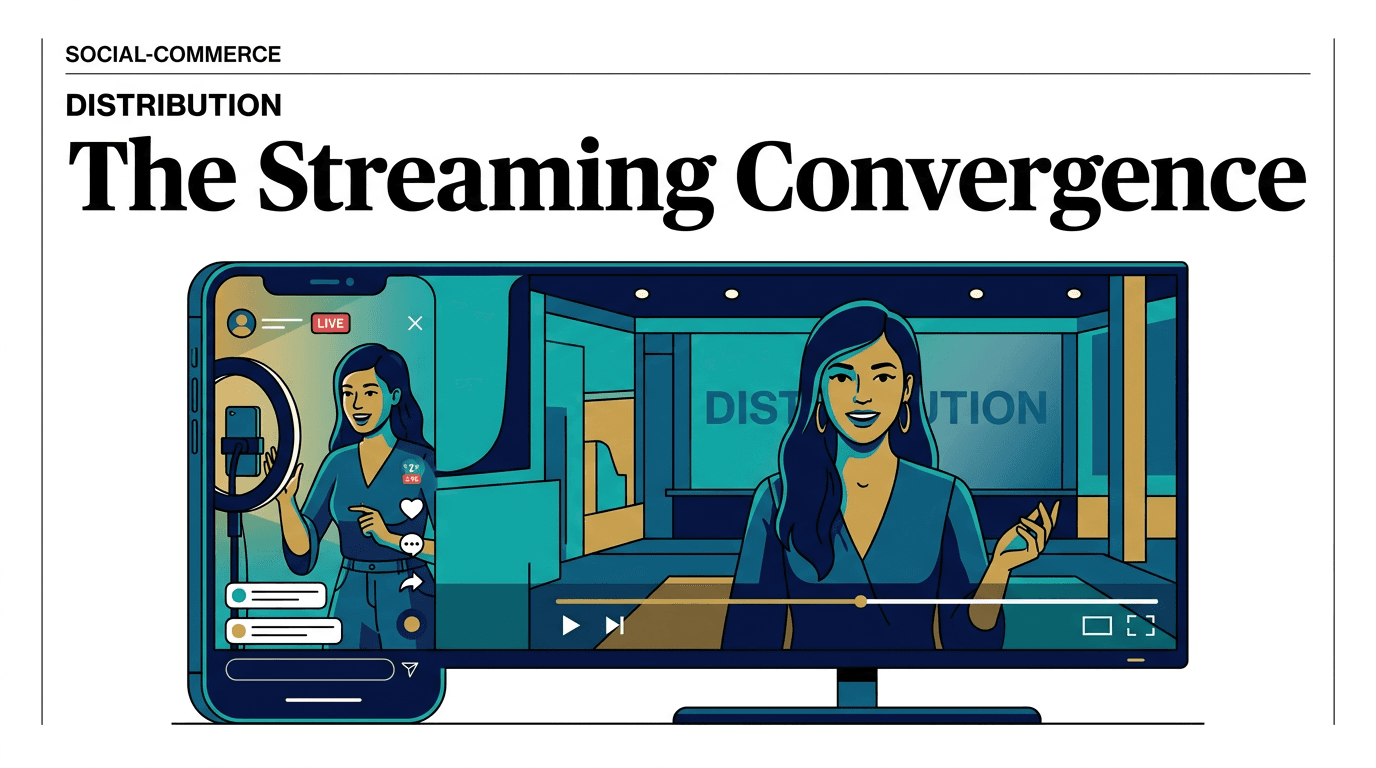
In March 2026, TikTok and Fox-owned streaming platform Tubi launched a joint creator program designed to transition top short-form social media stars into long-form streaming television. The initiative establishes a formal pipeline for digital-first talent to produce original content for Tubi's ad-supported video-on-demand (AVOD) platform.
For brand marketers, this alliance bridges the historically siloed worlds of mobile social feeds and connected TV (CTV), creating a unified canvas for hybrid sponsorships while simultaneously complicating influencer licensing rights, talent pricing benchmarks, and cross-platform campaign attribution.
Key Takeaways
- The Distribution Shift: Short-form creators are no longer just traffic drivers; they are becoming primary programming assets for major AVOD platforms seeking low-cost, high-engagement content.
- The Licensing Bottleneck: Standard social media influencer contracts are wholly inadequate for CTV, requiring brands to renegotiate terms around linear distribution, syndication, and SAG-AFTRA union compliance.
- Hybrid Ad Models: The partnership enables advertisers to run integrated campaigns that start as user-generated content (UGC) on mobile devices and scale into premium, co-viewed CTV ad spots on Tubi.
The Mechanics of the TikTok-Tubi Creator Program
The collaboration between TikTok and Tubi represents a calculated attempt to solve distinct structural problems for both platforms. For TikTok, the partnership provides a tangible upward-mobility path for its top-tier creators. This is crucial at a time when platform-native monetization tools, such as the Creator Rewards Program, continue to face criticism over volatile payouts and shifting algorithmic requirements. For Tubi, the deal secures a steady stream of culturally relevant, pre-validated intellectual property (IP) that appeals directly to Gen Z and Millennial audiences—demographics that increasingly favor independent creators over traditional Hollywood productions.
Under the terms of the program, selected TikTok creators receive production budgets, technical resources, and development support from Tubi to adapt their short-form concepts into episodic, long-form series. This is not merely about republishing vertical phone videos on a horizontal television screen. Instead, creators are tasked with developing native streaming formats—such as docuseries, reality competitions, and narrative comedies—that retain the raw, intimate appeal of their social media personas but meet the broadcast-quality standards of connected TV.
This structural bridge changes how audiences discover streaming content. Historically, streaming platforms relied on massive marketing budgets and algorithmic recommendation carousels to drive viewership for new titles. By leveraging creator economy monetization trends, Tubi can bypass traditional discovery hurdles. Creators actively promote their Tubi series directly within their organic TikTok feeds, using vertical clips, behind-the-scenes footage, and interactive Q&A sessions to funnel their existing mobile audiences directly to the Tubi app.
This cross-platform funnel is highly efficient. According to data from Tubi's internal audience insights, early pilot programs testing this cross-screen migration showed double-digit increases in app-install rates among users exposed to creator-led promotional clips on TikTok. The strategy turns the traditional marketing funnel on its head: instead of buying ads to build an audience for a show, the show's stars bring a pre-built, highly engaged audience with them on day one.
The Licensing Trap: Why Standard Social Contracts Fail on CTV
As creators transition from mobile feeds to CTV screens, the legal frameworks governing their content must undergo a radical transformation. For years, brand marketers and agency procurement teams have operated under standard Master Service Agreements (MSAs) designed for social media. These contracts typically grant brands the right to run sponsored posts on specific platforms for a limited duration—usually 30 to 90 days—with options to extend usage rights for an additional fee.
When applied to the TikTok-Tubi ecosystem, these standard agreements fall apart. Connected TV distribution introduces a complex web of intellectual property challenges, particularly regarding influencer licensing rights.
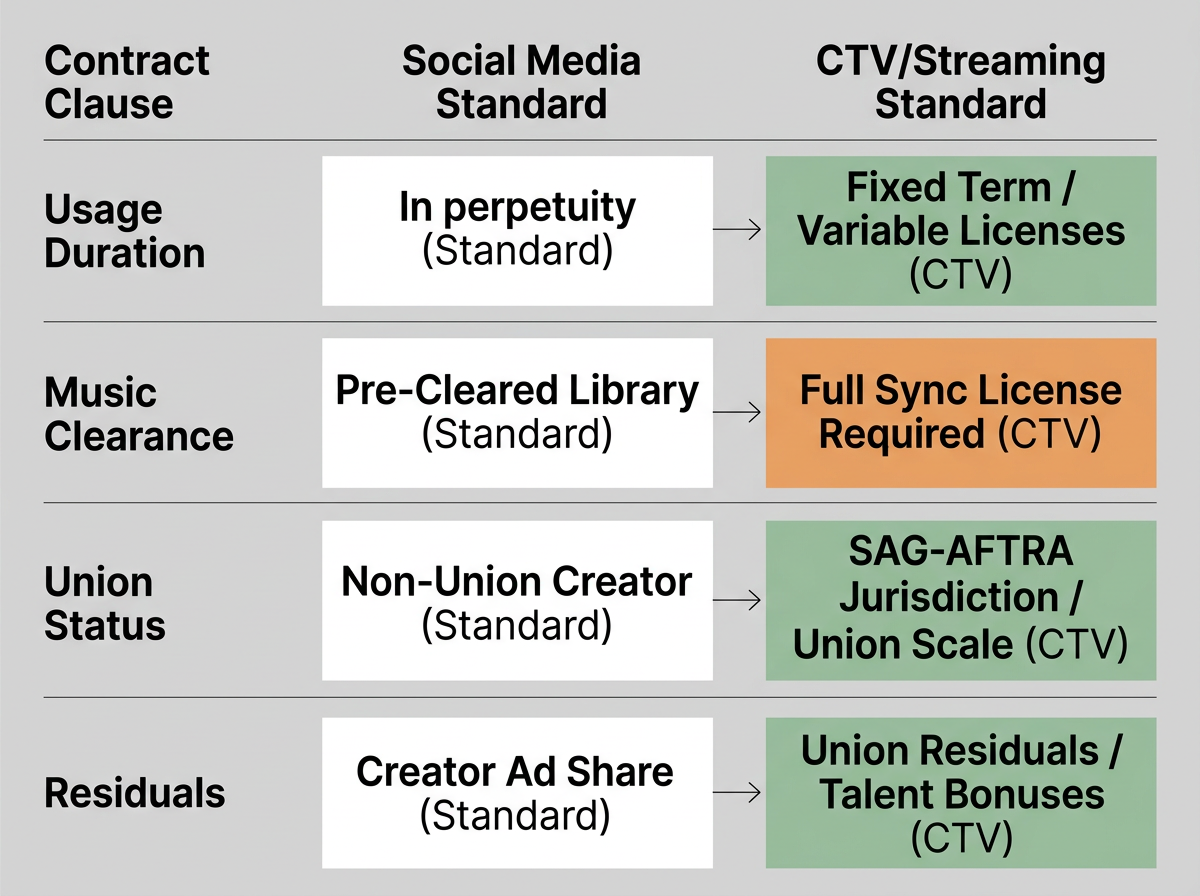
First, there is the issue of music clearance. A creator can easily use a trending audio track or a commercially licensed song from TikTok's commercial music library for a mobile video. However, those rights rarely transfer to programmatic CTV or linear syndication. If a brand sponsors a creator's video on TikTok and that video is later integrated into or adapted for a Tubi episode, the brand and the creator face severe liability if the music has not been cleared for worldwide, multi-platform, perpetual broadcast distribution.
Second, the physical environment of CTV introduces different regulatory and compliance standards. While social media advertising is governed primarily by FTC disclosure guidelines, CTV content must also navigate FCC-adjacent standards, platform-specific content moderation policies, and strict co-viewing regulations. This is particularly true if the content is broadcast in household environments where children are present.
Furthermore, the transition to streaming TV brings creators closer to union jurisdiction. Under SAG-AFTRA rules, once a creator's work is distributed on a major streaming platform like Tubi, the production may trigger union unionization requirements. This includes minimum scale payments, mandatory rest periods, and residual payments for future views. Brands that are accustomed to paying a flat, one-time fee to an influencer for a package of social posts will find themselves unprepared for the ongoing financial and administrative obligations of union-compliant CTV productions.
To mitigate these risks, agency legal teams must draft highly specific, multi-tiered contracts. These agreements must clearly delineate between "social-native" rights and "streaming-distribution" rights. Brands must secure explicit broad-form licensing rights that account for long-form adaptation, while creators must negotiate backend equity or revenue-share models to compensate for the extended lifespans of CTV content.
Hybrid Media Buying: Bridging Mobile Feeds and Connected TV
For media buyers, the Tubi-TikTok alliance unlocks a powerful new inventory class that combines the precise targeting of digital social media with the high-impact, premium environment of the living room screen. This integration is a direct response to the growing demand for cohesive, cross-screen ad campaigns. During TikTok's NewFronts presentation, the platform emphasized its commitment to developing ad formats that connect mobile engagement with larger screens [S5]. The Tubi partnership is the operational engine behind that promise.
Traditionally, a brand would buy TikTok ads to drive mid-funnel engagement and CTV ads to build top-of-funnel brand awareness. These two buys were executed by different teams, managed through different demand-side platforms (DSPs), and measured using different attribution models. The joint creator program allows brands to execute unified, full-funnel campaigns through a single, coordinated buy.
Consider a typical hybrid campaign structure:
- The Mobile Hook: A brand partners with a creator to produce a series of organic-style TikTok videos showcasing a product in a highly native, entertaining format. These videos are amplified using TikTok's Spark Ads, targeting specific demographic niches and behavioral segments.
- The CTV Payoff: Simultaneously, the brand sponsors the creator's longer-form episodic series on Tubi. During the ad breaks of that series, Tubi serves premium, non-skippable CTV spots featuring the same creator and product. This creates a powerful reinforcement effect, linking the casual, high-frequency mobile touchpoint with the high-attention, premium TV experience.
- The Shoppable Close: To close the loop, the campaign can leverage advanced shoppable ad formats. For instance, the Tubi CTV ad can display a dynamic QR code that, when scanned, takes the viewer directly to a mobile checkout page integrated with Google's massive Shopping Graph, which now tracks over 60 billion products [S1].
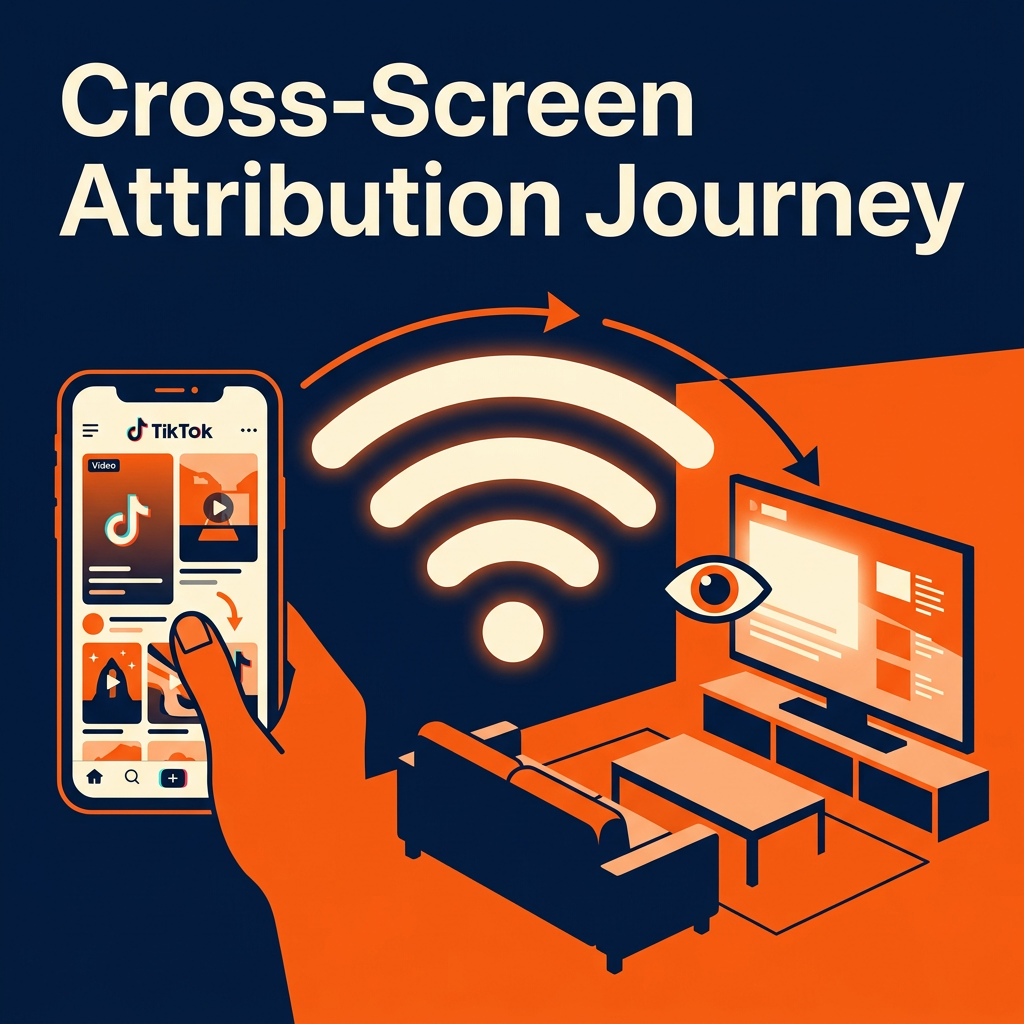
This hybrid approach also solves one of the biggest challenges in CTV advertising: frequency capping and audience saturation. By utilizing Automatic Content Recognition (ACR) data from smart TVs, brands can coordinate their media delivery. If a consumer has already seen a creator's sponsored video three times on their mobile TikTok feed, the system can automatically suppress that ad on Tubi, serving a different creative variation instead. Conversely, if a viewer watches a full episode of a creator's show on Tubi, the brand can retarget that specific device with a direct-response call-to-action on TikTok the next day.
This level of cross-screen coordination requires a shift in how agencies structure their media planning departments. Social teams and programmatic TV teams can no longer operate in isolation. They must collaborate on unified creative briefs, shared attribution windows, and blended CPM benchmarks.
Valuation Dilemmas: How to Price Multi-Screen Creator Talent
As the boundaries between social media and traditional streaming continue to blur, the industry faces a significant valuation crisis. There are currently no standardized pricing benchmarks for creators who straddle both worlds. Talent managers, brand strategists, and procurement officers are essentially negotiating in the dark, trying to reconcile two vastly different pricing philosophies.
In the social media space, creator pricing is heavily influenced by vanity metrics: follower counts, video views, and engagement rates. While agencies utilize tools like Sprout Social or Sprinklr to calculate estimated Earned Media Value (EMV), the final talent fee is often a subjective negotiation based on the creator's perceived cultural relevance. In contrast, CTV media buying is rooted in rigorous, legacy television metrics: Cost Per Thousand (CPM), Gross Rating Points (GRPs), and verified co-viewing multipliers.
When a creator signs a deal to produce content that spans both TikTok and Tubi, how should they be compensated?
If a brand pays a flat $50,000 fee for a TikTok campaign, that fee is based on the expectation of rapid, high-volume, but ultimately ephemeral distribution. A TV show on Tubi, however, has a much longer shelf life. It may remain in the platform's active library for years, generating consistent views and ad impressions over time. A flat-fee model undercompensates the creator for this long-term value, while a traditional television royalty model is too complex and slow for the fast-moving creator economy.
To bridge this gap, agencies are beginning to experiment with hybrid compensation models that combine upfront creative fees with performance-based backend incentives.
Hybrid Creator Compensation Model:
Total Compensation = Upfront Production Fee + (Guaranteed Social Deliverables x Flat Rate) + (CTV Ad-Revenue Share % OR CPM-Based Bonus Tier)
Under this framework, the creator receives a guaranteed base fee to cover production costs and immediate social media deliverables. Crucially, the contract also includes performance tiers tied to the success of the Tubi content. For example, if the creator's show reaches a specific viewership threshold or generates a certain volume of ad impressions on Tubi within the first 90 days, the creator receives a secondary payout.
This model aligns the incentives of the brand, the platform, and the creator. It protects the brand from overpaying for unproven streaming concepts while ensuring that creators are fairly compensated if their content becomes a breakout hit on CTV.
As influencer spending continues to mature—with even municipal organizations and local councils allocating substantial budgets to digital creators [S4]—the demand for standardized, performance-driven pricing models will only grow. The brands and agencies that master these hybrid valuation frameworks today will be uniquely positioned to capture the highest-quality creator inventory tomorrow.
Navigating the Multi-Screen Era
The TikTok-Tubi alliance is not an isolated experiment; it is a precursor to a broader convergence of social media and television. As platform algorithms increasingly reward longer-form, high-retention video content, more social platforms will seek distribution partnerships with streaming networks and CTV device manufacturers.
For brand marketers, the path forward requires a fundamental shift in mindset. You must stop viewing creators as mere distribution channels for mobile ads and start treating them as production partners for premium, multi-screen entertainment. This transition demands a deeper understanding of CTV programmatic ad buying, a more sophisticated approach to influencer contract templates, and a willingness to break down the internal silos that separate social media teams from traditional TV buyers.
The future of video advertising belongs to those who can seamlessly guide a consumer from a five-second mobile hook to a thirty-minute living room experience. The tools, the platforms, and the talent are now in place. The only remaining question is how quickly your brand can adapt to the new rules of engagement.
FAQ