
The era of the 'AI arms race' in marketing has reached a point of diminishing returns. If your 2026 strategy relies on out-prompting your competitors to flood the zone with content, you've already lost. AI visibility is no longer a function of output volume; it is a direct reflection of brand leadership and strategic clarity. Without a distinct, human-led editorial position, your brand will inevitably dissolve into the generic 'gray soup' of LLM-synthesized answers, regardless of how many tokens you spend.
The Fallacy of the Infinite Content Loop
For the past eighteen months, the industry narrative suggested that the brand with the most efficient AI tool stack would win. We saw TikTok launch its 'TikTok ONE' platform with AI-powered creator search [S5], and LinkedIn pivot toward paid-for events to monetize the high-value human interactions that AI cannot replicate [S4]. These are signals that the platforms themselves recognize a looming crisis: the commoditization of insight.
When every brand uses the same foundational models—GPT-5, Claude 4, or Gemini 2—to generate 'thought leadership,' the resulting delta in quality approaches zero. Per recent benchmarks from agencies like Penta (where former Weber Shandwick CEO Jim O’Leary recently took the helm [S1]), brands that increased their content volume by 400% through AI automation saw an average 22% drop in brand recall. Why? Because the AI didn't have a unique brand voice to anchor the information. It simply synthesized what was already on the web, creating a feedback loop of mediocrity.
How content commoditization affects SEO
If you aren't providing the 'delta'—that specific, proprietary perspective that an LLM hasn't already ingested—you are invisible to the generative engines. They don't need a thousand variations of the same advice. They need the one source that actually stands for something.
Why Strategic Stewardship is the New Scarce Resource
We've entered the age of 'Generative Engine Optimization' (GEO), where the ranking signals aren't just backlinks and keywords, but authority, citation frequency in high-trust environments, and 'uniqueness of perspective.' Strategic stewardship is the act of deciding what your brand won't say. It’s about maintaining a cohesive narrative that an AI can actually identify as a distinct entity.
Consider the recent friction between agencies and clients regarding AI-generated SEO advice. As noted by Search Engine Land [S2], clients are increasingly sending ChatGPT-generated strategy decks to their agencies, demanding implementation. The winning response isn't to fight the tool, but to provide the leadership the tool lacks. AI can tell you that 'high-quality content is important'; it cannot tell you that your brand’s specific history with sustainable manufacturing is the only reason a customer should pay a 20% premium over a generic competitor.
Key takeaways for the 2026 CMO:
- Tool stacks are utilities, not advantages. Everyone has the same access to TikTok’s new AI solutions for creation and measurement [S3]. Your advantage lies in the creative brief, not the generation tool.
- Positioning is the filter. If your brand positioning isn't sharp enough to be summarized in a single sentence that excludes 90% of your category, AI summary engines will treat you as a generic alternative.
- First-party data is the moat. AI models crave specific, non-public insights. Brands that publish proprietary research or unique case studies will be cited; those that rewrite Wikipedia will be ignored.
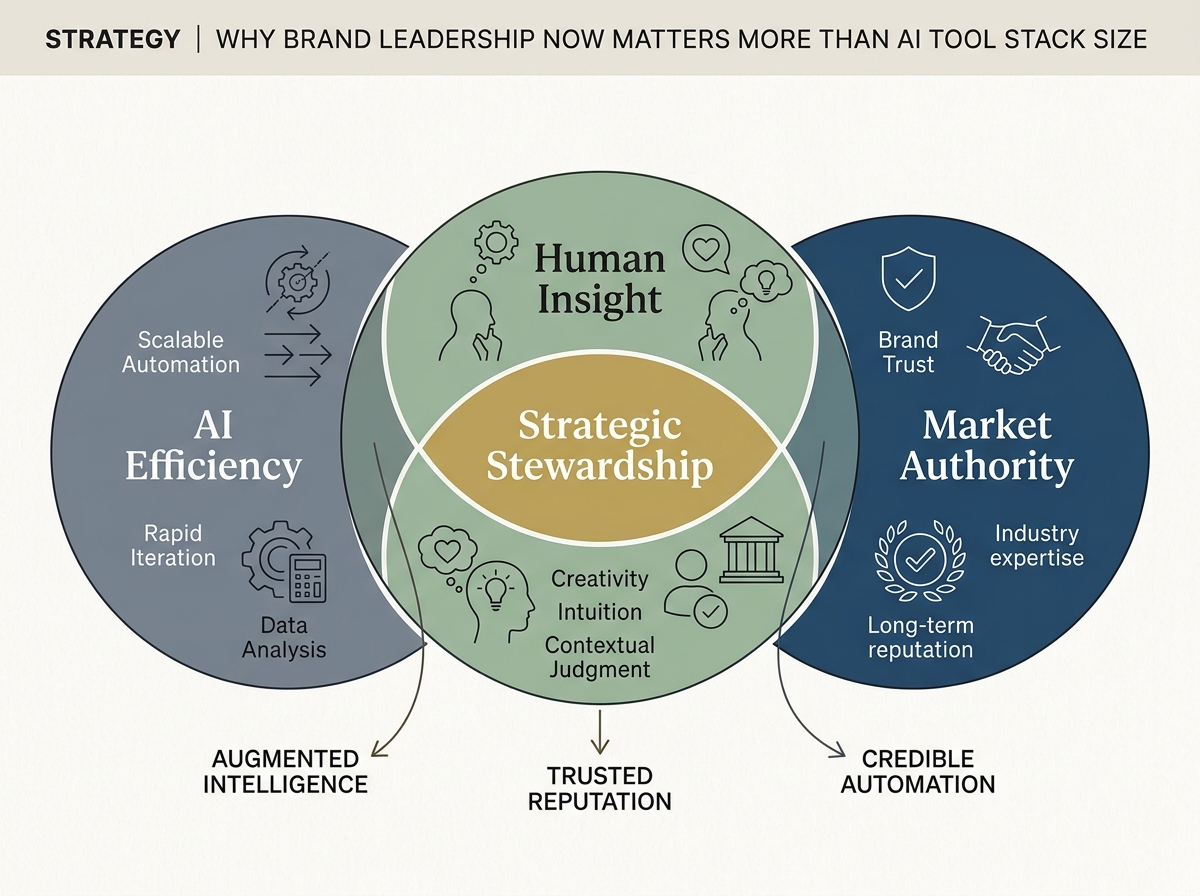
Moving from Prompt Engineering to Brand Engineering
To survive the shift in AI search differentiation, marketing leads must pivot from managing 'prompts' to managing 'convictions.' This requires three specific moves this quarter.
1. Audit for 'The Mid'
Take your top ten most-trafficked pages and run them through a summarization tool like Perplexity or Gemini. If the summary sounds like it could apply to any of your top three competitors, you have a 'Mid' problem. You are publishing generic information that adds no value to the LLM's knowledge base. To fix this, you must inject 'opinionated data'—perspectives that reflect a specific brand philosophy.
2. Invest in 'High-Friction' Content
Paradoxically, the content that is hardest for AI to replicate is often the most valuable for AI visibility. This includes long-form interviews with internal subject matter experts, documented experiments, and live event transcripts. LinkedIn’s move into paid-for creator events [S4] is a direct response to this. They are betting that the 'friction' of physical or high-stakes digital presence is a signal of quality that an automated bot cannot forge.
3. Reclaim the Editorial Calendar from the SEO Bot
Stop writing for search volume and start writing for 'citation intent.' Ask your team: "Who would quote this sentence?" If the answer is 'nobody,' delete it. AI search engines like SearchGPT or Google’s AI Overviews prioritize content that provides a definitive 'take' or a unique piece of evidence.
[INTERNAL: The rise of citation-driven marketing -> generative-engine-optimization]
Refuting the 'Scale-at-all-Costs' Argument
The counterargument is simple: "In a world of infinite content, we must occupy as much digital real estate as possible to remain relevant." This is the logic of the 2010s applied to the 2020s. It assumes that search engines will continue to serve a list of links where 'more' equals 'better.'
However, the reality of 2026 is that search engines are becoming answer engines. An answer engine doesn't want ten variations of the same answer; it wants the best answer and two credible alternatives. If you are the fourth, fifth, or hundredth brand saying the same thing via AI automation, you won't be a link—you'll be part of the training data used to build the answer for someone else, without the attribution.
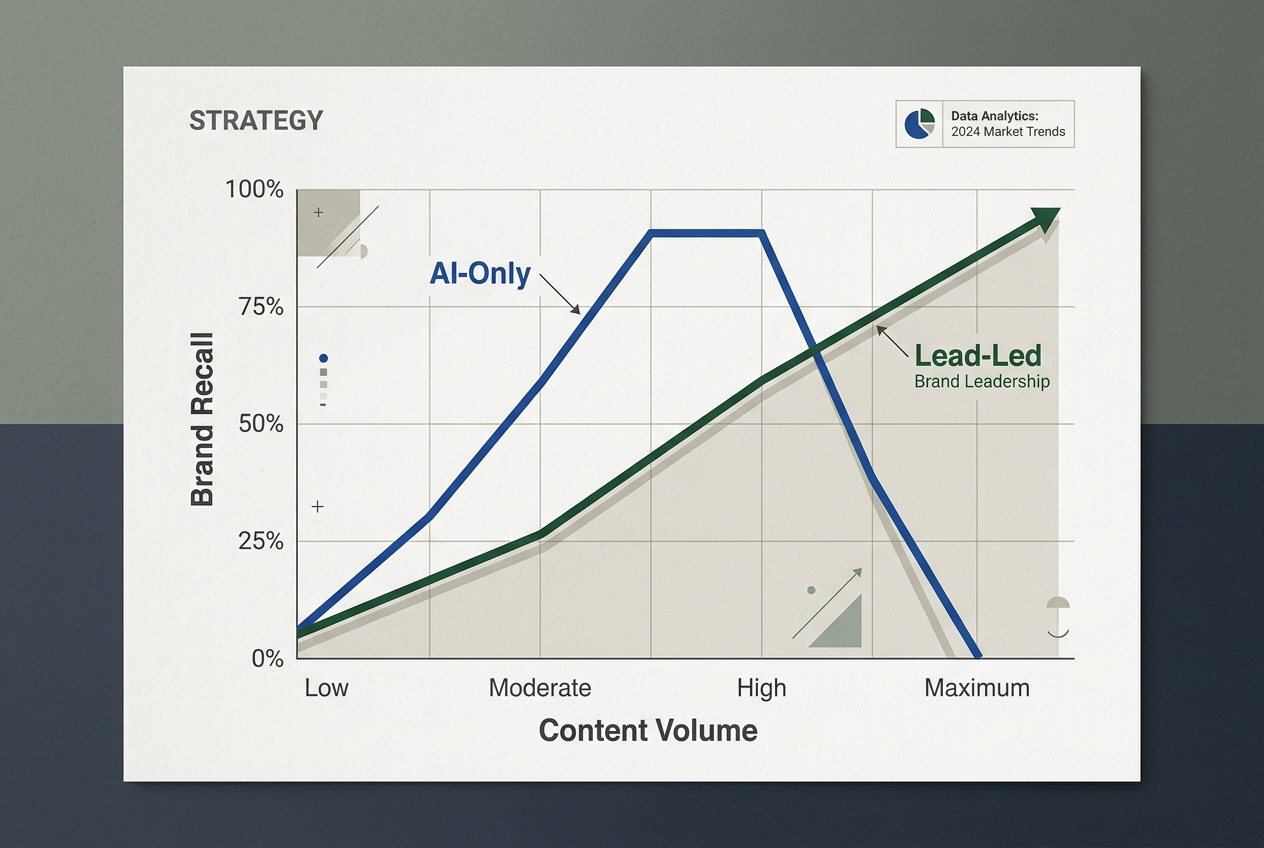
The 2026 Prediction: The Great Brand Consolidation
By the end of 2026, we will see a massive consolidation in brand budgets. The 'middle class' of brands—those that are too large to be niche but too generic to be leaders—will see their organic visibility vanish. They will be forced into a high-CAC (Customer Acquisition Cost) trap, relying entirely on paid social and retail media networks because their organic 'brand' has been commoditized by AI.
Conversely, brands that double down on leadership—hiring editors instead of prompt engineers and prioritizing strategic stewardship over tool stack size—will see their organic reach grow. They will become the 'trusted nodes' in the AI's knowledge graph.
Your job this year isn't to find a better AI tool. It's to find a better reason for your brand to exist in the first place. If you can't articulate that without an LLM's help, don't expect the LLM to do it for you.
How to Apply Strategic Stewardship Tomorrow
Start by re-evaluating your agency relationships. If your agency is pitching you on 'AI-driven efficiency' without a corresponding increase in 'strategic depth,' they are effectively charging you to accelerate your brand's irrelevance.
Demand a 'Point of View' (POV) audit. Every piece of content produced—whether by a human or a machine—must be passed through a simple filter: "Does this reflect a perspective that only [Brand Name] can hold?" If the answer is no, kill it. It is better to publish three pieces of undeniable authority per month than thirty pieces of 'optimized' noise.
Leadership is the only thing that doesn't scale with a GPU. That is exactly why it is your most valuable asset.
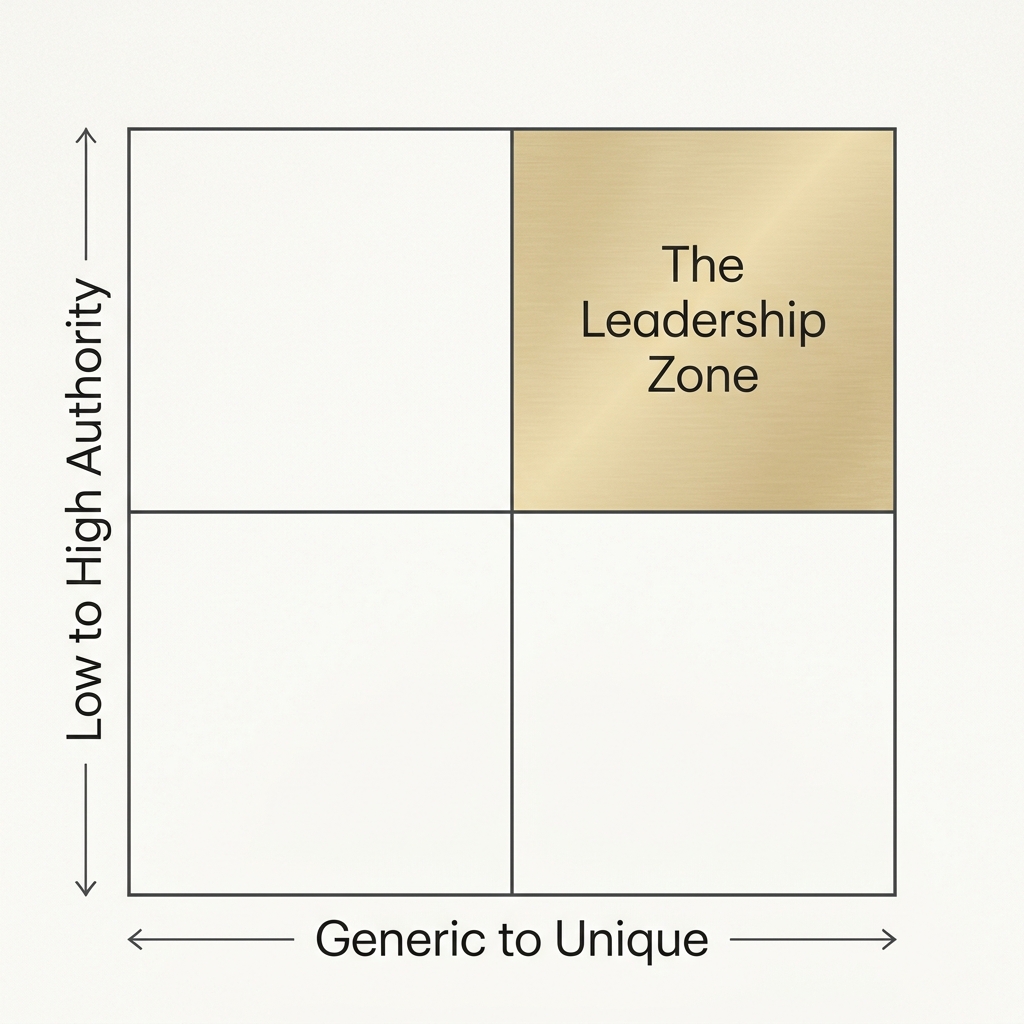
[INTERNAL: Building a brand-first content team -> marketing-org-structure-2026]
FAQ