
If you opt out of Google’s AI Overviews to protect your content, you are effectively choosing to disappear from the most valuable real estate in modern search. For social marketers, this isn't just an SEO debate; it is a visibility crisis. The recent integration of Top Stories directly into AI-generated summaries means that being 'too protective' of your IP will result in a total blackout during the viral news cycles where your brand needs to be most present.
The Illusion of Control in the Agentic Era
The impulse to flip the switch on Google’s AI crawlers is understandable. We’ve watched for years as platforms scraped publisher data to build products that eventually compete with those same publishers. But we are no longer in the era of simple blue links. As TikTok moves toward an agentic AI strategy for its ad tech (per eMarketer’s July 2026 report) and Google embeds its Gemini-powered summaries at the top of the SERP, the definition of 'referral traffic' is changing.
When you use the Google-Extended crawler controls or specific robots.txt directives to block AI training and display, you aren't just stopping a bot from learning your tone of voice. You are opting out of the new 'discovery layer.' According to data from Search Engine Journal in August 2026, Google has clarified that while publishers can limit how their content is used to train models, the specific intersection of AI Overviews and the Top Stories carousel creates a binary choice: you are either in the AI box, or you are below the fold. For a social media manager trying to capitalize on a trending moment, being below the fold is equivalent to being invisible.
We have to stop viewing AI Overviews as a separate entity from search. They are the interface. If your brand’s latest campaign or reactive social post gets picked up by a major news outlet, but your own site is opted out of AI features, Google will simply summarize your competitor’s take on your news. You lose the click, the attribution, and the authority.
Why Social-Heavy News Cycles Are the Biggest Risk
Social marketers live and die by the 'Top Stories' block. Whether it's a product launch on TikTok Shop or a viral response to a cultural moment, Google’s ability to pull real-time news into the SERP is the primary bridge between social buzz and web traffic.
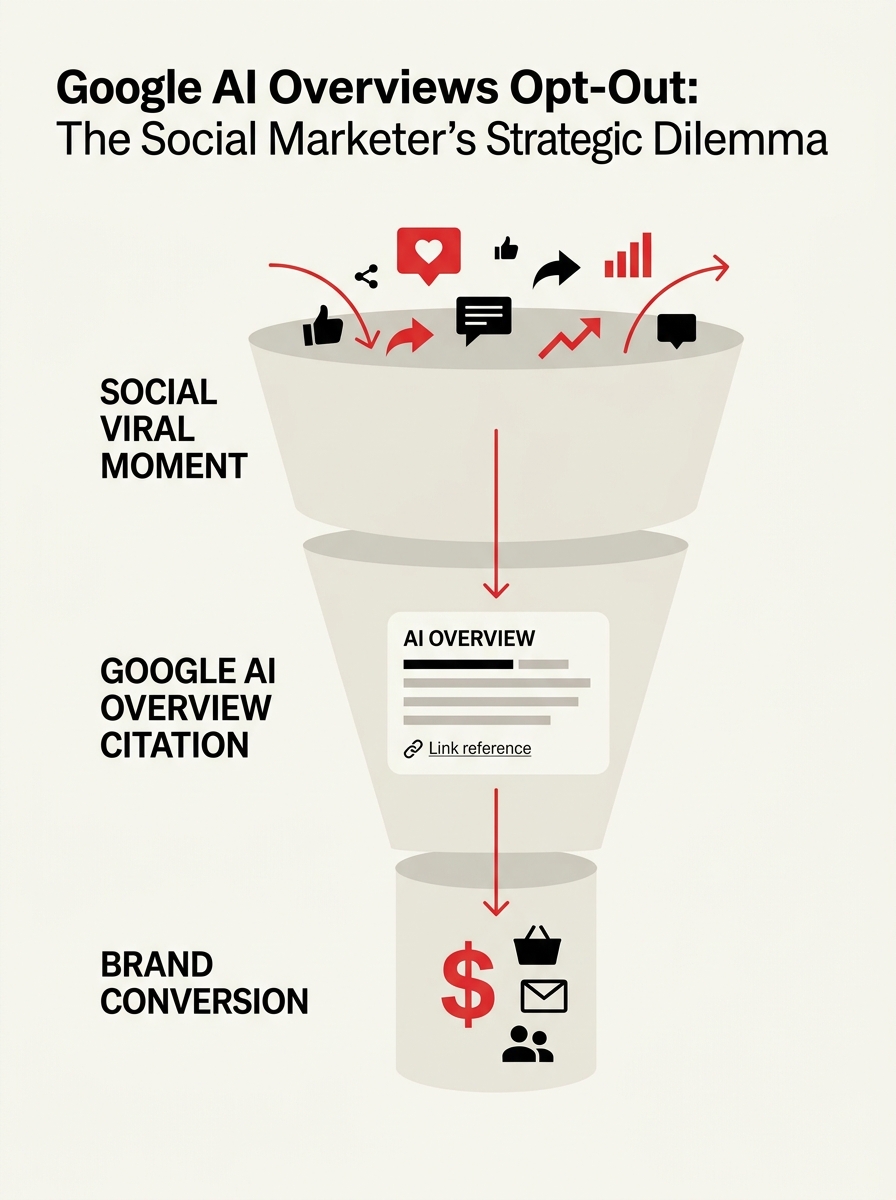
Since the August 2026 update, Top Stories are no longer just a list of links below the AI summary; they are frequently cited within the summary as supporting evidence. If you’ve opted out, your content cannot be used as a citation. This creates a vacuum. Consider the Filipino founders currently scaling on TikTok Shop and Shopee, as reported by Rappler. For these businesses, search visibility is the 'trust signal' that converts a social scroller into a customer. If a user searches for 'best TikTok Shop skincare Philippines' and an AI Overview summarizes the top three brands but excludes one because of an opt-out, that excluded brand loses more than a click—it loses market perceived-relevance.
How TikTok Shop is reshaping search intent
You cannot manage a brand's reputation if you are not part of the primary summary the user reads. The strategic dilemma is this: do you protect your data from being 'stolen' by an LLM, or do you allow the LLM to use your data so you can remain the definitive source for your own brand name?
Measurement and the Search Console Gap
The biggest hurdle for social strategists is the current state of Search Console social reporting. We are operating in a measurement dark age. While Google has introduced new filters for AI Overview impressions, they don't yet cleanly map to the 'social-to-search' journey.
When a campaign goes viral on Instagram, we see a spike in branded search. Traditionally, we’d track that through organic search clicks. Now, those clicks are being intercepted by AI Overviews. If the user reads the summary and feels their itch is scratched, they might not click through to your site at all. This 'zero-click' reality is terrifying for agencies that bill based on traffic metrics.
However, the counter-intuitive move is to lean into the AI. By optimizing for the AI Overview—using clear, declarative headers and structured data—you increase the likelihood of being the 'featured' citation. True North Social recently highlighted how brands are leveraging TikTok to reach new audiences, but the tail-end of that strategy must be a search presence that confirms the social claim. If the AI Overview backs up what the influencer said on TikTok, the conversion path is solidified. If the AI Overview is silent or points elsewhere, the social spend is wasted.
The Case for the 'Hard' Opt-Out: A Refutation
The strongest argument for opting out is the preservation of brand voice and the prevention of 'hallucinated' misinformation. If Google’s AI misinterprets your social campaign’s irony or tone, it could generate a summary that is factually incorrect or brand-damaging. Some strategists argue that it is better to have no summary than a wrong one.
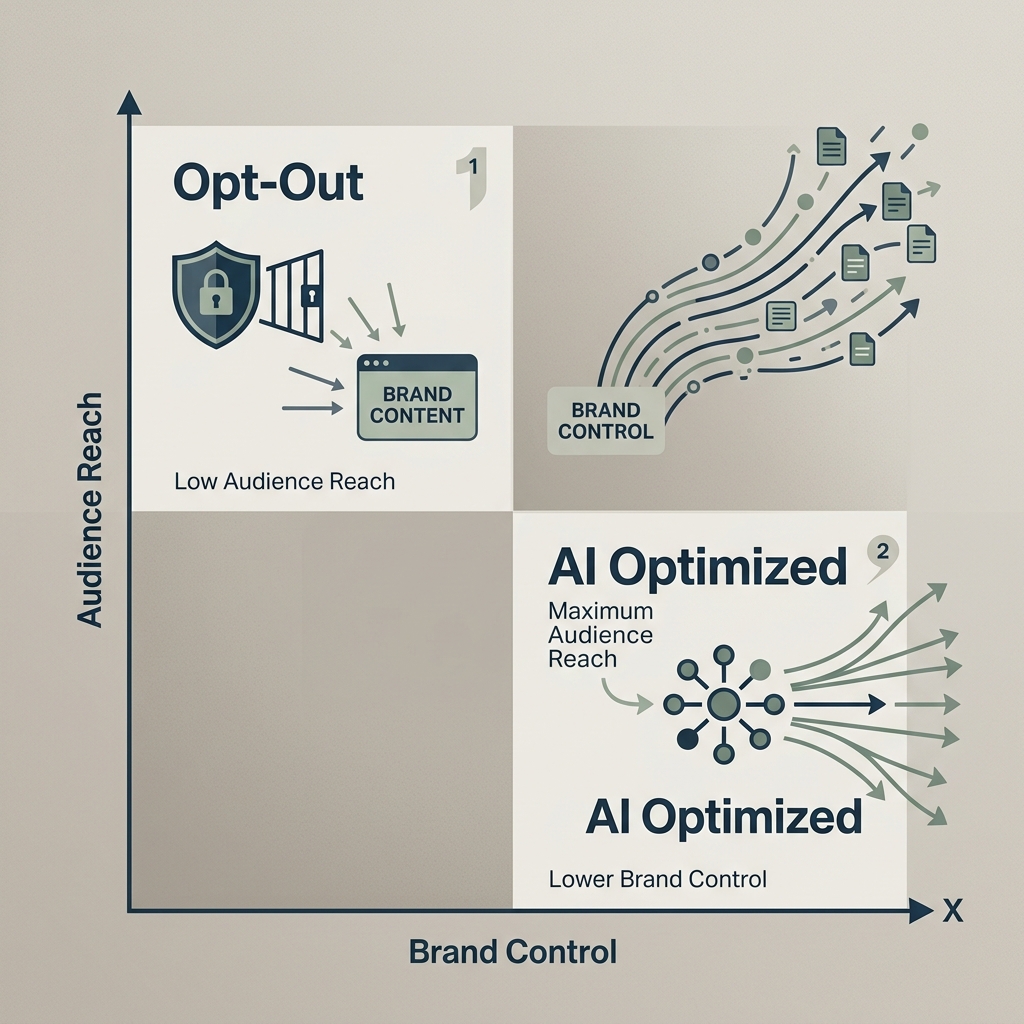
This is a defensive posture that ignores how the internet actually works. If you opt out, Google doesn't leave a blank space. It fills that space with other people's content. You aren't preventing a summary; you are just ensuring you aren't the one writing it. In a world where 'agentic AI' is becoming the standard for ad tech and user discovery, silence is not a strategy. It is an abdication.
You have to treat the AI Overview as a new type of social platform—one where the algorithm is the audience. You wouldn't opt out of the TikTok FYP because you're afraid the algorithm might show your video to the wrong person. You optimize the video so the algorithm shows it to the right person. Search is now no different.
Understanding agentic AI in social ad tech
How to Apply This Tomorrow
Stop treating robots.txt as a legal document and start treating it as a marketing lever. You need to audit your Search Console today to see where AI Overviews are already triggering for your top-performing social keywords.
- Identify the 'Social-Search' Bridge: Look for keywords that spike when you run influencer campaigns. Are these keywords triggering AI Overviews?
- Audit Citations: If an AI Overview appears, is your site cited? If not, who is? Usually, it's a third-party review site or a news outlet.
- Structured Data Overhaul: Ensure your site uses Schema.org markup that specifically identifies your social handles and official brand statements. This helps the AI connect your social presence to your search presence.
- Monitor the 'Top Stories' Integration: Since these now live inside the AI box, your PR team and social team must work in lockstep. A press release that isn't optimized for AI scraping is a missed opportunity for a primary citation.
The 2027 Prediction
By the end of 2027, the concept of 'opting out' of AI search will be viewed with the same derision we now reserve for brands that refused to join Facebook in 2009. We will see a massive 're-opting-in' event as publishers realize that the 'protection' of their IP led to a 40% decline in branded search equity.
Social marketers who master the 'AI Citation' game—ensuring their brand is the primary source for every summary—will replace the traditional SEOs who are still fighting a war for blue links that no longer matter. Visibility is the only currency that counts. Don't go bankrupt trying to save your data.
FAQ