
The traditional apprenticeship model of social media marketing is dead, killed by the very efficiency we spent a decade chasing. For fifteen years, the path to becoming a Chief Brand Officer or a Strategy Director began in the trenches: writing 50 variations of a Facebook caption, manually scheduling posts in Sprout Social, and pulling raw engagement data into messy Excel sheets. These repetitive, often mind-numbing tasks were the 'wax on, wax off' of our industry. They taught junior talent the nuances of brand voice, the rhythm of community sentiment, and the cold reality of platform volatility. But today, agentic AI—autonomous systems that don't just suggest text but execute entire workflows—has made those entry-level tasks obsolete. If we don't intentionally redesign the social media career path now, we are headed for a catastrophic leadership vacuum. We are effectively burning the ladder while expecting people to still reach the roof.
The collapse of the 'grunt work' training ground
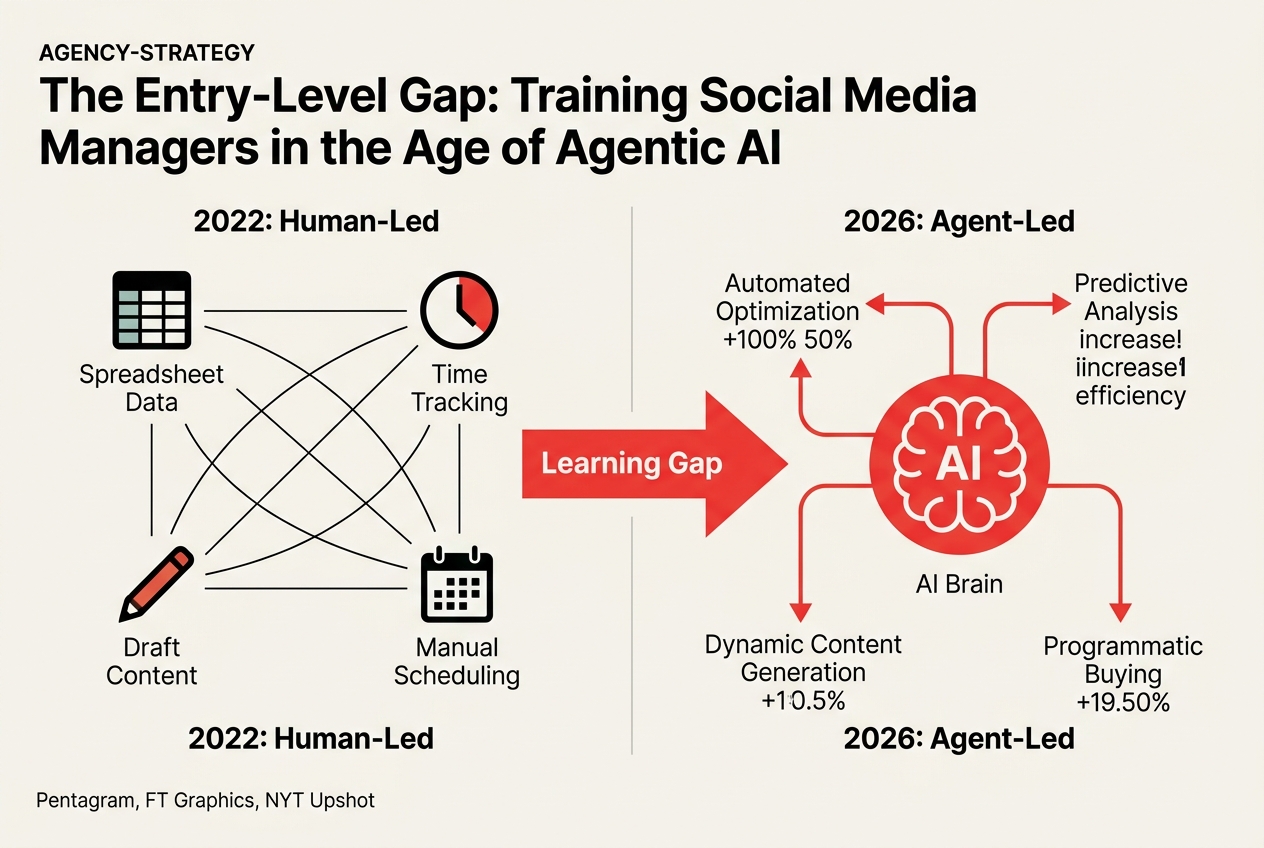
In a typical 2022 agency workflow, a Junior Social Media Manager spent roughly 70% of their week on execution. This included community management, basic reporting, and asset resizing. These tasks provided a safety net for failure. If a junior staffer wrote a mediocre caption, a senior lead caught it in the approval flow. Through that friction, the junior learned.
Fast forward to mid-2026, and the landscape has shifted. Tools like Jasper’s autonomous campaign workflows and the latest iterations of OpenAI’s agents can now ingest a brand book, analyze the last six months of top-performing content, and generate a month’s worth of scheduled posts across six platforms in minutes. They don't just draft; they optimize for the specific quirks of the current algorithm.
Why does this matter? Because the 'junior' role is being squeezed out of the P&L. Agency heads, pressured by clients to lower fees as 'AI makes things easier,' are cutting headcount at the bottom of the pyramid. According to internal benchmarks from several mid-sized digital agencies, the ratio of junior-to-senior staff has shifted from 4:1 to nearly 1:1 in the last 24 months. We are losing the volume of human attempts required to build intuition. You cannot teach a strategist how to handle a PR crisis on social if they’ve never spent a year responding to 'where is my order' comments in the DMs.
The volatility of AI-driven visibility
One of the most dangerous myths currently circulating in C-suites is that AI has 'solved' social media distribution. If the machine can write and post, surely it can win? However, recent research published in July 2026 by Search Engine Journal AI Visibility Rankings Aren’t Stable highlights a critical flaw: AI visibility is statistical noise. The study found that AI-generated content rankings and visibility scores fluctuate wildly between runs.
This instability means that the 'set it and forget it' mentality of agentic AI is a trap. Without a human who understands the why behind a sudden drop in reach, a brand is just a passenger on a glitchy algorithm. Junior marketers used to be the 'canaries in the coal mine.' They noticed when the vibe shifted because they lived in the feeds. If we replace them with agents, we lose our early warning system.
Take the recent SaaS social media campaigns highlighted by Influencer Marketing Hub this month. The successful ones—like the recent 'Human-First' push from Slack—weren't successful because of volume. They were successful because they leaned into hyper-specific, culturally relevant nuances that an AI, by definition, can only approximate based on historical data. If your entire team consists of senior 'prompters' and no one who has built a community from scratch, your brand voice will eventually regress to the mean.
The counterargument: Efficiency creates 'Super-Juniors'
There is a vocal segment of the industry—largely led by AI-native startups and venture-backed agencies—arguing that we aren't losing training grounds; we are simply upgrading them. The argument suggests that by removing the 'drudgery' of scheduling and basic reporting, we allow entry-level talent to focus on 'high-level strategy' from day one.
It’s a seductive idea. Why have a 22-year-old spend four hours on a spreadsheet when they could spend four hours analyzing sentiment trends? The flaw in this logic is that strategy isn't an academic subject you can learn in isolation. It is the byproduct of thousands of small, tactical observations.
Asking a junior to 'do strategy' without having done the execution is like asking someone to design a car without ever having driven one. They might know what a car looks like, but they don't understand how it feels when the tires lose grip in the rain. In social media, the 'rain' is a sudden algorithm shift or a viral backlash. If the junior has only ever looked at AI-summarized reports (which, as we’ve seen, can be noisy and inconsistent), they lack the visceral understanding of audience behavior needed to make strategic calls.
Redesigning the career path: The 'Editor-in-Chief' model
If the old ladder is gone, we must build a new one. Forward-thinking agencies are moving away from the 'Social Media Manager' title for entry-level staff and moving toward 'AI Content Editors' or 'Platform Analysts.'
In this model, the junior isn't responsible for writing the caption; they are responsible for auditing the 20 captions the AI produced. They are trained to look for 'hallucinations' in brand voice—those subtle moments where the AI sounds a bit too much like a marketing textbook and not enough like a human.
Key takeaways for agency leaders:
- Mandate 'Manual Days': Force junior staff to spend one day a week executing without AI tools. They need to feel the friction of the platforms to understand them.
- Focus on 'The Why': Shift reporting from 'what happened' (which AI does well) to 'why it happened' (which AI still struggles with).
- Shadowing as a KPI: Since juniors aren't doing the grunt work, they must be present in high-level client meetings. Exposure is the new apprenticeship.
- Prompt Auditing: Teach juniors not just how to prompt, but how to deconstruct why a prompt failed. This builds the same linguistic and brand-voice muscles that writing from scratch used to.
The risk of the 'Missing Middle'
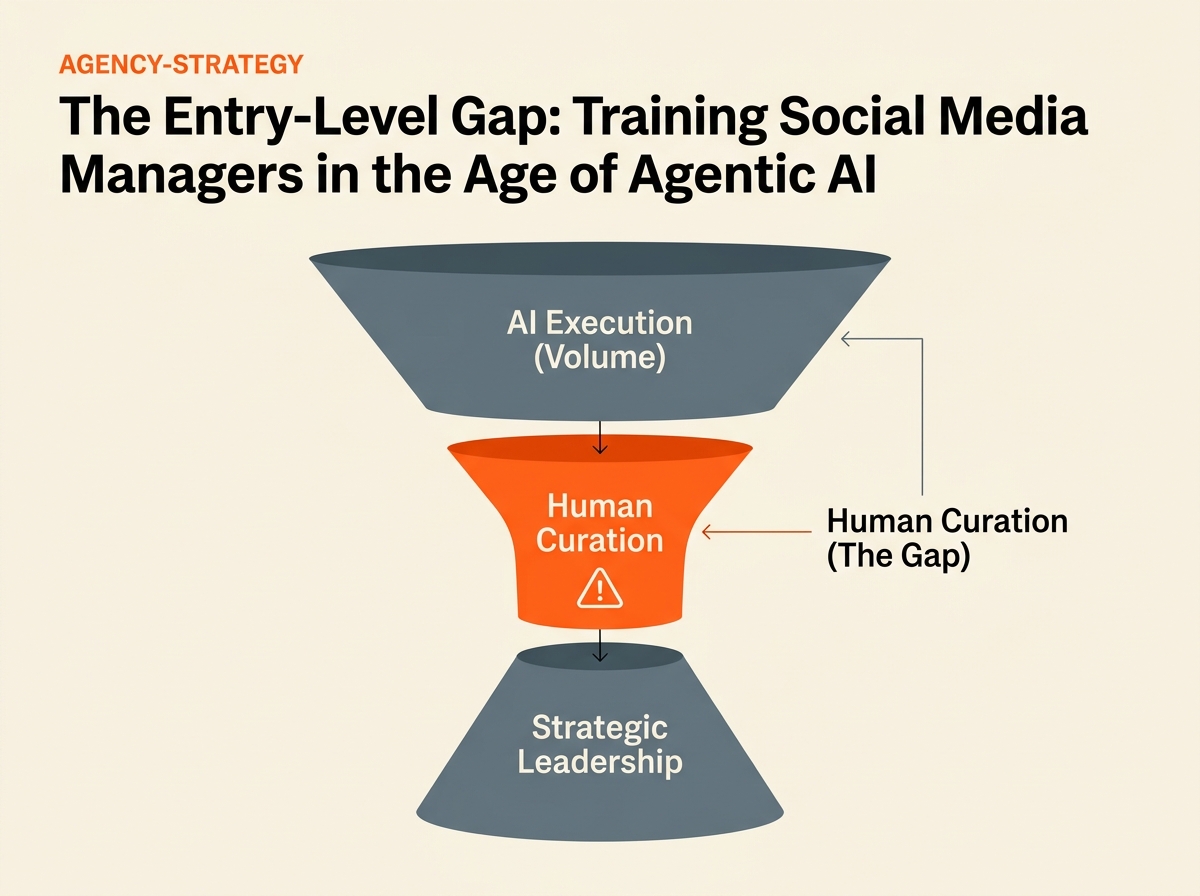
We are currently seeing the emergence of a 'missing middle' in marketing departments. We have the senior leaders (Gen X and Millennials) who learned the hard way, and we have the new AI-augmented juniors. In five years, when those seniors look to retire or move up, who takes their place?
If the current crop of juniors only knows how to manage agents, they won't have the foundational skills to manage people or complex brand ecosystems. We see this reflected in recent Salesforce data regarding SMB advertising tips; the most effective strategies still rely on 'human-centric' storytelling. If our future leaders don't know how to tell a story because they've always outsourced the 'telling' to a machine, the industry’s creative output will flatline.
We must also consider the platform's role. As noted by The Guardian Nigeria recently, algorithms are increasingly 'burying' content that feels templated or overly optimized. This is the 'AI Paradox': the more we use AI to optimize for the algorithm, the more the algorithm (which is also AI) recognizes the pattern and devalues it in favor of 'authentic' human signals. The junior who can find that human spark is worth ten who can merely run a 'perfect' AI workflow.
Applying this to your team tomorrow
You don't need to ban AI to save your training pipeline. You just need to stop treating AI as a replacement for the junior and start treating it as the junior's first 'direct report.'
If you are a Brand Lead or Agency Owner, your job this week is to look at your entry-level job descriptions. If the primary responsibilities are things an agent can do, you aren't hiring a future leader; you're hiring a temporary placeholder. Change the role. Give them the AI tools, but hold them accountable for the delta—the specific value they added that the machine couldn't.
Ask them to find the one comment in a thread of 500 that signals a new trend. Ask them to explain why a specific AI-generated image feels 'off' for the brand's aesthetic. These are the new 'wax on, wax off' exercises. They are harder to grade, and they require more involvement from senior staff, but they are the only way to ensure the next generation of social media leaders actually knows how to lead.

Prediction: The 2028 'Human Premium' Rebound
By 2028, the market will reach 'peak AI' in social content. Feeds will be so saturated with perfectly optimized, agent-produced content that engagement rates will crater across the board. Brands that survived the 'Entry-Level Gap' by over-investing in human intuition today will see their organic reach double compared to AI-reliant competitors. We will see a massive hiring surge for 'Human-Only' creative roles, but the salaries will be astronomical because the talent pool will have shriveled. The agencies that thrive will be those that didn't just 'leverage' AI, but those that used the time AI saved to turn their juniors into masters of the one thing machines can't replicate: genuine, unpredictable human connection.
If you aren't training your juniors to be more than prompt engineers, you are participating in the long-term devaluation of your own agency. The machines are coming for the tasks, not the talent—unless you let them.
FAQ