
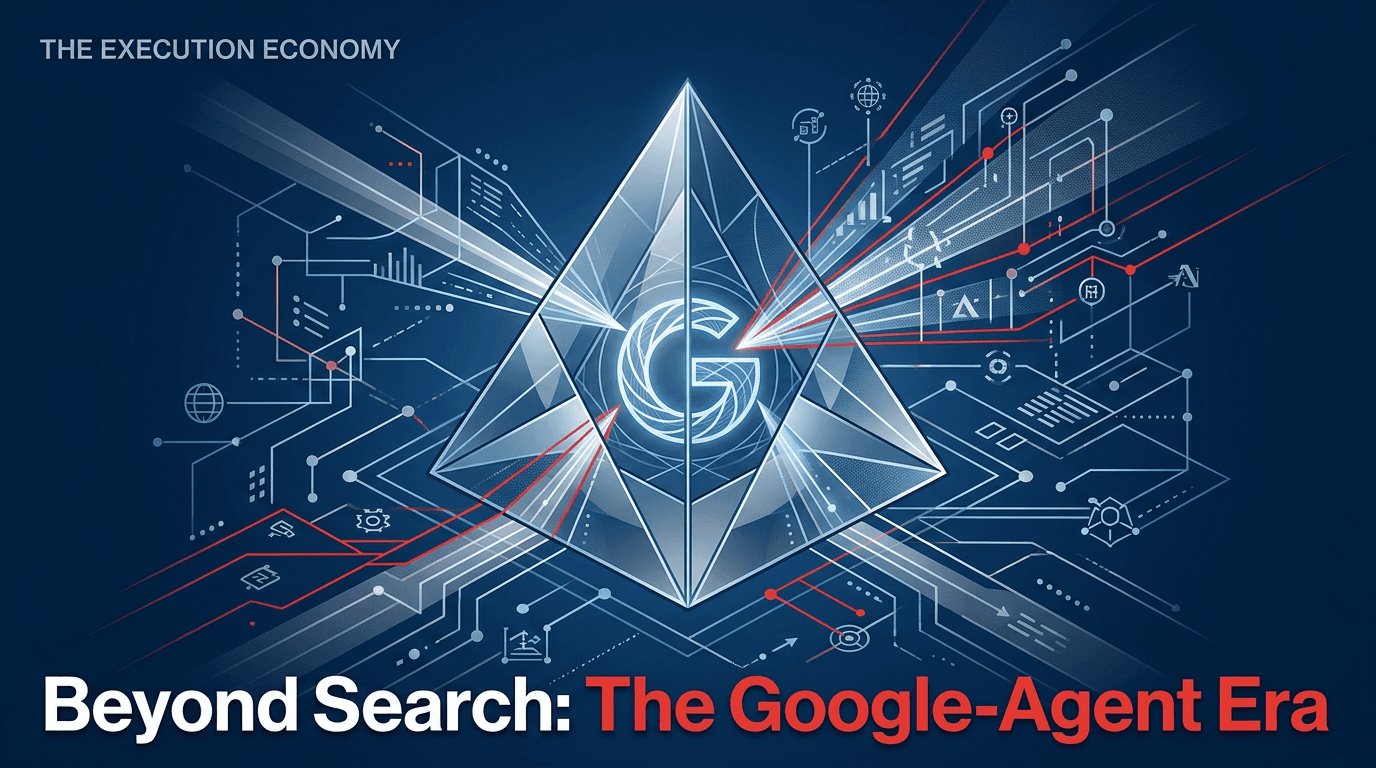
Since the May 2026 rollout of the Google-Agent user agent, the fundamental contract of the internet has changed. For twenty years, we optimized for human eyeballs. We built landing pages to capture attention, reduce bounce rates, and lead a person through a funnel. But with the introduction of the specific Google-Agent identity, Google has signaled that the browser is no longer just a window—it's an actor.
This guide will show you how to transition your site from a library of content into a platform for autonomous agents. By the end of this tutorial, you will have moved beyond simple 'readability' to 'actionability,' ensuring that when a user asks their AI to "book the best sustainable hotel in Austin," your brand isn't just mentioned in the summary—it's the one the agent actually transacts with.
What you need before starting
- Full access to your site's
robots.txtand server headers. - Authority to implement advanced Schema.org JSON-LD (specifically Actions and Product models).
- A functioning API or structured checkout flow that can be parsed by LLMs.
- Access to Google Search Console to monitor the new 'Google-Agent' crawl frequency.
TL;DR
- Google-Agent vs. Googlebot: Googlebot indexes for search; Google-Agent crawls to execute tasks for users via Gemini and other LLMs.
- Actionability is the new SEO: High-ranking content is useless if the agent cannot find the 'buy' button or the 'book' API in your code.
- Schema 2.0: You must move from descriptive Schema (what this is) to prescriptive Schema (how to do this).
- The Shift: We are moving from a 'Click-Through' economy to an 'Execution' economy.
Step 1: Differentiate your traffic with the Google-Agent Header
The first step is identifying when the AI agent is visiting versus the traditional crawler. Google officially split the identities to allow webmasters to serve more 'machine-dense' data to the agent without affecting the visual SEO of the main site.
Per Google's updated documentation, the Google-Agent string is used specifically when the system is acting on behalf of a user request in a generative context. Unlike the standard Googlebot, which seeks to map the web, Google-Agent is looking for endpoints. You need to ensure your server doesn't treat this agent as a generic bot or, worse, a scraper to be blocked. Following the trend seen in TikTok's 2026 'Discovery to Business' updates [S3], platforms are prioritizing transaction-ready data over mere surface-level engagement.
What to do:
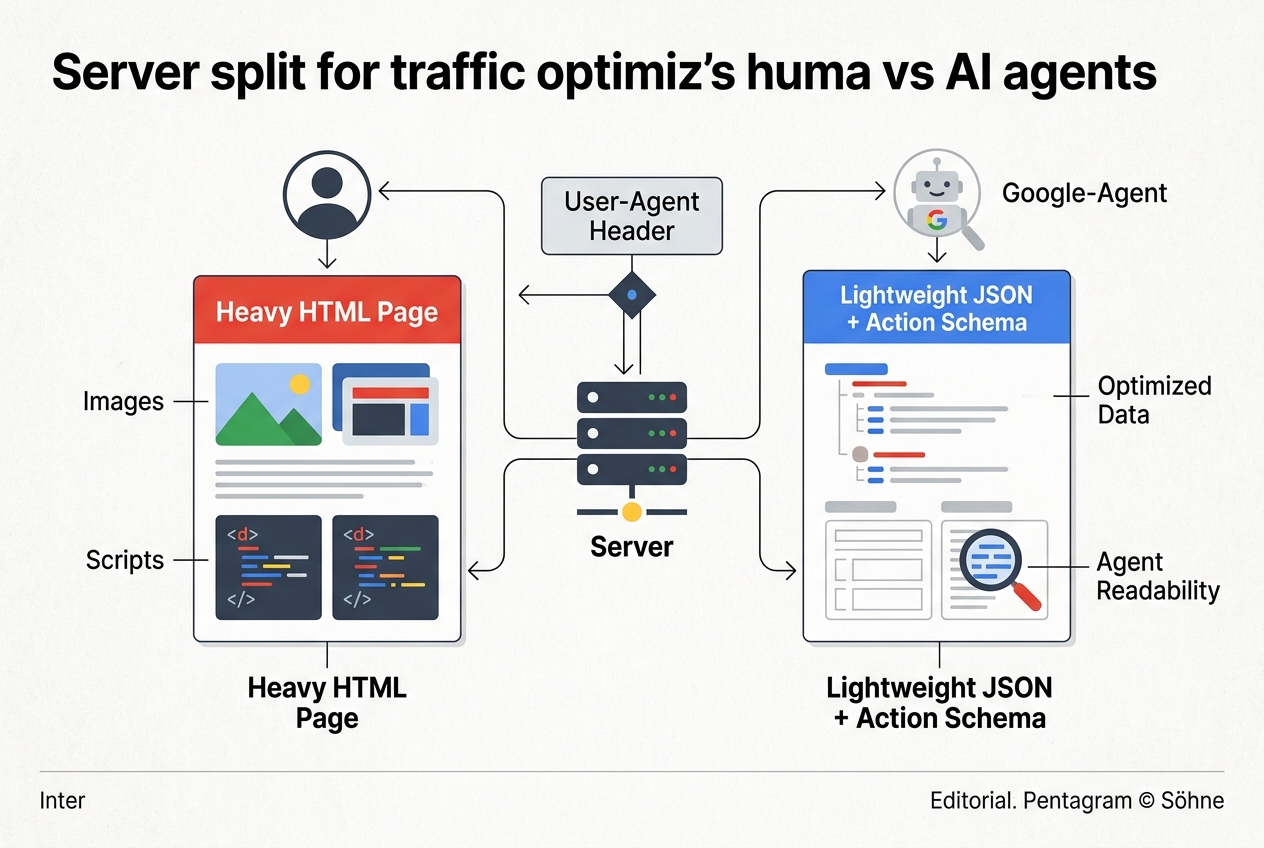
Update your server configuration to recognize the User-Agent: Google-Agent header. Instead of serving the full heavy JavaScript bundle meant for a human browser, serve a 'Headless-Optimized' version of the page that prioritizes structured data and API documentation.
Why it matters: Processing power for LLMs is expensive. If the Google-Agent has to fight through 4MB of high-res images and parallax scrolling scripts to find your pricing table, it will likely time out or return a 'hallucinated' estimate to the user. By serving a streamlined version, you ensure 100% accuracy in the agent's response.
Common Pitfall:
Don't accidentally block Google-Agent in your robots.txt while trying to block AI scrapers like GPTBot or CCBot. Google-Agent is the one that brings you the transaction; treat it like a VIP buyer, not a data thief.
Step 2: Implement the 'Action-Schema' Layer
Standard SEO involves telling Google, "This is a product." AI Agent optimization involves telling Google, "This is how you buy this product for a user." We are moving from the Product schema to the PotentialAction schema.
Since the November 2025 algorithm shifts [S2], we've seen platforms like Instagram and TikTok move toward 'intent-based' ranking. Google is doing the same. Your code must now include the entry points for the agent to perform its task.
What to do:
Wrap your checkout or booking flow in Action schema. Specifically, use BuyAction, ReserveAction, or SubscribeAction. You must define the target URL not as a landing page, but as a deep-link or an API endpoint that the agent can interact with.
{
  "@context": "https://schema.org",
  "@type": "BuyAction",
  "target": {
    "@type": "EntryPoint",
    "urlTemplate": "https://api.yourbrand.com/v1/checkout?item={id}",
    "actionPlatform": [
      "http://schema.org/DesktopWebPlatform",
      "http://schema.org/IOSPlatform"
    ]
  },
  "result": {
    "@type": "Reservation",
    "name": "Confirmed Booking"
  }
}
Why it matters: When a user says "Gemini, find me a flight to London and book it," the AI doesn't want to read a blog post about 'Top 10 London Flights.' It wants the JSON object that allows it to execute the POST request. Brands that provide this 'Action Layer' will be the default choice for the AI's selection process.

Common Pitfall: Providing broken or authenticated-only endpoints. If the agent can't see the price without a login, it will skip you for a competitor with transparent, agent-readable pricing.
Step 3: Optimize for 'Agentic Reasoning' via Semantic Clusters
AI agents don't just look for keywords; they look for 'proof of capability.' If a user asks an agent to "find a lawyer who can handle a complex cross-border real estate deal," the agent is looking for semantic clusters that prove expertise. This is particularly relevant in high-stakes markets like real estate, which have been radically redefined by social and AI discovery [S4].
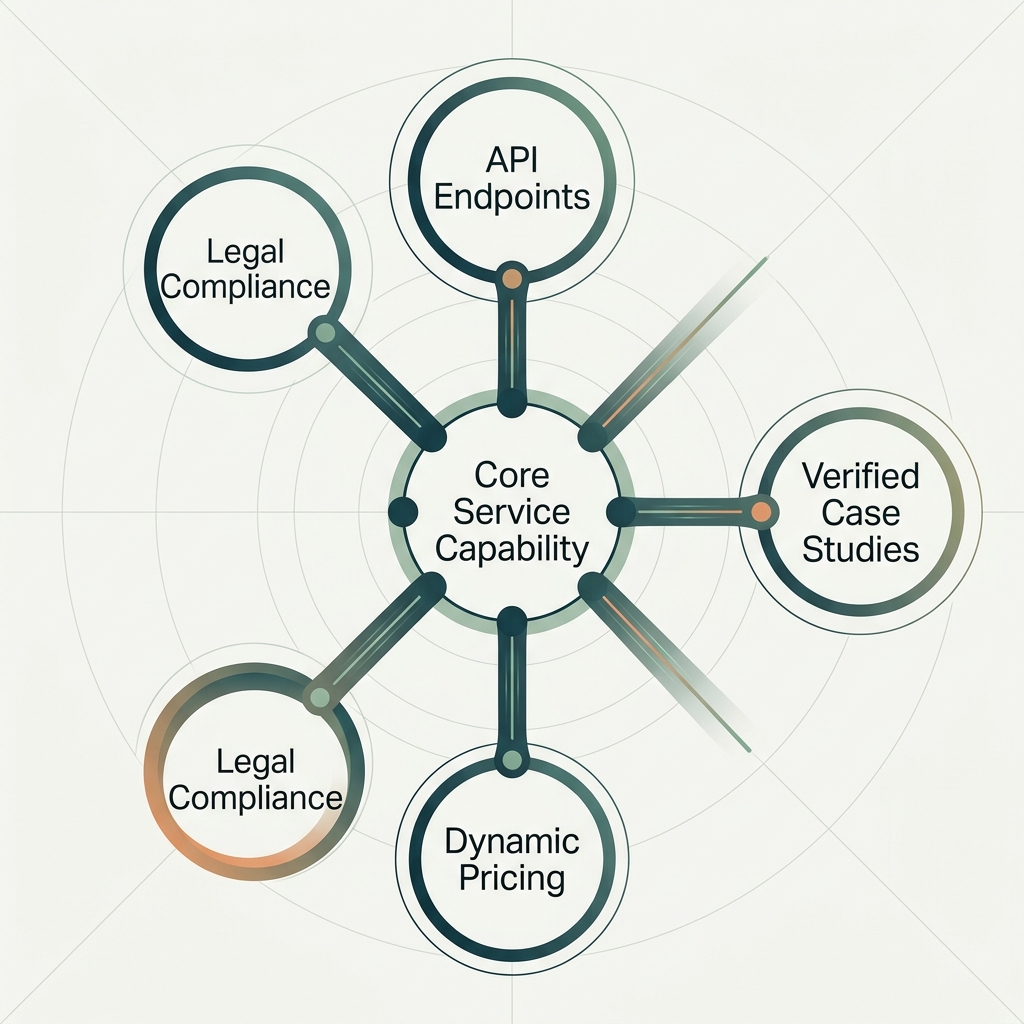
What to do: Structure your content in 'Reasoning Hubs.' Instead of a single long article, use a hub-and-spoke model where the central hub defines the service and the spokes provide the raw data (case studies, pricing variables, legal jurisdictions) that an LLM can use to justify its recommendation to the user.
Why it matters: Agents are programmed to be 'helpful and harmless.' They need to cite their sources to the user. By providing clear, data-backed spokes, you give the agent the 'citations' it needs to confidently recommend your brand over another. You aren't just selling to the user; you're providing a legal and logical defense for the AI to choose you.
Common Pitfall: Using vague marketing fluff. Phrases like "unparalleled service" or "world-class quality" are discarded by agents as 'low-signal noise.' Use specifics: "98% success rate in 48-hour closings" or "Direct API integration with 14 major banks."
Step 4: Verification — The 'Agent-Audit' Test
How do you know if the Google-Agent actually 'understands' your site as an actionable platform rather than just a collection of words? You must perform an Agent-Audit. This is the new 'Fetch as Google.'
What to do:
- Use the 'Google-Agent Simulator' (available in the 2026 version of Search Console).
- Run a query through a raw Gemini Pro API call asking it to "Perform [Action] on [Your URL]."
- Check your logs for the
Google-Agentstring to see which specific JSON-LD blocks were accessed. - Verify that the agent didn't encounter a 'Hallucination Trigger'—usually caused by conflicting data in the footer versus the main body.
Why it matters: Traditional SEO tools like Semrush or Ahrefs measure ranking. They do not measure 'Agency.' A site can rank #1 for 'best coffee' but have 0% 'Agency' if an AI can't figure out how to order a bag of beans from it. Verification ensures your technical debt isn't killing your conversion rate in the AI era.
Common Pitfall: Assuming that high rankings in the 'Search Generative Experience' (SGE) summary mean you are optimized for agents. SGE summaries are for reading; Google-Agent is for doing. They are two different systems.
Beyond Search: 3 Related Tactics for the AI Era
Now that your site is ready for the Google-Agent, you need to look at the broader ecosystem. The 'Execution Economy' isn't limited to Google; it's a fundamental shift in how value is captured online.
- Develop a 'Brand GPT' or Custom Action: Don't wait for Google to map your site perfectly. Build a custom GPT or a Claude Tool that uses your API. This creates a direct 'Agentic Path' for users who aren't using Google as their primary interface. This bypasses the search engine entirely, moving you from discovery to direct utility.
- Shift from Social Likes to 'Agentic Signals': As noted in recent reports on the Indian marketing landscape [S5], vanity metrics like likes are failing to drive revenue. Instead, optimize your social content for 'Save-to-Agent' actions. Use CTAs that encourage users to say "Hey Siri, save this product to my shopping list" or "Gemini, remind me to check this brand's pricing tomorrow."
- Implement 'Price-Transparency' Headers: Agents are highly price-sensitive because they are often given budget constraints by users ("Find me a hotel under $200"). Use specific meta-tags for
<meta name="price-min" content="150">and<meta name="price-max" content="190">to ensure the agent doesn't have to guess your rates from a messy table.
How to transition your social strategy from engagement to utility
The impact of AI agents on B2B lead generation
Why the 'Execution Economy' is replacing the 'Creator Economy'
Summary of the Agentic Shift
The transition to the Google-Agent identity is the most significant change to the web's infrastructure since the move to mobile-first indexing in 2015. For years, we've heard that 'Content is King.' In the era of AI agents, Context is King, but Action is the Kingdom.
If your website remains a static brochure, it will become invisible to the bots that now make the majority of purchasing decisions. By implementing the four steps outlined above—identifying the agent, layering action-schema, building semantic hubs, and verifying agency—you ensure that your brand is not just a footnote in an AI's summary, but the destination for its transaction.
Stop building for the searcher who wants to know. Start building for the agent that wants to do.
FAQ