

If you have checked your brand's presence on Perplexity or SearchGPT lately, you might have felt a brief surge of dopamine. You ask the engine for the 'best social media management tools for agencies,' and there you are—listed as a top recommendation. But then you check your Google Analytics 4 (GA4) referral traffic, and the numbers are flat.
You've fallen into the AEO gap.
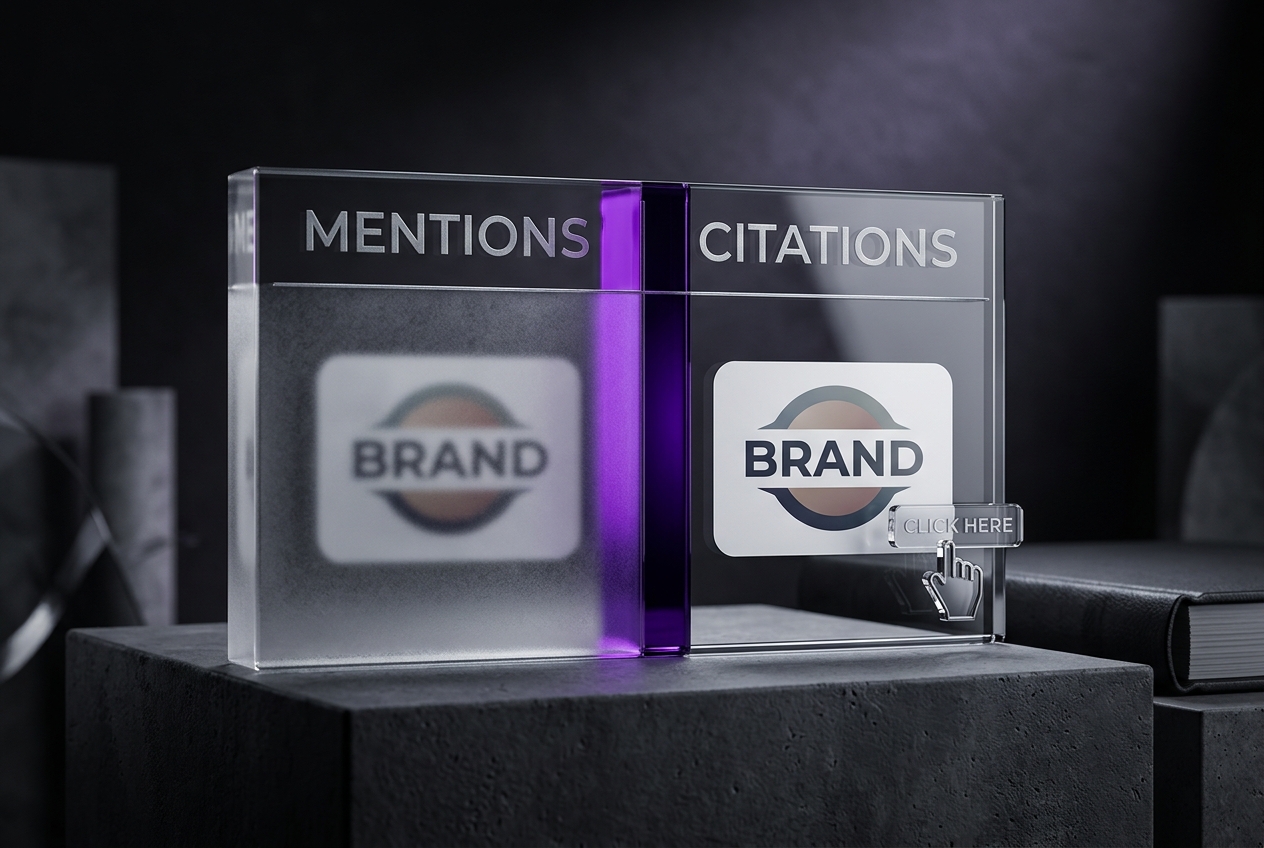
Answer Engine Optimization (AEO) is the new battleground, but many practitioners are measuring the wrong signals. Being mentioned by an AI agent is a brand awareness play; being cited with a clickable link is a performance play. In the current landscape, these two outcomes are driven by entirely different technical triggers. If you don't understand the difference, you're essentially optimizing for 'zero-click' ghost mentions that do nothing for your bottom line.
Key takeaways
- Mentions are probabilistic: AI models mention brands based on training data patterns, often without needing a live web connection.
- Citations are deterministic: Links are generated when an engine uses Retrieval-Augmented Generation (RAG) to verify a fact in real-time.
- The 'Mention Trap': High conversational visibility without citations leads to high brand recall but zero attribution or traffic.
- Optimization Shift: To move from mention to citation, you must move from broad authority to 'atomic fact' density.
The fundamental mechanics of AI mentions vs. citations
To fix your traffic problem, you first have to understand how a Large Language Model (LLM) actually 'decides' to talk about you.
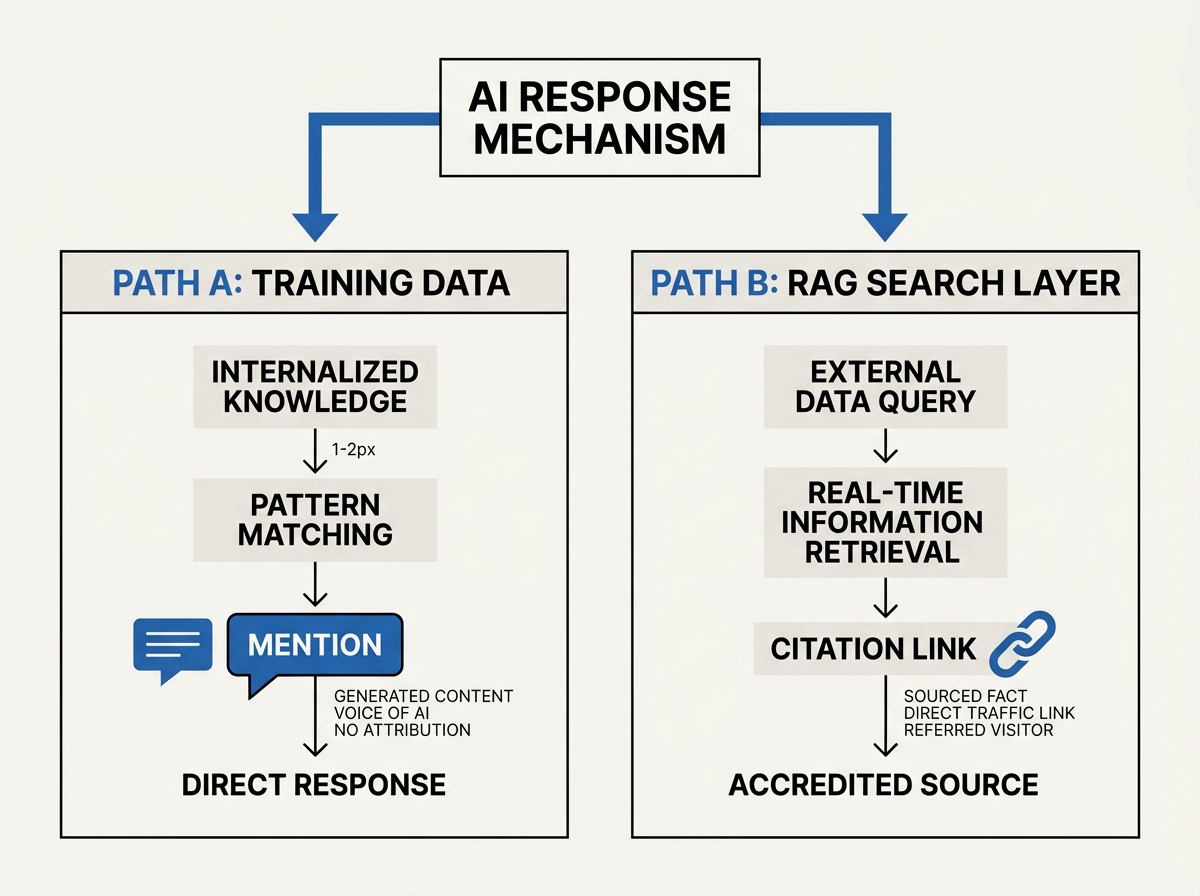
A mention is a result of the model's internal weights. When an LLM like GPT-4o or Claude 3.5 is trained, it ingests billions of tokens. If your brand is frequently discussed in high-authority contexts (like being a regular subject in Social Media Today's platform analysis), the model develops a statistical association between your brand name and certain keywords. When a user asks a question, the model predicts the next most likely word. If you've built enough 'brand gravity,' your name is simply the most probable next word in the sequence. This happens entirely offline, without the AI 'searching' the web.
A citation, however, is a product of the search layer—often called the 'agentic' or 'RAG' layer. When Perplexity or Google's AI Overviews (AIO) realizes it needs fresh data or proof for a claim, it performs a traditional search, scrapes top results, and synthesizes an answer. The links you see in the footnotes are the sources it deemed most reliable for that specific query.
Think of it this way: A mention is the AI remembering you from school. A citation is the AI looking you up in a phone book to make sure you still live there. If you aren't in the phone book (the current index), you don't get the link, even if the AI remembers your name.
Why brands are winning the chat but losing the click
We are seeing a divergence in how 'authority' is calculated. In traditional SEO, a backlink from a high-DR site passed 'link juice' that helped you rank. In AEO, the AI doesn't care about link juice; it cares about 'semantic proximity' and 'fact verification.'
According to recent industry shifts, such as those noted by Finn Partners' new integrated media approach, the traditional silos of PR and SEO are collapsing because AI engines treat PR mentions as training data and SEO content as RAG sources.
If your brand is a household name, you will get mentions. You’ll be the 'top of mind' answer for the AI. But if your website is a bloated mess of JavaScript that a scraper can't parse in under 200 milliseconds, the AI will mention you but link to a competitor who has a cleaner, more 'scannable' site. The competitor gets the traffic; you get the 'shoutout.' In a performance-driven world, a shoutout doesn't pay the bills.
This is further complicated by the rise of 'AI slop.' As highlighted in Ahrefs' stance on AI content quality, engines are becoming increasingly aggressive at filtering out generic, AI-generated summaries. If your content looks like a rehash of what's already in the training data, the RAG layer will skip you in favor of original research or primary data.
The technical triggers for AI citations
If you want the link, you have to satisfy the RAG agent. This agent has a very specific set of priorities that differ from the traditional Google crawler.
- Structured Data and Schema: While Google has used Schema for years to build Rich Snippets, AI engines use it to build their knowledge graphs. If you aren't using
Product,Organization, orReviewschema, you're making the agent work too hard. It will move on to a source that provides a clean JSON-LD feed. - The 'Atomic Fact' Strategy: AI engines don't read articles; they extract propositions. An article that says "Our tool is great for teams" is useless. An article that says "Our tool reduces Slack notification fatigue by 22% for teams of 50+" is an atomic fact. The latter is citeable.
- Latency and LLM-Readability: Perplexity and SearchGPT are speed-obsessed. If your page takes 3 seconds to become interactive, the search agent—which is often running on a timeout—will grab a snippet from a faster site. This isn't just about Core Web Vitals; it's about 'text-to-code' ratios. Minimalist, text-heavy pages are winning in AEO.
Moving from conversational visibility to referral traffic
So, how do you actually execute this? It requires a shift from 'keyword targeting' to 'entity positioning.' You aren't trying to rank for a word; you're trying to become the definitive source for a specific fact or solution that the AI needs to verify its own output.
Take the example of internal tool development. As seen with Buffer's recent Build Week transparency, brands that share specific, raw data about their internal processes create 'unique information gain.' AI engines crave unique information gain because it allows them to provide answers that their competitors (who only rely on training data) cannot.
If you publish a case study that includes a unique metric or a proprietary framework, you aren't just 'creating content.' You are creating a 'citation hook.' When a user asks an AI 'How do I improve my social media workflow?', the AI will pull from its training data to give a general answer (mentioning you if you're famous), but it will look for a source to explain the '2026 Workflow Framework.' If that framework is yours, you get the citation.
The accountability crisis in AEO
There is a hidden danger in chasing AI mentions: the lack of control. As a recent Search Engine Journal analysis on AI accountability pointed out, when AI alters the context of your brand, who owns the mistake?
If an AI mentions your brand but attributes a competitor's pricing or a faulty feature to you, a mere mention becomes a liability. This is why citations are the only real defense. A citation provides a path back to the 'source of truth'—your website. Without that link, the user has no way to verify the AI's claims, and you have no way to correct the record.
How to audit your AEO performance today
You cannot manage what you don't measure, and GA4 is currently ill-equipped to show you 'mentions.' You need a new stack.
- Use 'Agent-Specific' Tracking: Watch for User-Agents like
PerplexityBotorGPTBotin your server logs. If they are hitting your site but not resulting in referral traffic, your content is being used for training/answering but not for linking. - Test the 'Cite-Ability' of your Top Pages: Take your best-performing SEO article and paste it into a 'summarizer' AI. Ask it to 'Extract 5 citeable facts.' If it can't find specific numbers, names, or unique processes, you will never win a citation in the wild.
- Monitor the 'Share of Model': Use tools like Brandwatch or specialized AEO trackers to see how often your brand appears in LLM responses compared to competitors. If your Share of Model is high but your Referral Traffic is low, your 'Atomic Fact' density is too low.
What this means for your 2026 strategy
The era of the '10 blue links' is fading, but the era of the 'verified source' is just beginning. To bridge the gap between being part of the conversation and being part of the customer journey, you must stop writing for 'readability' and start writing for 'extractability.'
Your goal for the next quarter shouldn't just be to 'rank #1.' It should be to become the 'primary source' for the three most important questions in your niche. When the AI is asked those questions, you don't just want it to remember you. You want it to point to you.
Citations are the new currency of trust. Mentions are just noise.
FAQ