
What happens when the dashboard you pay for becomes the bottleneck in your workflow? For years, social media managers have lived in a state of 'tab fatigue,' jumping between a CRM, a project management tool, a creative asset library, and a social media management platform (SMM). The dashboard was the destination. But in a mid-2026 pivot that signals a seismic shift for the industry, Hootsuite is betting that the future of social isn't a destination at all—it's a plumbing system.
By prioritizing a 'headless' social strategy, Hootsuite is moving away from being a proprietary UI and toward becoming a high-scale social media management API. This isn't just a technical update; it's a structural admission that for the world's largest brands, the 'all-in-one' dashboard is dead. The enterprise doesn't want another login. It wants social data and publishing capabilities to live inside the tools its teams already use, from Salesforce and Slack to custom-built internal AI agents.
TL;DR
- The Headless Shift: Hootsuite is transitioning to an API-first model, allowing brands to decouple the social 'engine' from the user interface.
- Workflow Orchestration: Instead of logging into Hootsuite, teams can now trigger social posts and pull analytics directly into internal BI tools or CRMs.
- Efficiency Gains: This move aims to eliminate manual data entry and 'tab switching' by embedding social capabilities into existing enterprise tech stacks.
- AI Integration: A headless stack allows brands to connect their own proprietary AI models directly to social publishing pipes without third-party friction.
Understanding the Headless Social Architecture
To understand why 'headless' is the word of the year in martech, think of a traditional SMM like a vending machine. You go to the machine, you press the buttons on its specific interface, and it gives you a product. You are limited by where that machine is located and how its buttons work.
'Headless' social media management is more like a water utility. The water (the ability to post, reply, and track) is always there, flowing through the pipes. You can tap into it with a kitchen faucet, a garden hose, or an industrial sprinkler system. You choose the 'head' (the interface), while the provider manages the 'body' (the infrastructure, API connections to Meta and TikTok, and compliance layers).
According to Hootsuite’s May 2026 announcement [S1], this strategy is designed to solve the fragmentation problem. As platforms like TikTok introduce deeper ties between search and commerce [S3], the complexity of managing these signals manually in a third-party dashboard becomes overwhelming. By going headless, a brand’s commerce engine can automatically trigger a TikTok post when stock levels reach a certain threshold, without a human ever touching a social dashboard.
This shift mirrors what happened in the Content Management System (CMS) world a decade ago. Contentful and Strapi disrupted WordPress by offering 'content as a service.' Now, we are seeing 'social as a service.' The value isn't in the buttons you click; it's in the reliability of the API that talks to Instagram's Graph API or X's developer portal.
Why the All-in-One Dashboard Failed the Enterprise
For a decade, the selling point of platforms like Hootsuite, Sprout Social, and Sprinklr was 'the single pane of glass.' The promise was that every social activity—from listening to publishing—would happen in one place. But as social became central to every department (customer service, HR, sales, and product), that single pane of glass became a wall.
Consider the workflow of a global retail brand. Their customer service team lives in Zendesk. Their sales team lives in Salesforce. Their creative team lives in Adobe Creative Cloud. Forcing all of them to log into a social dashboard to execute their specific slice of the social strategy creates data silos and security risks.
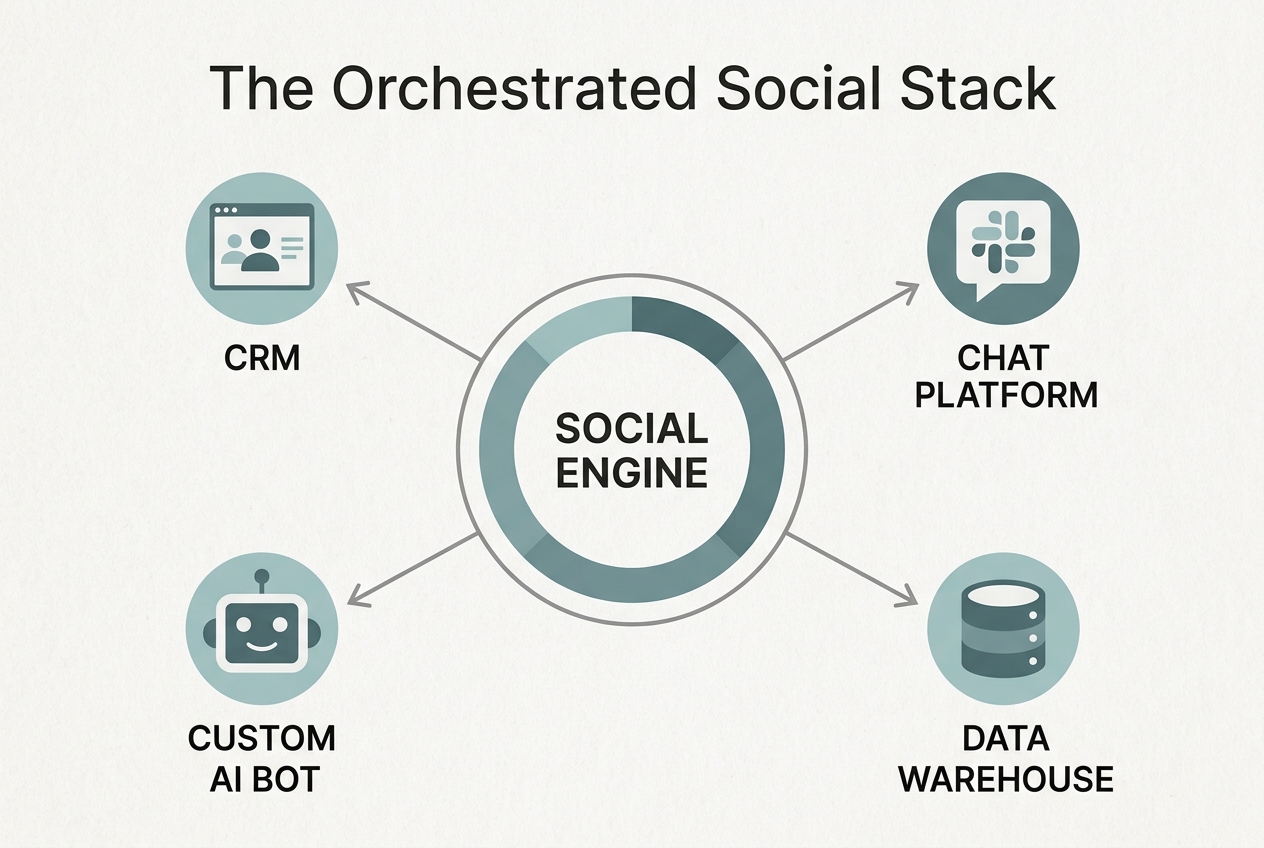
Furthermore, the 'all-in-one' model often leads to feature bloat. Platforms race to add AI caption generators and basic image editors that mid-to-large agencies never use because they already have specialized tools like Jasper or Canva. Per recent industry sentiment, enterprise buyers are increasingly looking for 'best-of-breed' stacks rather than 'jack-of-all-trades' suites. They want the best social engine, the best analytics engine, and the best CRM—and they want them to talk to each other via robust APIs.
Martech Orchestration: Building Your Own Interface
When you move to a headless stack, your social media tech stack becomes a modular kit. This process, often called martech orchestration, allows you to build custom workflows that are proprietary to your business.
For example, a sports betting brand might build a custom internal tool that monitors live game scores. Through Hootsuite’s API, they can programmatically generate and publish real-time odds updates to X and Threads the millisecond a goal is scored. No human could ever move fast enough to do this in a manual dashboard.
This level of automation is becoming a requirement as platform algorithms shift toward rewarding 'real-time' and 'high-relevancy' content. As Professor Watson noted in a recent update to social media marketing curricula [S4], the focus is shifting from creative execution to 'AI-powered campaign strategies' where the infrastructure is as important as the copy.

Another critical advantage is data integrity. When you pull social analytics directly into a Snowflake or BigQuery instance via an API, you can cross-reference social engagement with actual sales data in real-time. You no longer have to export CSVs from a social tool and manually upload them to a BI tool. The 'headless' approach makes social data a first-class citizen in the company’s data lake.
The Role of AI in the Headless Ecosystem
AI is the primary catalyst for the headless movement. In 2024 and 2025, we saw 'AI features' added to social dashboards—mostly simple wrappers around GPT-4 to help write captions. But in 2026, brands are building their own fine-tuned LLMs trained on their specific brand voice and historical performance data.
An enterprise doesn't want to use Hootsuite’s generic AI; they want to use their AI. A headless stack allows them to feed social data into their proprietary model and then use the API to push the model's output directly to the platforms. This creates a closed-loop system where the AI learns from every post's performance and adjusts the next one automatically.
This level of sophistication is what separates top-tier brands from those still buying followers or using outdated growth hacks [S5]. It's about building a machine that operates at the speed of the feed. If TikTok’s algorithm is prioritizing search-intent content [S3], a headless system can scan trending search terms and instantly update the metadata or captions of a brand’s entire video library to match.
Challenges: The Cost of Complexity
Going headless isn't a silver bullet. It requires a level of technical maturity that many small-to-medium businesses (SMBs) don't possess. While a dashboard is 'plug-and-play,' an API-first strategy requires developer resources or at least a very high proficiency with iPaaS tools like Zapier, Make, or Workato.
There is also the 'maintenance tax.' Social platforms like Instagram and LinkedIn change their API documentation frequently. One of the primary values of a platform like Hootsuite has always been that they handle the API breakages so you don't have to. In a headless model, you are still paying Hootsuite for that 'translation' layer, but you are now responsible for the custom code on your end that receives that data.
Security is another concern. Opening up APIs across multiple internal tools increases the 'attack surface' for a brand. If a junior developer accidentally leaks an API key in a public GitHub repository, a malicious actor could theoretically post to a brand’s global social accounts. This necessitates a robust governance framework and strict OAuth protocols.
How to Prepare Your Team for the Headless Era
If you are a social media lead or an agency strategist, the shift to headless social media management changes your job description. You are moving from being a 'content publisher' to being a 'workflow architect.'
- Audit Your 'Tab Fatigue': Track how many different tools your team touches to get a single post live. If you are moving data manually from a project management tool (like Monday.com) to a social tool, you are a candidate for a headless transition.
- Upskill in Data Literacy: You don't need to learn to code, but you do need to understand how APIs work. Understanding concepts like 'webhooks,' 'endpoints,' and 'JSON' will be as important as understanding 'engagement rate' by 2027.
- Consolidate Your Data Lake: Start pushing for social data to be included in your company’s central data warehouse. This is the first step toward true martech orchestration.
- Evaluate Your SMM Provider: Ask your current provider about their API roadmap. Are they building more buttons in their own UI, or are they making it easier for you to pull their functionality into your UI?
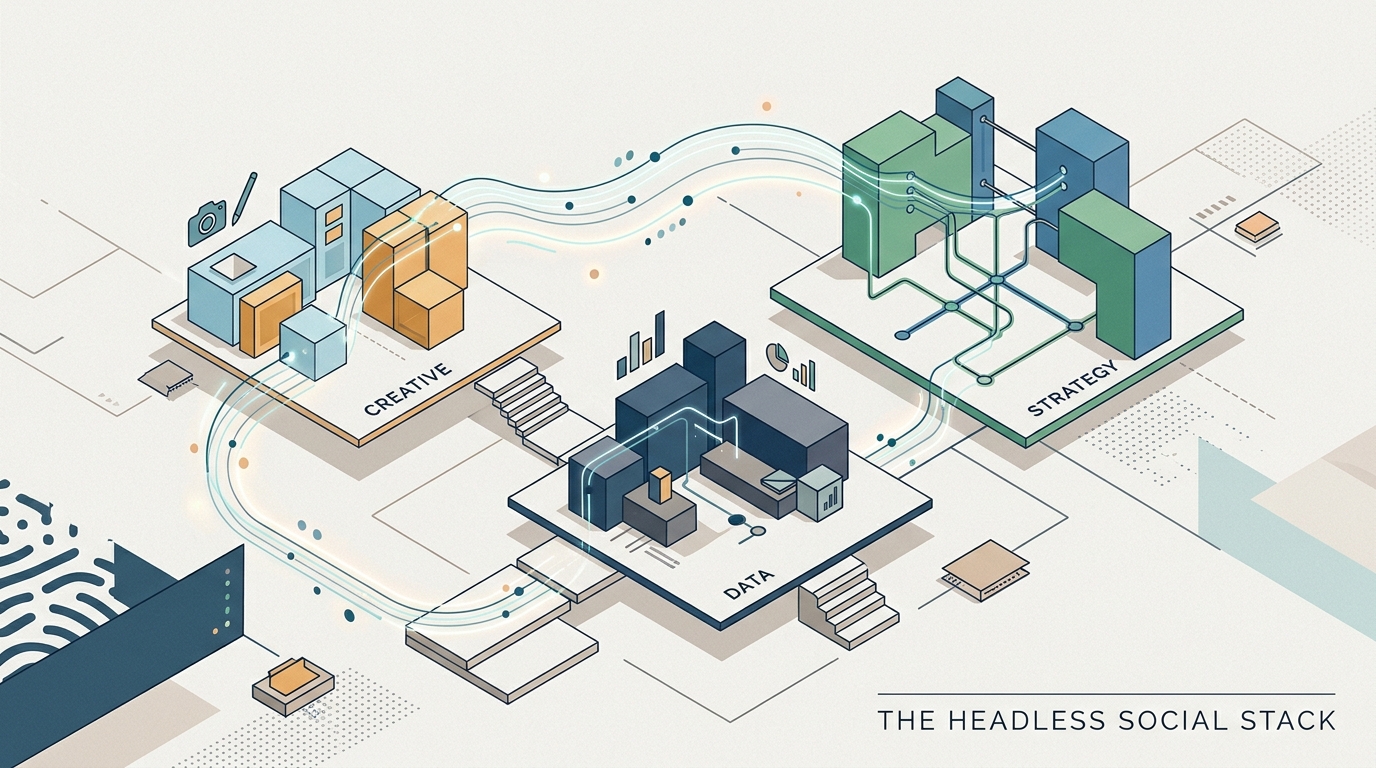
Hootsuite’s bet is a gamble on the maturity of the market. They are betting that the future of social isn't in the hands of people who want a pretty calendar view, but in the hands of those who want to build the most efficient, automated, and data-driven marketing machine possible. For the enterprise, the 'head' is now optional, but the 'body'—the reliable, compliant, and scalable API—is more essential than ever.
FAQ