

Why does my Google Search Query Report look like it was written by a robot instead of a customer?
If you have spent any time in the Google Ads dashboard over the last few months, you've likely noticed a subtle but fundamental shift in the 'Search Terms' column. Where you once saw the messy, misspelled, and highly specific queries of human beings, you are increasingly seeing sanitized, broad phrases that look suspiciously like your own keyword list. This isn't a coincidence. As Google integrates AI Overviews (SGE) and visual search via Lens more deeply into the core search experience, the platform is moving away from reporting literal input toward a model of 'interpreted intent.'
For the performance marketer, this is more than a reporting quirk. It represents a widening 'intent gap'—a space where Google’s AI decides what a user meant, serves your ad, but denies you the data to see if that interpretation was actually correct.
Key takeaways
- Literalism is dead: Google is increasingly reporting the AI's interpretation of a query rather than the raw text, especially for multimodal (Lens) and conversational (AI Overviews) searches.
- Negative keyword friction: Without raw query data, identifying 'waste' becomes a game of inference rather than evidence, making traditional negative keyword harvesting less effective.
- The 'System 1' Shift: Advertisers must shift from matching words to matching 'states of mind,' as Google’s Gemini-powered matching engine prioritizes semantic relevance over character-string matching.
- Actionable fix: Lean into first-party conversion data and 'Value-Based Bidding' to signal to the AI which interpretations actually lead to revenue.
The fundamental shift from strings to things
To understand why your Search Query Report (SQR) is changing, we have to look at how Google’s underlying architecture has evolved. For two decades, search was a 'string-matching' game. You bid on 'red running shoes,' and Google looked for users typing those exact characters. Even with the introduction of 'close variants' in 2014 and the expansion of 'exact match' to include intent in 2018, there was still a tether to the literal word.
That tether has been cut. With the full-scale rollout of AI Overviews, Google is now a 'reasoning engine.' When a user takes a photo of a broken faucet with Google Lens and asks, 'How do I fix this leak?', the 'query' isn't a text string. It is a multidimensional data packet containing an image, a geolocation, a search history, and a conversational prompt.
In your Google Ads reporting, you won't see 'photo of a Delta 1200 series faucet with a drip.' You might just see 'faucet repair parts.' Google has interpreted the intent and served the ad, but in doing so, it has stripped away the context that allowed you to refine your targeting. This is the core of the interpreted intent gap. According to Kantar’s 2026 Brand Value report [S1], Google has reclaimed the top spot as the world's most valuable brand precisely because it has successfully positioned itself as an AI-first utility. But for the practitioners paying the bills, that utility comes at the cost of transparency.
How interpreted intent breaks the negative keyword workflow
For a decade, the standard operating procedure for a search specialist was simple: Download the SQR, sort by spend, find the irrelevant queries, and add them as negative keywords. It was a linear, logical process of pruning.
Interpreted intent breaks this loop in three specific ways:
- The Masking Effect: If Google interprets a dozen different weird, low-intent queries as one single 'intent bucket,' you only see the bucket. You can't negate the specific 'weird' terms because you don't know they exist.
- Semantic Over-Reach: Google’s AI might decide that 'cheap' and 'affordable' are the same intent. If your brand is luxury and you've negated 'cheap,' the AI might still serve your ad for a 'cheap' query if it interprets the user's overall profile as a 'luxury seeker' who just happened to use the wrong word.
- The Lens Black Box: Visual searches are notoriously difficult to categorize. If someone uses Lens to find a dress similar to one they saw in a movie, Google interprets that visual data into a text-based query for your report. But the text-based query ('floral midi dress') doesn't tell you that the user was actually looking for a specific 1970s vintage aesthetic that you don't carry.
This lack of visibility is particularly galling when compared to the competitive landscape. While Google is tightening the lid on data, platforms like TikTok are expanding their search utility. TikTok’s recent launch of 'Search Hubs' and 'Branded Buzz' [S3] actually aims to connect creator content more directly to search behavior, providing a level of contextual relevance that Google is currently abstracting away into its 'AI black box.'
The mechanism: Gemini, PMax, and the 'Privacy' Shield
Google justifies this lack of data through two primary lenses: privacy and performance. The 'privacy' argument suggests that as queries become more conversational and specific, they risk becoming 'Personally Identifiable Information' (PII). If a user types a very specific medical or financial query, Google argues that showing that exact string to an advertiser is a privacy risk.
However, the 'performance' argument is the one that actually drives the bottom line. Google’s internal data (often cited in quarterly earnings calls) suggests that Performance Max (PMax) and Broad Match campaigns using Smart Bidding outperform manual campaigns because the AI can 'see' signals—like browser history, time of day, and device—that humans can't process in real-time.
By reporting 'interpreted intent,' Google is essentially forcing advertisers to trust the algorithm. If the AI believes a query for 'blue shoes' is actually an intent to buy 'navy sneakers,' and it results in a conversion, Google considers the reporting gap a 'feature,' not a bug. They are optimizing for the outcome, not the audit. This mirrors the broader industry trend where TikTok’s 'Attribution Portfolio' [S4] is also attempting to move the conversation away from last-click literalism toward a more holistic view of the customer journey.
Managing the gap: Strategic adjustments for 2026
You cannot fight the tide of AI-driven reporting, but you can change how you navigate it. If you continue to manage Google Ads as if it’s 2019, your efficiency will crater as the 'interpreted intent' gap swallows your margins.
1. Shift to 'Seed' Negatives
Instead of waiting for bad queries to show up in your SQR, you must become more aggressive with proactive negative keyword lists. Use tools like SparkToro or AnswerThePublic to find the 'adjacent' intents that Google might mistakenly lump in with your core business. If you sell 'SaaS for HR,' don't just negate 'HR jobs'; negate the entire semantic field of 'career advice,' 'resume tips,' and 'interview prep' before the AI has a chance to 'interpret' them as relevant.
2. The Rise of 'Negative Intent' Signals
Since you can't see the words, you must look at the behavior. Monitor your 'Search Top Impression Share' and 'Click-Through Rate' (CTR) at the ad group level more closely than the SQR. If your CTR is dropping while impressions are rising, it’s a signal that Google’s 'interpretation' of your keywords is drifting too broad. You may need to tighten your match types or, ironically, move back to 'Phrase Match' to create a harder boundary for the AI.
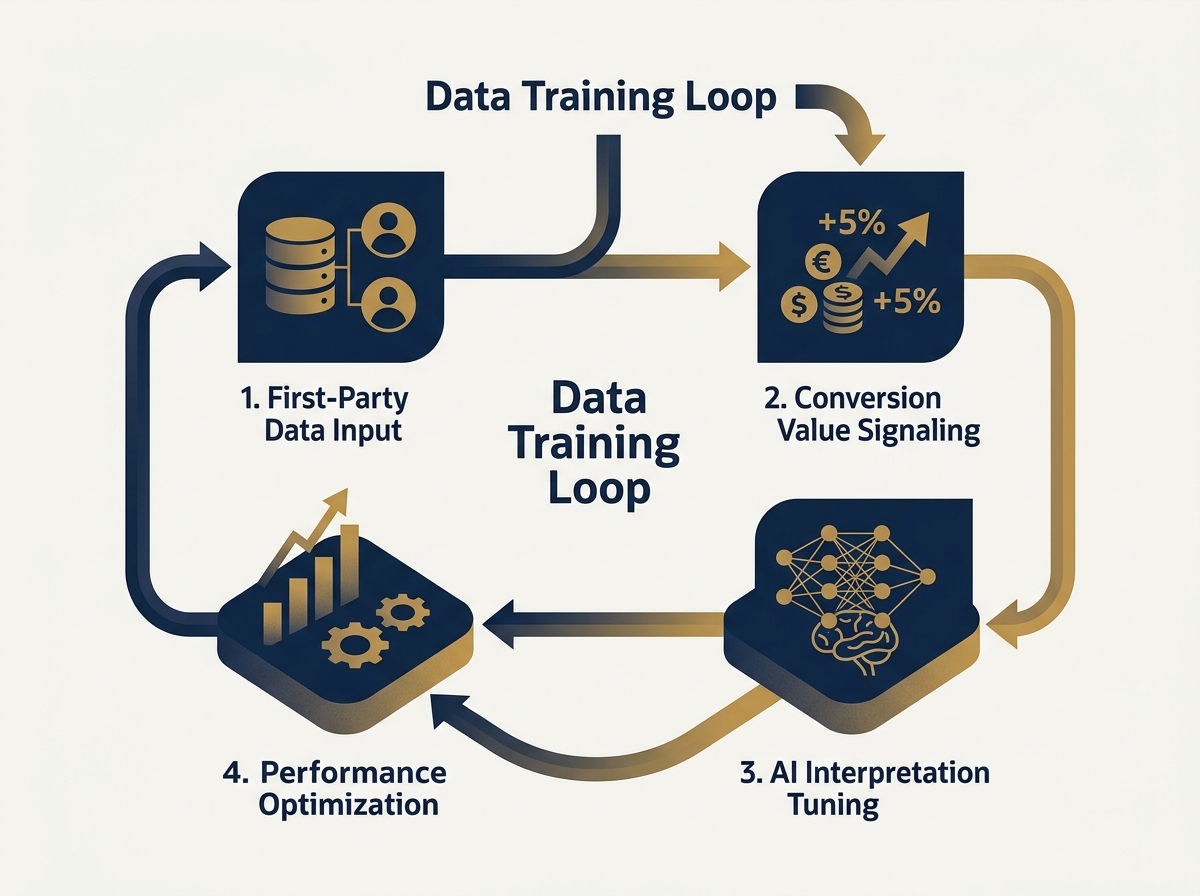
3. Feed the Machine Better Data
If Google is going to interpret intent, you need to make sure it has the right 'dictionary.' This means passing 'Offline Conversions' and 'Enhanced Conversions' back to the platform. If the AI sees that its interpretation of 'affordable' led to a high-value sale, it will do more of it. If it sees that its interpretation led to a bounce, it will (eventually) learn to stop. You are no longer a keyword manager; you are a data trainer.
The competitive context: TikTok and the 'Social Search' alternative
It is worth noting that while Google is making its search data more opaque, its competitors are doing the opposite to gain market share. TikTok’s 'TopReach' product [S2] and its new AI Ads tool [S5] are designed to give marketers more control over how their creative intercepts search intent.
For a brand marketing lead, this means the monopoly of the Google Search Query Report is ending. We are moving into a world where search intent is fragmented across platforms. Your 'intent strategy' must now account for the fact that a user might start with a visual search on Lens (Google interprets the intent), move to TikTok for a review (TikTok captures the buzz), and finally convert on a branded search.
If you only look at the 'interpreted' data Google gives you, you are seeing a low-resolution version of reality. To stay competitive, you must cross-reference your Google 'intent buckets' with the raw, unfiltered search trends visible on social platforms.
Conclusion: Winning in the age of abstraction
The move to interpreted intent is a permanent shift in the search landscape. Google is betting that its Gemini AI can understand what a user wants better than the user can express it in words. For marketers, this requires a difficult psychological shift: letting go of the 'word' and focusing on the 'value.'
Stop obsessing over the individual search terms that are missing from your report. They aren't coming back. Instead, focus on building robust first-party data loops, aggressive proactive negative lists, and a multi-platform view of how your customers actually talk. The 'intent gap' is only a threat if you rely on Google to tell you the whole truth. If you bring your own truth—in the form of hard conversion data—the AI becomes a powerful tool rather than a black box.
As we move further into 2026, the most successful search marketers won't be those with the longest negative keyword lists, but those who are best at training Google's AI to interpret their brand's value correctly. The 'Search Query Report' is no longer a transcript; it’s a summary. Learn to read between the lines.

FAQ