
Why does my social media ROI look so low when my total revenue is up? It is the question haunting every performance marketer in 2026. You launch a high-production Reels campaign, your brand mentions spike, but your GA4 dashboard insists that 70% of your conversions came from 'Organic Search' or 'Paid Brand Search'. This is the Skepticism Tax—a measurement penalty paid by social teams who generate demand that Google eventually harvests.
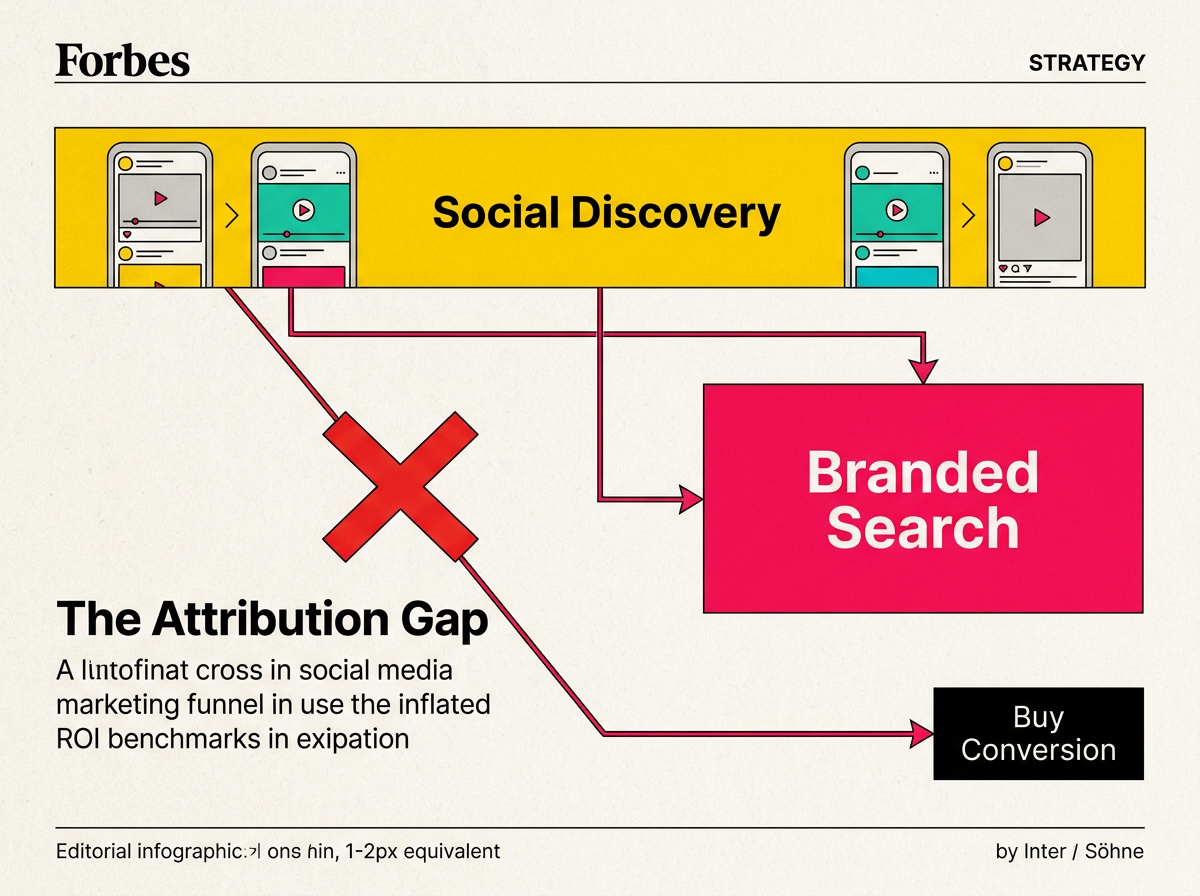
This phenomenon isn't new, but it has reached a breaking point. As users become increasingly savvy and platforms like TikTok and Instagram become discovery engines rather than just social networks, the path to purchase has fractured. A user doesn't click your ad; they see it, they doubt it, they research it, and then they buy it. By the time they hit the 'Buy' button, the social touchpoint has been scrubbed from the standard tracking pixel's memory.
The Mechanism of Credit Theft: How Branded Search Masks Discovery
To understand the Skepticism Tax, you have to look at the anatomy of a modern conversion. In the early 2010s, the 'Click-to-Conversion' window was a relatively straight line. Today, it is a zigzag. When you run a Meta campaign, you aren't just buying clicks; you are buying mental real estate.
Per recent Search Engine Land analysis, branded search volume often correlates more closely with top-of-funnel social spend than it does with SEO efforts. When a user sees a compelling ad for a new skincare line, their first instinct isn't always to click the 'Shop Now' button—especially with the rise of account security concerns and 'mod' apps that have made users wary of clicking direct links (as seen in recent reports of Instagram account compromises via third-party tools like 'Honista' [S3]). Instead, they open a new tab and type the brand name into Google or an AI search engine like Perplexity.
This is where the 'tax' is levied. Your analytics software sees a branded search visit. It sees a conversion. It assigns 100% of the value to the search engine. Meanwhile, your social spend is viewed as an expense with no return. You are effectively paying for the discovery on Meta, then paying again for the click on a Google Branded Search ad, while the social team gets none of the credit.
The Search vs. AI Visibility Gap
As we move deeper into 2026, the problem is compounding with the rise of AI-driven search. Clients and stakeholders are increasingly demanding visibility in ChatGPT and Perplexity, often assuming that traditional SEO success translates directly to AI citations. However, as recent industry discussions highlight [S2], ranking #1 on Google does not guarantee a mention in an LLM’s response.
Recent case studies from Ahrefs [S1] have shown that even technical optimizations like Schema markup aren't moving the needle on AI citations as much as the 'GEO Schema' advocates promised. What does move the needle? Brand salience. If your brand is being discussed across social platforms, it enters the training data and the RAG (Retrieval-Augmented Generation) cycles of these AI engines.
This creates a secondary layer of the Skepticism Tax. Social media is doing the heavy lifting of making your brand 'AI-visible' by generating the mentions and discourse that these models scrape. Yet, when a user asks Perplexity for a recommendation and buys your product, the social campaign that seeded the brand's reputation remains invisible in your attribution report.
Moving from Last-Click to Incremental Lift
If you want to stop paying the Skepticism Tax, you have to stop relying on last-click attribution. It is a measurement of the 'closer,' not the 'playmaker.' To find the true value of social, you must measure incremental lift—the revenue that would not have occurred without the social campaign.
There are three primary ways to measure this today:
- Geographic Holdout Tests: Run social ads in one region (e.g., Chicago) while keeping them dark in another (e.g., Philadelphia). Measure the delta in total revenue, including the search lift in the active region. This is the gold standard for proving that social drives 'organic' sales.
- Post-Purchase Surveys (PPS): Tools like KnoCommerce or Fairing allow you to ask customers, "How did you first hear about us?" Consistently, brands find that while GA4 says 'Search,' the customer says 'TikTok.'
- Marketing Mix Modeling (MMM): Unlike pixel-based tracking, MMM uses statistical regression to look at historical spend across all channels and total sales. It can quantify how a $10,000 increase in Meta spend impacts branded search volume three days later.
How to set up your first MMM for under $5k
The Human Element: Why 'Optimized' Content is Failing
There is a cultural component to the Skepticism Tax as well. As social media has shifted from a place for 'weird thoughts and normal life updates' to a 'competition for engagement' [S4], users have developed a high-tuned radar for 'optimized' content. When a post feels like 'unpaid marketing work,' the skepticism tax increases. Users are less likely to click and more likely to go 'verify' the brand elsewhere.
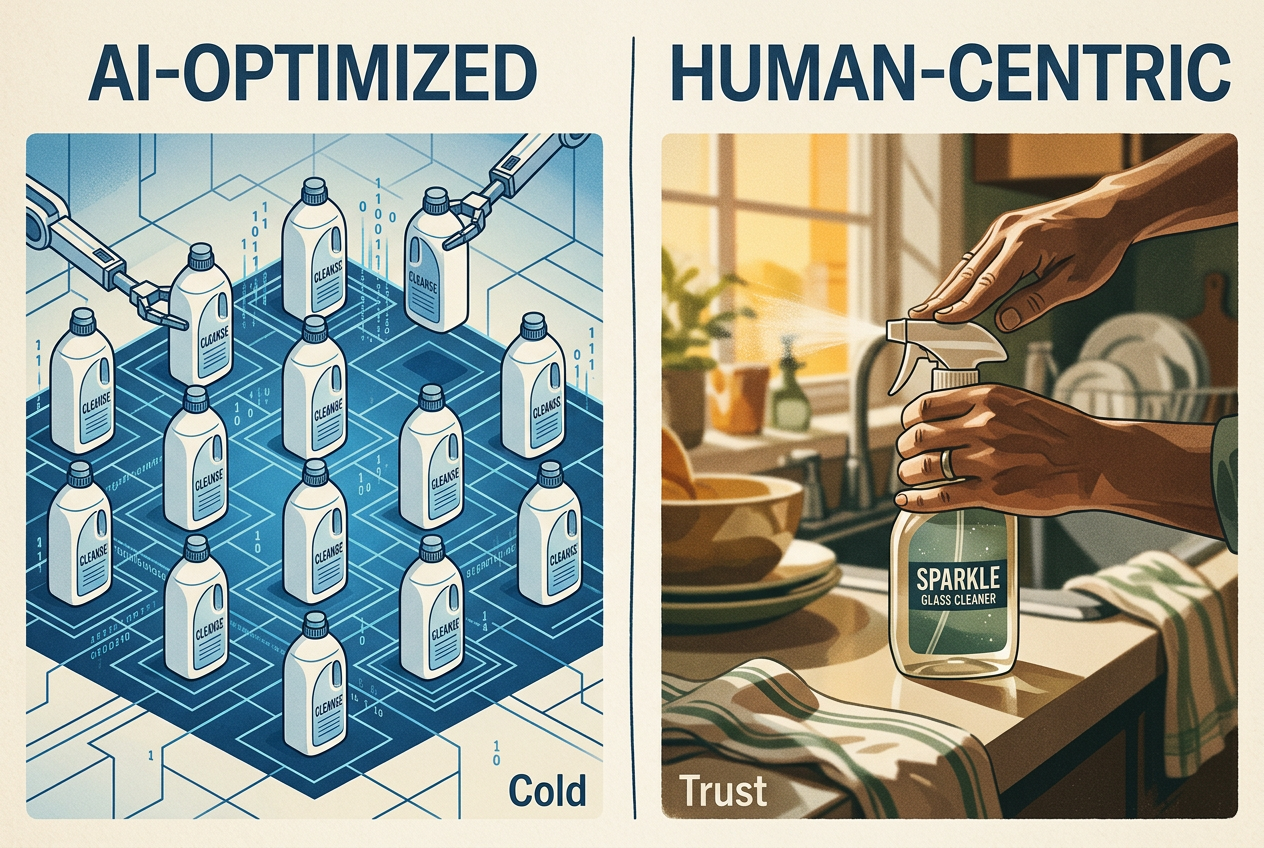
The most underrated skill in 2026 is creating content that feels human in an AI-heavy internet [S5]. Brands that lean too hard into AI-generated creative or hyper-optimized influencer scripts are finding their direct click-through rates (CTR) plummeting, even if their reach remains high. This forces more users into the search funnel, further inflating the perceived value of search at the expense of social.
To combat this, your creative strategy must prioritize 'Social Proof Signals.' This includes unpolished, high-utility content that doesn't look like an ad. When the content feels genuine, the 'tax' decreases because the trust barrier is lowered, leading to more direct conversions and fewer 'I'll look this up later' moments.
What This Means for Your 2026 Strategy
You cannot manage what you can't measure, but measuring the wrong thing is worse than not measuring at all. If you continue to optimize your social budgets based on last-click ROI, you will inevitably cut the very top-of-funnel spend that fuels your search engine success.
Key Takeaways for Marketing Leads:
- Audit your Branded Search: Look for correlations between social spend spikes and branded search volume. If they move in lockstep, your social is working, regardless of what the Meta Pixel says.
- Implement a 'Skepticism Buffer': When reporting social ROI to stakeholders, include a 'Search-Assisted' multiplier based on holdout tests.
- Focus on Brand Salience for AI: Since Schema won't save your AI rankings [S1], focus on social volume to ensure your brand is part of the 'conversation' that AI models index.
- Diversify Measurement: Move away from a single source of truth. Use a triad of Platform Data, MMM, and Post-Purchase Surveys to get a holistic view.
[INTERNAL: The rise of zero-click social and what it means for your traffic -> zero-click-social-strategy]
The Future of Attribution is Probabilistic, Not Deterministic
The era of 'knowing' exactly which ad caused which sale is over. Between privacy regulations and the fractured nature of user behavior, we are moving into a probabilistic world. The Skepticism Tax is a permanent fixture of the landscape. Your job isn't to eliminate it, but to account for it.
By acknowledging that social media is the engine and search is merely the exhaust, you can make smarter budget decisions that favor long-term growth over short-term dashboard vanity. Stop letting Google take the credit for the demand you worked so hard to create.
In the coming months, we expect more platforms to integrate MMM-lite features directly into their ad managers, attempting to bridge this gap. But until then, the burden of proof lies with the strategist. Use the data to tell the full story, not just the last chapter.
Why the 'Creators as Retailers' trend is changing attribution
FAQ