

Roughly 25% of North American marketing agencies have transitioned to fixed-fee pricing models as of mid-2026, according to recent industry benchmarking data. This shift marks a decisive break from the decades-old billable hour, driven by the rapid integration of generative AI which has fundamentally decoupled labor time from creative and analytical output.
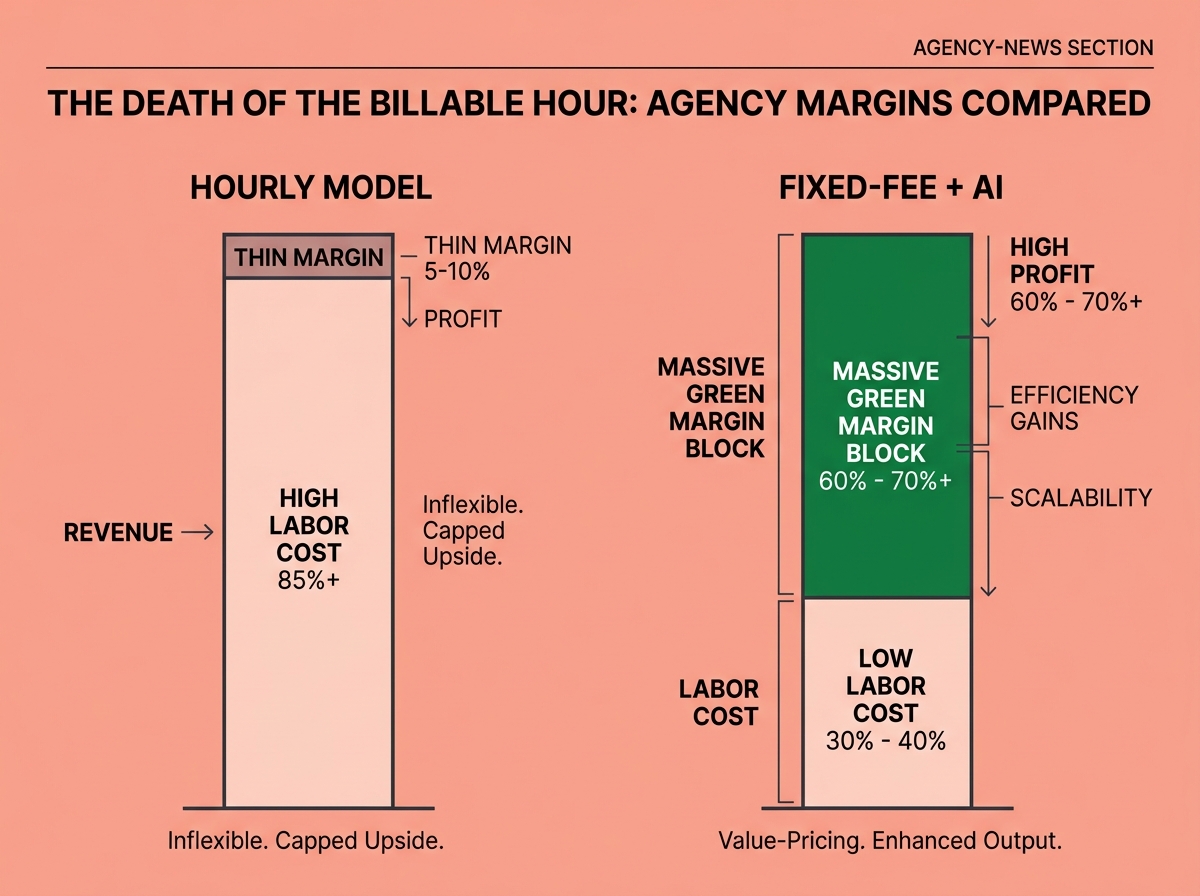
For social media marketers and agency leads, this isn't just a billing change—it is a survival strategy. If you continue to charge by the hour while using AI agents to automate 40% of your workflow, you are effectively penalizing your own efficiency. The move to fixed-fee or value-based structures allows agencies to capture the margin created by AI while providing brands with the budget predictability they now demand.
TL;DR
- Efficiency Trap: Hourly billing is incompatible with AI-driven workflows that compress 10-hour tasks into 10 minutes.
- Predictability: Fixed fees offer brands budget certainty, while agencies gain higher effective hourly rates through automation.
- Strategic Pivot: Successful agencies are bundling services into high-value "product packs" rather than selling commoditized labor.
The AI Catalyst: Why the Billable Hour is Breaking
The traditional agency commercial model relied on a simple equation: sell hours at a markup over labor costs. However, the rise of specialized AI agents for SEO and social media—exemplified by tools detailed in recent Ahrefs research from May 2026—has shattered this math. When an AI agent can handle technical audits, keyword clustering, and content drafting in a fraction of the time a human requires, the "hours" spent on a project plummet.
If an agency charges $200 an hour and uses AI to reduce a project from 20 hours to 2, their revenue drops from $4,000 to $400 for the same deliverable. This is the "efficiency paradox." By moving to fixed-fee pricing, the agency maintains the $4,000 price tag based on the value delivered to the client, while the reduced labor time increases the agency’s internal margin.
We are seeing this play out across specific channels. For instance, per Hootsuite’s May 2026 guidance on Facebook ad targeting, the complexity of manual audience segmentation is being replaced by AI-driven algorithmic targeting. Agencies that once billed for hours of manual audience building must now pivot to billing for the strategic oversight of these automated systems. The labor has shifted from "doing" to "directing," a transition that fixed-fee models accommodate far better than a stopwatch.
Competitive Pressure and the Rise of "Productized" Services
Brands are no longer interested in paying for a junior associate’s learning curve. They want outcomes. This has led to the rise of "productized" services—fixed-price bundles that promise a specific result. We see a parallel in the e-commerce space, where Google’s product packs have become a primary sales channel as of mid-2026. Agencies are now mirroring this by offering their own "Social Growth Packs" or "Search Visibility Bundles."
According to Search Engine Land’s analysis of 63,000+ merchants, the brands winning in these automated environments are those with the cleanest data and most robust schema. Agencies are now pricing the setup of these technical foundations as one-time fixed fees rather than ongoing hourly maintenance. This provides a clear entry point for clients who are wary of open-ended retainers.
[INTERNAL: How to transition your agency to value-based billing -> agency-pricing-models-guide]
Measuring Success in a Fixed-Fee World
The move away from hours requires a more sophisticated approach to measurement. If you aren't billing for time, you must prove value through performance data. This is why we are seeing major players like NIQ join the TikTok Marketing Partners program to earn Media Mix Modeling (MMM) badges. As of late 2025, the industry has shifted toward these high-level econometric models to justify agency fees.
When an agency operates on a fixed fee, the burden of proof shifts to the ROI. You are no longer reporting on "what we did this month" but rather "what we achieved for you." This requires a deeper integration with the client's data stack. Agencies are increasingly building their own proprietary AI agents—not just for SEO, but for reporting and attribution—to maintain this competitive edge without ballooning their own overhead.
The Role of WebMCP and AI Discovery Layers
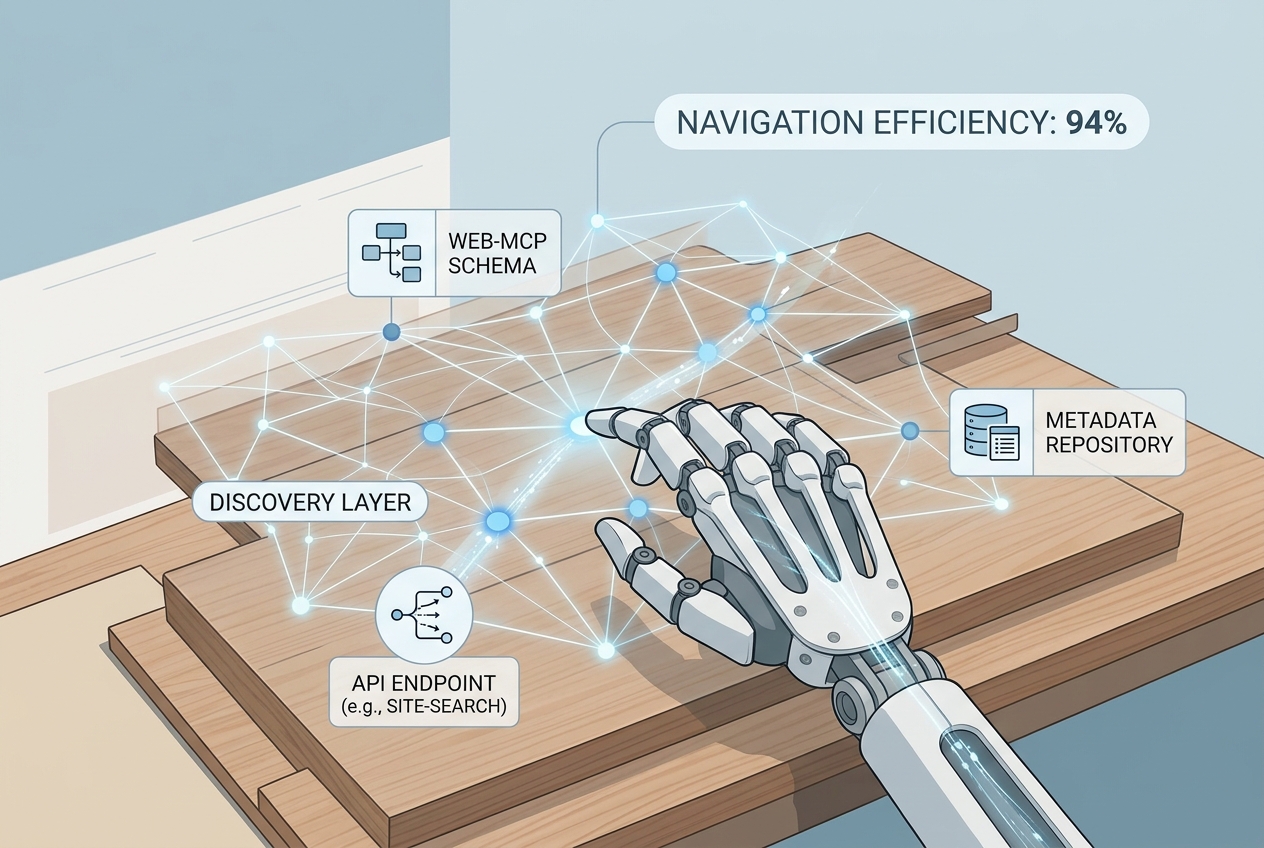
Looking ahead, the next frontier for fixed-fee agencies lies in the "discovery layer." With the emergence of WebMCP (Web Model Context Protocol), AI agents are becoming the primary way users discover brands. Preparing a client’s digital footprint for these agents is a high-value, high-complexity task that doesn't fit neatly into an hourly bucket.
Agencies are now positioning themselves as architects of this new discovery landscape. They are charging significant fixed fees to implement WebMCP schema and optimize for AI agent interaction. This is a far cry from the "post three times a week" social media management of 2022. The expertise required to navigate these protocols is scarce, allowing agencies to command premium fixed prices that are decoupled from the actual minutes spent on implementation.
Navigating the Transition: Risks and Rewards
Transitioning to fixed-fee pricing isn't without risk. The biggest danger is "scope creep." Without the guardrail of the billable hour, agencies can find themselves doing infinite revisions for a finite fee. To mitigate this, successful agencies are becoming hyper-specific in their Statements of Work (SOWs).
- Define the Output: Instead of "Social Media Management," the SOW specifies "12 Reels, 20 Static Posts, and 4 Community Management hours per week."
- Limit Revisions: Fixed fees must include a hard cap on revision cycles—typically two—with additional changes triggering a change-order fee.
- Tiered Pricing: Offer "Good, Better, Best" fixed-fee tiers to give clients a sense of control without opening the door to hourly negotiation.
For the brand, the benefit is clear: transparency. They know exactly what will hit the P&L each month. For the agency, the benefit is scalability. If you can deliver a $10,000 monthly service in 20 hours instead of 50, you've effectively more than doubled your capacity without hiring a single new headcount.
What to Watch Next: The Performance Hybrid
As we move into the latter half of 2026, expect to see the rise of the "Hybrid Fixed-Performance" model. This involves a base fixed fee to cover the agency's overhead and AI tool costs, plus a performance kicker based on hitting specific KPIs—like lowering the cost per conversion on Facebook ads, a metric Hootsuite identifies as the "ultimate measure" of ad value in the current landscape.
This model aligns the agency’s incentives perfectly with the client’s. The fixed fee ensures the agency doesn't go broke doing the work, and the performance bonus ensures they are constantly optimizing their AI agents to deliver better results. It is the final evolution of the agency-client relationship in the post-hourly era.
FAQ